


The world of social media marketing channels is no stranger to Instagram, which is widely used. In recent years, Instagram has developed and evolved at a comparable rate to Facebook, adopting new features at a breakneck pace and becoming even more important to businesses and users alike.
As one of the fastest-growing social media networks, Instagram is currently one of the most popular. Approximately 1 billion people use Instagram every month. The number of interactions on Instagram is four times higher than Facebook’s, as well. Instagram marketing is proving to be so popular, based on these statistics.
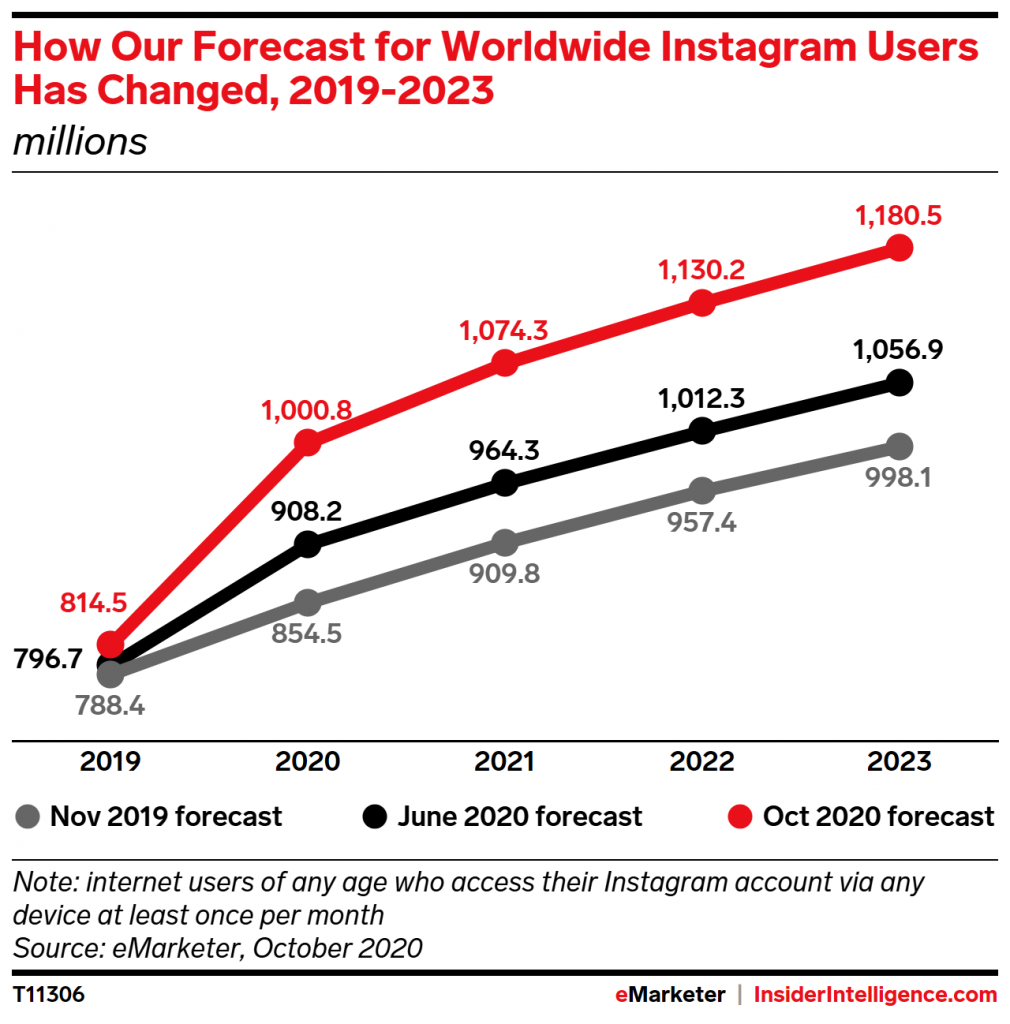
Here’s where Instagram actually stands as of 2026, according to Meta’s own Q3 2025 earnings report and Business of Apps:
- Instagram passed 3 billion monthly active users in 2025, per Meta’s own reporting, more than double where it stood five years ago.
- Instagram generated an estimated $66.9 billion in revenue in 2024, accounting for roughly 40% of Meta’s total revenue, up sharply from the $24 billion and 36.9% share it represented in 2020.
- India is now Instagram’s largest market by a wide margin, with over 480 million users, more than double the United States, which sits at roughly 180 million.
- Around 63% of users are under 35, though the 35+ segment has been growing faster than any other age group over the past two years as Instagram’s Shopping and professional features attract an older, higher-spending audience.
Instagram is a platform that thrives on strategies, so there are a lot of influencers who have mastered the art of creating the perfect strategy that works. Your brand can be successful with the right strategy.
Your strategy should cover the type of content to share to interest your target audience and gain more followers. Many businesses use a professional content marketing service to develop content strategies that keep their Instagram audience engaged while supporting their broader marketing goals.
The visual nature of Instagram sets it apart from other social networking sites. Instagram is the perfect place to show off your products or services that have an impressive final result if your business relies on their design.
1. Instagram For Business Marketing Strategy
Instagram offers two sorts of profiles to its users: personal and business. A business account provides a plethora of additional benefits and prospects. For example, you may monitor your performance in real-time, gain insight into your followers’ behavior, and provide information about your business.
Then you set up your business profile:
- Create an ideal bio. Create a 150-character description of your business, emphasizing what makes it unique.
- Optimize the appearance of your profile photo. It should be easily identifiable and accurately depict your business. You may choose to include a logo.
- Include a link to your website. This is critical for lead generation.
- Utilize business alternatives. In business mode, you can add a category, contact information, and CTAs. Make the most of this opportunity to connect with customers.
2. Set Your Business Goals
To maximize efficiency, ensure that your goals are SMART: specific, measurable, attainable, relevant, and timely.
Begin by creating goals for your Instagram marketing campaign. Your Instagram strategy will be guided by your goals, from selecting your content formats to utilizing advertisement mechanisms.
Some major objectives that brands seek to achieve with Instagram include increasing brand exposure, managing reputations, developing communities, accelerating sales, and gaining consumer and market information.
Your objectives should be aligned with your business’s requirements. If your financial results are generally satisfactory, there is probably no reason to increase sales via Instagram. Rather than that, concentrate on acquiring consumers or market information.
3. Determine Your Target Audience
A critical error to avoid here is creating a fictitious persona. Rather than relying on guessing, use a data-driven strategy. To learn more about your potential clients, you can search for hashtags connected to your business on Instagram.
Determining your audience is critical; if you skip this stage, all of your efforts to accomplish company goals will be in vain. A good tip is to create a buyer persona in this case. Determine the demographics of your average consumer, including their age, gender, occupation, region, and income level. The more you understand your customers, the more effective your marketing.
4. Research Your Competitors
Investigate the Instagram accounts of your competitors to obtain a better understanding of Instagram marketing. Analyze what they post, their audience, and how they engage with other brands and influencers. It’s also a good idea to look at your competitors’ branded hashtags to get an idea of their popularity.
Ways to Market on Instagram in 2026
Reels: Instagram’s Primary Growth Engine
If you build one thing well on Instagram right now, make it Reels. Instagram’s algorithm actively prioritizes Reels over static posts and carousels for reach into non-follower audiences, which makes it the fastest way to grow beyond the people who already follow you.
Reels reward a specific kind of content: fast hooks in the first two seconds, native trends and audio, and a clear payoff before the viewer’s attention drifts. A well-made 15 to 30 second Reel showing a product in use, a behind-the-scenes moment, or a quick tip relevant to your audience consistently outperforms polished, longer-form video for actual reach.
Post Reels consistently rather than occasionally. Instagram’s recommendation system rewards accounts that publish regularly with more consistent distribution, one great Reel a month won’t build the same momentum as a steady weekly rhythm, even if each individual video is simpler.
Instagram Shopping: Turning Browsers Into Buyers Without Leaving the App
Instagram Shopping lets customers purchase directly from a post, Reel, or Story without leaving the app, and it’s become a genuinely significant revenue channel, with over 130 million users tapping shopping tags every month.
Set up a Shopping profile through Meta’s Commerce Manager, tag products directly in your posts and Reels, and use Product Collections to group items by theme or use case. Instagram’s AI-powered product tagging can now automatically suggest tags for products it recognizes in your images and video, worth turning on and reviewing rather than tagging everything manually.
For any business selling physical or digital products, an untagged product shown in a post is a missed sale. If a product appears on screen, it should almost always be tagged.
Broadcast Channels: One-Way Updates Straight to Your Most Engaged Followers
Broadcast channels are a newer format worth understanding: a one-to-many messaging tool that lets a business send text, photo, video, and poll updates directly to anyone who joins the channel, similar to a messaging app announcement list rather than a feed post competing for algorithmic reach.
They’re particularly useful for product launches, exclusive early access, or direct updates to your most engaged customers without depending on the algorithm to decide whether those followers see it. Because channel members opted in specifically to receive these updates, engagement rates tend to run meaningfully higher than standard feed content.
Threads Cross-Posting: Extending Reach Without Extra Content Production
Threads, Meta’s text-based platform tied directly to Instagram accounts, has become tightly integrated enough that cross-posting is now a low-effort way to extend reach without producing separate content. A quick behind-the-scenes thought, a customer question turned into a public answer, or a short-form observation that doesn’t need a visual works well cross-posted from Instagram to Threads.
This isn’t a replacement for a dedicated Instagram strategy, but for most businesses, it’s close to free additional reach for content that’s already being created.
Hashtags: Still Useful, Now a Supporting Signal Rather Than a Primary Discovery Tool
Hashtags used to be one of the main ways Instagram content got discovered. That’s changed. Instagram’s AI-driven recommendation system now weighs content signals, watch time, engagement rate, saves, and shares, far more heavily than hashtag matching when deciding what to show non-followers.
Hashtags still help with categorization and can support discoverability at the margins, use 3 to 5 specific, relevant tags rather than a long generic list, but don’t treat hashtag strategy as the primary lever for growth the way it may have been treated in the past. That role now belongs to Reels performance and content that earns saves and shares.
Instagram Stories: Still the Best Tool for Direct, Time-Sensitive Engagement
Stories haven’t gone anywhere, and they still serve a different purpose than Reels. Where Reels are built for reach to new audiences, Stories are built for daily touchpoints with people who already follow you.
Use Stories for the things that don’t need permanence: a flash sale, a poll asking followers what they want to see next, a quick behind-the-scenes look at your day, or a countdown sticker building anticipation for a launch. The interactive stickers, polls, questions, quizzes, countdowns, are genuinely useful for engagement, not just decoration, they give your audience an easy, low-effort way to interact, and that interaction signals to Instagram that your content is worth showing to more of your existing followers.
How Instagram’s AI Recommendations Changed What Gets Seen?
The single biggest shift in how Instagram distributes content isn’t a new feature, it’s the recommendation system underneath everything. Instagram has moved decisively away from chronological, follower-based distribution toward an AI-driven system that decides what to show each user based on predicted interest, regardless of whether they follow the account posting it.
This has two direct implications for business accounts. First, follower count matters less than it used to as a predictor of reach, a smaller account with strong engagement signals (saves, shares, watch time, comments) can outperform a larger account with passive followers. Second, consistency and format performance now compound: accounts that post formats Instagram is actively pushing, currently Reels, get rewarded with more distribution, which creates more engagement data, which earns even more distribution.
The practical takeaway: stop optimizing purely for follower growth as a vanity metric. Optimize for the engagement signals that tell Instagram’s system your content is worth showing to more people, watch time, saves, shares, and comments, since those are what the algorithm actually weighs now.
Meta’s Advantage+ AI tools, originally built for ad campaigns, have increasingly influenced organic content recommendations as well, blurring the line between what used to be a clear separation between paid reach and organic discovery. For businesses running both organic content and paid ads, treating them as one connected system, rather than two separate strategies, increasingly produces better results than optimizing each in isolation.
Parting Word
With Instagram constantly evolving and booming with new features and designs to aid a smoother experience for users, it also considers brands that carry out their businesses on the app. This means Instagram is constantly and consistently updating its app to make it easier to carry out business.
One of the best ways to utilize Instagram for your business is to use every new feature, be it reels, stories, IGTV, etc., as the Instagram algorithm tends to push content put out in these new formats to a more diverse audience.
Instagram Marketing helps businesses create a perfect balance between advertisements and engagement. If smart enough, it is possible to advertise your products and services without being too aggressive.
To get a grip on Instagram Marketing, you have to understand content marketing better. To have a free clarity call with our Digital Marketing Experts, click here!