


Getting on page one is difficult these days. With Google’s AI answers, endless product ads, and new search features popping up all the time, you’ve got to be strategic to stay ahead.
That’s where a solid e-commerce SEO company steps in. In this list, we’ll show the top e-commerce SEO companies for 2026.
| Company | Best For | Platform Strengths | Starting Price |
| MonsterClaw | Any ecommerce brand – B2B or B2C | Shopify, WooCommerce, custom builds | Custom |
| OuterBox | Mid-to-enterprise stores scaling fast | Shopify, BigCommerce, Magento, headless | $3,000+/mo |
| Siege Media | Content-led organic growth | Platform-agnostic, content focus | $5,000+/mo |
| WebFX | Product page optimization, conversion | Shopify, BigCommerce, WooCommerce | $3,000+/mo |
| Single Grain | Enterprise brands, AI SEO | Enterprise platforms, custom builds | $5,000+/mo |
| First Page Sage | Long-term authority and GEO | Platform-agnostic | $5,000+/mo |
| Coalition Technologies | Replatforming, technical rebuilds | Shopify, WooCommerce, Magento | $2,500+/mo |
| 180 Marketing | Ecommerce-only specialist | Shopify, WooCommerce | $1,000+/mo |
| Inflow | Data-driven mid-to-enterprise | Multi-platform | $3,000+/mo |
| Passionfruit | Startups and small stores | Shopify, marketplace SEO | $1,500+/mo |
Reletable Reads: Technical SEO for SaaS from SaaS SEO Experts
What Makes a Great E-commerce SEO Company in 2026?
You aren’t looking for someone for your e-commerce business who just ranks first on Google for “best SEO agency.” The agency you need is one that truly gets the real struggle of selling products online, even when AI is present.
Here’s what to look for:
- You go for those who have experience in the e-commerce niche. Companies that have already worked on product catalogues, seasonal promotions, and high-intent keywords.
- Your SEO company should know how to win visibility in these spaces.
- Companies can tackle technical SEO. It can boost site speed, optimize for mobile, and improve structured data and crawl efficiency.
- Optimizing content and product page to actually convert, not just rank.
- If you sell globally, they should know how to optimize for multiple regions and languages.
10 Best Ecommerce SEO Companies in 2026 (Full Reviews)
Check out these top 7 e-commerce SEO companies for various types of e-commerce businesses. You can pick the one that fits your business model the best!
1. MonsterClaw: Best for Any E-commerce Brands
[Source: MonsterClaw LLC]
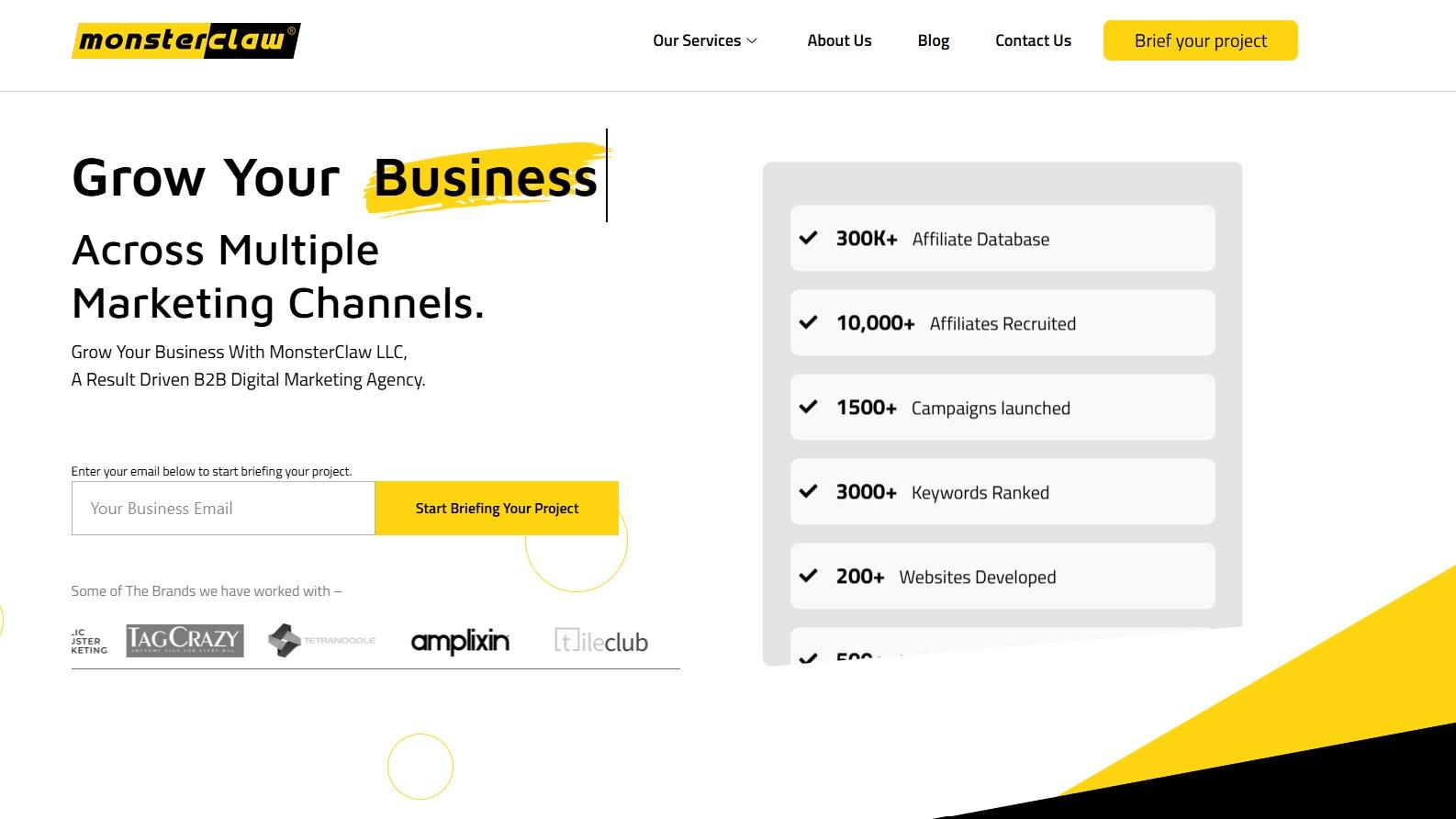
MonsterClaw is basically a one-stop shop for all your business needs. They’ve got everything you could want, especially when it comes to SEO. With their SEO services, you can expect stuff like audits, authority backlinks, eCommerce SEO, and so much more.
Notable Clients:
- Amplixin
- Scraperapi
- Platinum LED
- FastPages
- Tetranoodles
- Jagger Guitar
Benefits:
- Marketing strategy to boost results
- Uses cloud-based CRM and collaboration tools
- Handle data carefully by following the Data Protection Policy
- Stargic manager to guide the clients
Services:
- SEO services
- Affiliate marketing services
- IT services
- Content writing
2. Single Grain: Best for Large E-commerce Brands
[Source: Single Grain]
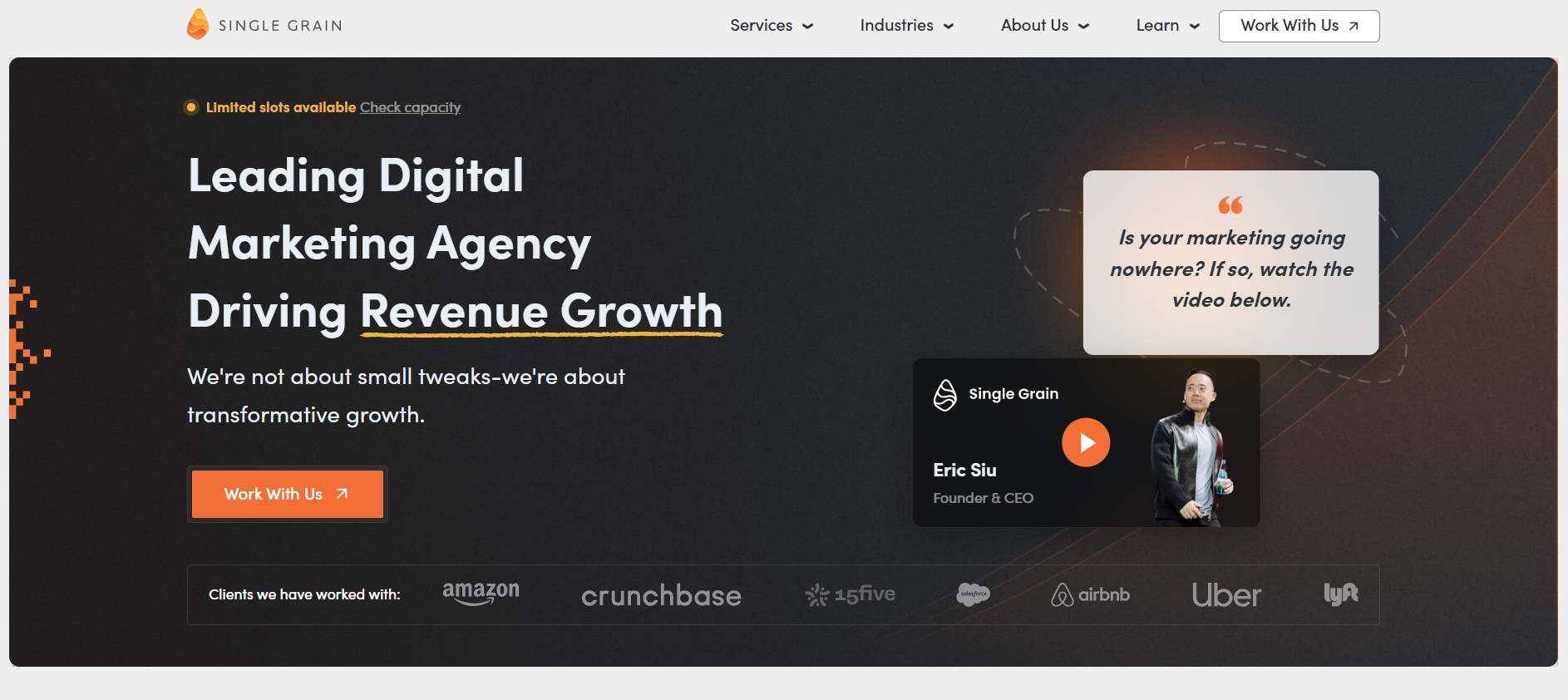
Single Grain is a Los Angeles agency that really knows its stuff when it comes to enterprise-level SEO. They’ve built a solid reputation and helped e-commerce businesses generate some serious revenue.
Notable Clients:
- Amazon
- Crunchbase
- Airbnb
- Uber
- Salesforce
Benefits:
- Optimising with AI-powered “Search Everywhere”
- Bringing deep tech know-how
- Advanced analytics
- Blending content with paid media
Services:
- SEO services
- Paid advertising
- Content marketing
- Creative strategy
3. Passionfruit: Best for Startups and Small Businesses
[Source: Passionfruit]
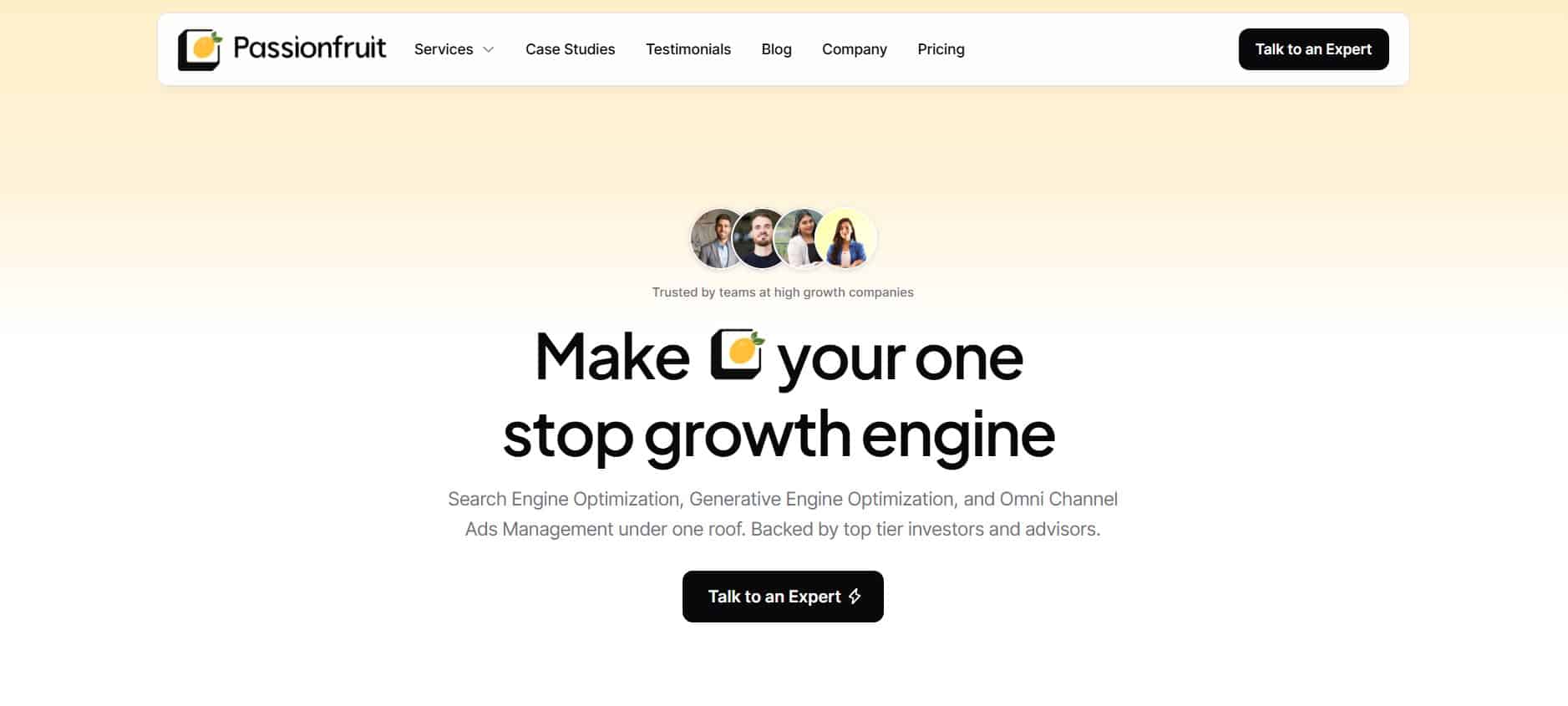
A flexible agency that’s all about helping up-and-coming e-commerce brands that are working with tight budgets.
Notable Clients:
- Nykaa
- Shaadi.com
- AKOVA
- mCaffeine
Benefits:
- Building up expertise with AI
- Doing weekly check-ins
- Keeping an eye on getting a good ROI.
- Building topical authority
Services:
- SEO
- Marketplace SEO
- Ads
- GEO
4. Aumcore: Best for 360° digital marketing solutions
[Source: Aumcore]
This New York agency gets SEO and how to handle global markets. With plenty of experience in different industries, they blend custom strategies with creativity and the latest techniques.
Notable Clients:
- Femel
- Walmart
- Sime Darby
- Levis
- Uniliver
Benefits:
- Voice-friendly tactics
- Reaching out to different languages and cultures
- Helping e-commerce grow
Services:
- SEO
- SEM
- UX research
- Affilaure marketing
- Copywriting
- CMS
5. Siege Media: Best for Technical SEO
[Source: Siege Media]
This expert is all about technical audits and SEO that really focuses on results. Their services put customers first, and they’ve got the track record to prove it.
Notable Clients:
- Chime
- Zillow
- Hippo
- The Zebra
- Pacaso
Benefits:
- Look after everything tech-related
- Fixing any issues that prevent search engines from crawling the site
- Improving Core Web Vitals
- Ensure the structured data is all set up right
Services:
- Content strategy
- Product SEO
- Link building
- Digital PR
- Web design
- Content creation
6. WebFX: Best for Content and Product Page Optimization
[Source: WebFX]
A tried-and-true digital marketing agency that offers flexible services. They focus on smart marketing choices to keep you ahead in the fast-changing online world.
Notable Clients:
- Subway
- Hilton
- Fujifilm
- Jiffylube
- Verizon
Benefits:
- Solid content plan
- Making product page optimization
- Extensive experience
Services:
- Digital Marketing Services
- SEO Services
- PPC Services
- Content Marketing Services
- Social Media Services
- Web Design Services
- Digital Advertising Services
7. First Page Sage: Best for AI-Driven SEO Strategies
[Source: First Page Sage]
Considered the leading e-commerce SEO agency thanks to features like strong leadership, a solid company size, and a couple of media mentions.
Notable Clients:
- Logitech
- Salesforce
- Dignity Health
- USbank
Benefits:
- Content created by influencers and experts
- Authoritative brand positioning
- Trustworthy leadership
Services:
- SEO services
- B2B SEO services
- SEO consulting services
- Strategic SEO plan
Relatable Reads: 20 Best SaaS Affiliate Programs With Highest Commissions
8. 180 Marketing – Best Ecommerce-Only SEO Specialist
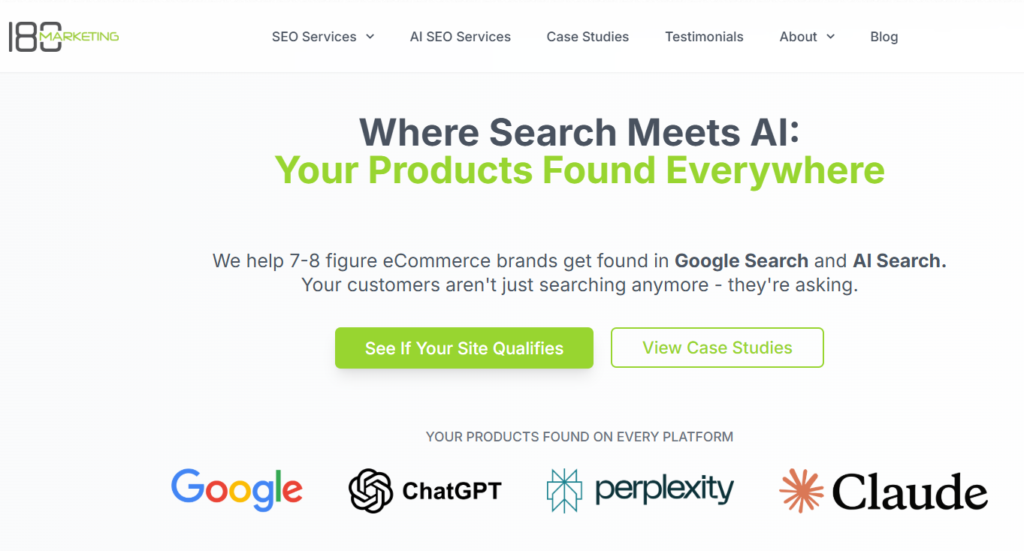
180 Marketing focuses exclusively on ecommerce SEO with no SaaS, no local, no lead gen. This niche focus means their entire process, knowledge base, and team expertise is built around product catalog challenges.
They are known for unconventional link acquisition approaches – including publishing content assets that earn links from authoritative sources – rather than standard outreach-based link building.
Founded in 2013. Clutch rating: 4.8 stars from 29 reviews. Starting price: $1,000/month.
Services: SEO, technical analysis, content marketing, link building
Best for: Mid-size ecommerce brands that want an agency with no distractions from anything other than ecommerce
9. Inflow – Best Data-Driven Ecommerce SEO for Mid-to-Enterprise

Denver-based Inflow approaches ecommerce SEO as an iterative experiment. Every recommendation is tested, measured, and traced back to conversion metrics – not just rankings. They are particularly strong with mid-to-enterprise brands that need accountability alongside execution.
Their advanced analytics setup connects organic traffic changes directly to revenue impact, making Inflow a strong choice for brands where internal teams need performance proof before approving budget increases.
Services: ecommerce SEO, CRO, content strategy, analytics
Best for: Growing stores with internal marketing teams that need specialist SEO expertise tied directly to revenue reporting
10. Passionfruit – Best Ecommerce SEO Agency for Startups and Small Stores
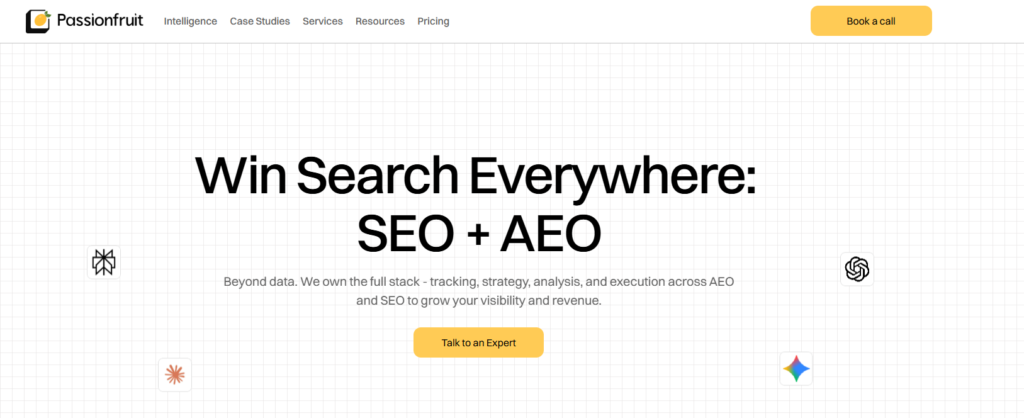
Passionfruit is built for early-stage and small ecommerce brands working with limited budgets. The agency focuses on topical authority building, AI-driven content production, and ROI tracking – with weekly check-ins that provide more communication than most agencies offer at comparable price points.
Their AI visibility service covers Google, Bing, ChatGPT, Perplexity, and Gemini – giving small stores access to GEO capabilities typically reserved for enterprise budgets.
Notable clients: Nykaa, mCaffeine, AKOVA, Shaadi.com
Services: SEO, marketplace SEO, GEO, paid ads, content
Best for: Stores under $2M in revenue that need a full-service SEO partner at a startup-appropriate budget
Factors to Consider Before Hiring
Even the most skilled SEO company may not be the right fit for you. Before signing a contract, think about:
| Your budget and expected ROI |
|
| Niche-specific needs |
|
| Reporting methods |
|
| Communication style |
|
| Contract terms |
|
Check out How to Grow an E-commerce Business: Scale to $10M+ in 2026
What Makes a Great Ecommerce SEO Company?
Ecommerce SEO has 6 specific technical requirements that standard SEO agencies frequently handle incorrectly. Evaluate any agency against these before signing.
1. Product Page Optimization at Scale
A store with 500 SKUs has 500 product pages that each need unique title tags, meta descriptions, structured data, and internal links pointing to them. An agency that handles this manually will never keep pace with catalog growth.
Strong ecommerce SEO agencies have systematic processes – template frameworks plus editorial review – that scale without requiring a human to touch every page individually.
2. Category Architecture and Internal Linking
Category pages are where most ecommerce organic revenue comes from. They target high-volume commercial intent queries (“women’s running shoes,” “stainless steel cookware”) that product pages cannot rank for individually.
An agency that focuses only on product pages and ignores category architecture will miss the majority of organic revenue opportunities.
3. Faceted Navigation and Crawl Budget Management
Faceted navigation – the filters on category pages for size, color, price, material – generates thousands of URL combinations that create duplicate content and waste crawl budgets if left unmanaged.
Google wastes a crawl budget on filter combinations like /shoes?color=red&size=10&price=50-100 instead of indexing the pages that actually drive traffic. This is one of the most common and expensive technical problems in ecommerce SEO.
Strong agencies handle faceted navigation through canonical tags, robots.txt directives, and parameter handling in Google Search Console blocking crawl waste while preserving the user experience.
4. Product Schema and Structured Data
Product schema tells Google exactly what a page is selling – price, availability, ratings, and brand.
Pages with complete product schema earn rich results in SERPs: star ratings, price ranges, and stock availability shown directly in the search result. These rich results increase CTR by 15% to 30% compared to standard listings.
An agency that does not implement and maintain product schema is leaving measurable traffic on the table.
5. Duplicate Content from Variants
Product variants – different sizes, colors, or materials of the same product – frequently create near-identical pages that compete with each other. A store selling a shirt in 8 colors may have 8 product pages with 95% identical content. Google struggles to determine which to rank.
The fix is canonical tags pointing all variants to the primary product page, combined with unique descriptive content on each variant that justifies its existence.
6. AI Search Visibility (GEO)
In 2026, ecommerce product discovery increasingly starts in AI tools. 51% of B2B buyers now begin research in AI chatbots more often than Google, per G2’s March 2026 survey. Consumer ecommerce buyers use Google AI Overviews, ChatGPT search, and Perplexity to compare products before visiting product pages.
Agencies that optimize only for Google rankings are missing product discovery from AI platforms. GEO-capable agencies ensure your product category pages and comparison content appear in AI-generated answers – not just organic blue links.
How Much Do Ecommerce SEO Services Cost in 2026?
Ecommerce SEO pricing depends on 4 primary variables: catalog size, market competition, technical starting point, and services scope.
| Store Size | Monthly SEO Budget Range | Primary Focus |
| Small (under 200 products) | $500 – $1,500/month | Technical setup, foundational on-page, basic content |
| Mid-size (200 – 2,000 products) | $1,500 – $4,000/month | Category optimization, content scaling, link building |
| Large (2,000 – 10,000 products) | $4,000 – $8,000/month | Crawl management, full catalog coverage, authority building |
| Enterprise (10,000+ products) | $8,000 – $20,000+/month | Custom architecture, international SEO, GEO, full program management |
Most ecommerce SEO retainers start at approximately $1,139 per month based on
analysis of 346 agencies. Quality campaigns for competitive ecommerce categories typically run $3,000 to $7,500 per month.
Warning signs on pricing:
Any agency guaranteeing specific rankings – this is not possible and signals dishonest practices
Prices under $1,000 per month for a store with 500+ products – the scope cannot cover what is needed
No mention of link building in the engagement scope – authority building is non-negotiable for competitive categories
Agencies that charge per backlink with no discussion of relevance or authority – quantity is not the correct metric
Expected ROI timeline: Ecommerce stores that invest in SEO achieve an average ROI of 317% within 9 months, per independent analysis. Revenue impact typically starts at month 3 to 4 for product and category pages targeting commercial intent – not when blog content starts ranking.
How to Choose an Ecommerce SEO Company: 7 Questions to Ask
Before signing with any agency, ask these specific questions. The answers will reveal whether the agency is capable of growing an ecommerce store at your scale.
1. Show me 3 ecommerce case studies with revenue data, not just traffic data. Traffic growth without conversion growth is not ecommerce SEO success. Any strong agency has documented how their work connected to actual store revenue.
2. How do you handle faceted navigation and crawl budget? If the agency cannot explain their specific process for managing filter parameters, they will create crawl budget problems in your store.
3. What is your product schema implementation process? Structured data must be implemented and maintained as your catalog changes. An agency without a systematic approach will let it decay.
4. How do you scale product page optimization across a large catalog? The answer reveals whether they have a repeatable process or will manually touch every page – which is not viable at scale.
5. How do you measure success – and what is your reporting cadence? Monthly reports that show rankings without revenue attribution are not sufficient. Expect bi-weekly communication and revenue-connected reporting.
6. Do you build links? What types and how? Legitimate link building from relevant industry sources, digital PR, and editorial placements. Any mention of “mass outreach” or guaranteed link quantities is a red flag.
7. Do you offer GEO – are you optimizing for AI search visibility? In 2026, this is no longer optional for competitive ecommerce categories. An agency without GEO capabilities is operating a 2022 SEO strategy.
Ecommerce SEO Services: What Should Be Included
If you’re evaluating providers, understanding what comprehensive Ecommerce SEO Services should include makes it much easier to compare agencies based on expertise rather than marketing claims. If you’re looking for a tailored approach that covers technical SEO, content optimization, authority building, and AI search visibility, explore our Professional SEO Services.
| Service Category | What It Covers |
| Technical SEO | Crawl architecture, indexing, site speed, Core Web Vitals, schema markup, faceted navigation |
| On-Page Optimization | Title tags, meta descriptions, H1/H2 structure, internal linking, product and category page content |
| Content Strategy | Category page content, buying guides, comparison content, FAQ sections |
| Link Building | Editorial backlinks from relevant industry sources, digital PR, authority acquisition |
| Reporting and Analytics | Revenue attribution, keyword tracking, conversion reporting, monthly strategy reviews |
| GEO / AI Search | Content structured for AI citation, FAQ schema, entity clarity across platforms |
Ecommerce SEO for Specific Platforms
The ecommerce platform your store runs on determines what technical SEO challenges your agency must solve. Platform selection matters as much as agency selection.
Shopify SEO: Shopify’s default URL structure creates duplicate content through /collections/ and /products/ paths. Product schema implementation requires custom code injection. App-heavy Shopify stores accumulate JavaScript render issues that block indexing. Best agencies: MonsterClaw, OuterBox, Coalition Technologies, 180 Marketing. Learn more about shopify SEO
WooCommerce SEO: WooCommerce gives more architectural control than Shopify but requires more active crawl management. Yoast or Rank Math configuration, server-side rendering for dynamic pages, and database optimization for large catalogs are core requirements. Best agencies: MonsterClaw, Coalition Technologies, Inflow.
BigCommerce SEO: BigCommerce has strong built-in SEO defaults but generates faceted navigation URL sprawl at scale. The platform’s CDN and canonical tag implementation require specialist knowledge. Best agencies: OuterBox, WebFX.
Magento and Adobe Commerce SEO: Magento’s complex architecture creates enterprise-level crawl challenges. Staging environment issues, multi-store configuration, and JavaScript rendering errors are common. Required for high-SKU enterprise stores. Best agencies: OuterBox, Coalition Technologies.
Headless Commerce SEO: Server-side rendering configuration, dynamic sitemap generation, and JavaScript crawlability are critical for headless setups. Most agencies cannot handle headless ecommerce SEO correctly. Best agencies: OuterBox, Single Grain.
Frequently Asked Questions
The best ecommerce SEO company depends on your store size, platform, and budget. MonsterClaw, OuterBox, and Siege Media are consistently ranked among the top options across independent analyses. MonsterClaw is best for any store size with full-service needs. OuterBox is strongest for mid-to-enterprise stores scaling fast. Siege Media leads for content-driven organic growth programs.
Ecommerce SEO retainers typically start at $1,139 per month for small stores based on analysis of 346 agencies. Most growing stores invest $3,000 to $7,500 per month. Enterprise campaigns for stores with 10,000+ SKUs run $8,000 to $20,000+ per month. Any campaign under $1,000 per month for a catalog of 500+ products is unlikely to cover the scope required for meaningful growth
Yes. Ecommerce businesses that invest in SEO achieve an average ROI of 317% within 9 months. Unlike paid advertising that stops generating traffic when budget stops, SEO builds organic traffic that compounds over time. At month 24 of a well-executed SEO program, stores consistently report 8x to 12x the return on investment compared to their paid ad spend for equivalent revenue contribution.
Product and category pages targeting commercial intent keywords typically start gaining ranking momentum within 3 to 4 months. Conversion lift takes longer and also depends on pricing, on-site UX, and competitive pressure. Revenue impact that justifies the full investment is typically visible at the 6 to 9 month mark for mid-size stores.
Shopify, WooCommerce, and BigCommerce are strong contenders when it comes to the best.
Top SEO companies vary by industry and region. However, notable agency names include MonsterClaw, Single Grain, and Aumcore.
Yes. SEO will bring long-term, high-intent traffic without paying for each click. It focuses on brand visibility, trust, and conversion.