



The right affiliate commission structure can be the difference between attracting top-performing partners and struggling to recruit anyone.
A well-planned affiliate commission balances partner motivation with your profit margins. As a result, it creates a win-win model that encourages affiliates to promote your brand consistently.
Let’s explore how to set competitive commission rates, choose the right payout models, and build a structure that attracts high-quality partners without eating into your bottom line.
What is an Affiliate Commission Structure?
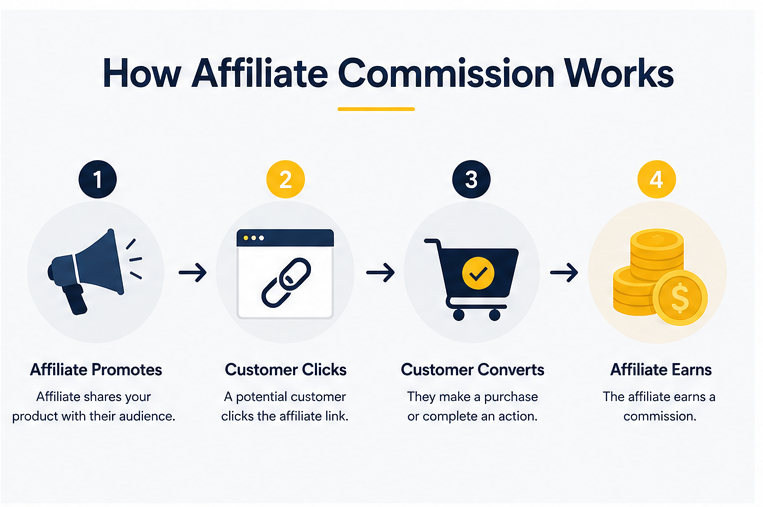
An affiliate commission structure is a company’s framework for how much affiliates get paid and under what circumstances for generating leads, sales, or other specific actions. It’s the rules governing the compensation, not just the amount.
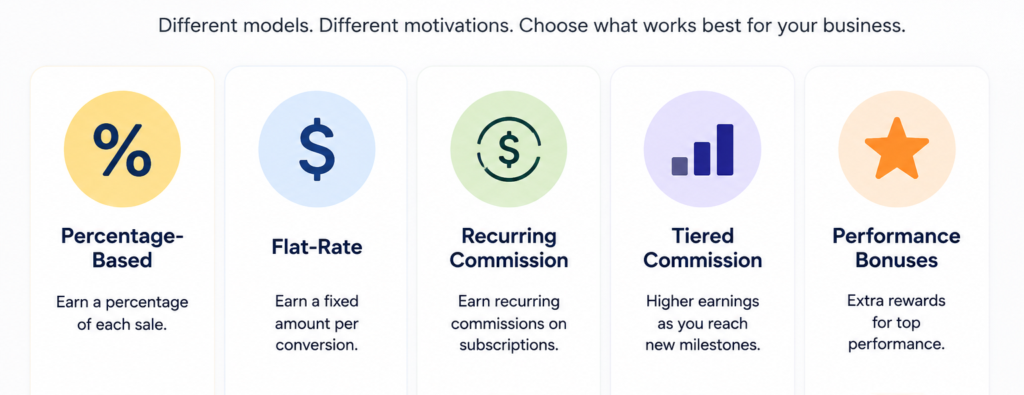
The majority of programs base their framework on one or more of these strategies:
- Percentage-based commissions: a cut of the sale value
- Flat-rate commissions: a fixed dollar amount per conversion, regardless of order size
- Recurring commissions: ongoing payouts tied to subscription or renewal revenue
- Tiered commissions: rates that increase as affiliates hit performance thresholds
- Performance bonuses: extra incentives layered on top of a base rate
The parameters of your affiliate program are more complete than the commission structure. Even before an affiliate reaches the compensation line, program terms also address topics like cookie duration, payment schedules, allowed promotional tactics, and exclusions, all of which affect how appealing your offer appears.
Why Your Commission Structure Matters
A well-thought-out structure does more than just compensate employees. It influences who enrolls in your program and how diligently they work for you.
- It draws seasoned affiliates: Before deciding where to spend their time, seasoned partners evaluate offers from dozens of programs.
- It raises the level of activity: Instead of just joining up and remaining silent, affiliates are encouraged to start promoting through a clear and motivating framework.
- It promotes improved traffic: Affiliates that are interested in conversion rather than merely clicks are drawn to structures that prioritize quality over volume.
- Retention is enhanced: Affiliates remain loyal to programs that encourage development and pay consistently.
- It sets your program apart: When comparing you to the competition in a competitive niche, affiliates frequently start by looking at your commission structure.
What Is a Good Affiliate Commission Rate?
Any article that claims there isn’t a universal “good” rate is oversimplifying the situation. A low-margin online retailer would go bankrupt at a rate that is ideal for a SaaS company with 80% gross margins.
A variety of criteria determine the appropriate rate:
- Gross margin – how much room you actually have to give away
- Average order value – bigger baskets can support smaller percentages
- Customer acquisition cost – what you’d otherwise spend to get this customer through paid ads or other channels
- Customer lifetime value – one-time buyers versus repeat customers change the math entirely
- Product category – commission norms vary widely between industries
- Conversion rate – a page that converts well can justify a lower payout per click
- Affiliate traffic quality – some traffic converts higher regardless of rate
- Competitor commission rates – a useful benchmark, but not a strategy on its own
Your commission percentage is not the figure that really counts. Your profitability is determined by the number of customers you recommend.
If the underlying economics don’t stand up, a program that offers a generous-looking rate may not be sustainable.
How to Benchmark Affiliate Commission Rates
It’s a good idea to start by researching competitor programs, but don’t stop at the headline percentage. View the complete image:
- Cookie Length (even at a reduced rate, a 30-day cookie outperforms a 7-day cookie)
- Exclusions from products
- Real-world value is altered by payment terms: net-30 versus net-60
- Their landing page conversion rates
- Are commissions recurring?
- Layered bonus structures
- This math will still be done by an affiliate comparing two programs side by side. It’s best if you do it first.
Relatable Read: High-Ticket Affiliate Marketing: 20 Programs to Try in 2026
How to Calculate the Right Affiliate Commission Rate?
Start With Your Unit Economics
Before picking a number, work out your actual revenue per referred customer. Subtract:
- Cost of goods sold
- Payment processing fees
- Discounts applied at checkout
- Expected refunds
- Operational costs tied to fulfillment or service delivery
What’s left is your maximum sustainable affiliate payout. The ceiling you shouldn’t cross without eating into profit.
Factor in Customer Lifetime Value
You often have more money to pay affiliates if your company generates recurring income as opposed to one-time purchases. Many SaaS programs can afford commission rates that would be unsustainable for a single-purchase e-commerce business since a customer who subscribes for 18 months is worth significantly more than their initial payment suggests.
Consider Your Target Affiliate’s Economics
Affiliates are estimating their actual take-home pay, not just your commission share. A 15% commission on a product with a 1% conversion rate may be reduced to a 7% commission on a product with a 4% conversion rate. Do the calculations from both your side and the affiliate’s side of the table.
Example Affiliate Commission Calculation
A simple starting formula:
Average order value × commission rate = affiliate payout
So a $100 average order value at a 10% commission pays $10 per sale.
Now expand it. Say the $100 order has a 60% gross margin ($60), a 3% refund rate, and the consumer has an estimated lifetime value of $250 over recurrent purchases. That $10 payout suddenly seems reasonable, and you might be able to increase it, add a recurring element, or add a bonus tier without negatively impacting profitability.
Common Affiliate Commission Models
There are different affiliate commission models, such as percentage-based and flat-rate commission.
Here is a list of all the different affiliate commissions model matter to your business.
1. Percentage-Based Commission
The default for most ecommerce programs. Affiliates earn a set percentage of each qualifying sale.
Advantages: scales naturally with order value, easy for affiliates to understand.
Disadvantages: payout can swing significantly with discounting or seasonal pricing changes.
2. Flat-Rate Commission
Regardless of the size of the order, affiliates are paid a certain amount for each qualified sale or conversion.
Lead generation, insurance, financial services, and any other industry where “order value” isn’t a clear idea benefit greatly from flat prices; a signed-up consumer is valued the same whether they clicked once or spent an hour browsing.
3. Recurring Commission
In addition to the original sale, affiliates receive a commission on subsequent payments from customers. In SaaS and subscription businesses, where the first payment is frequently a small portion of the customer’s overall value, this model is particularly prevalent.
Time-limited recurring commissions cap payouts after a predetermined number of months, whereas lifetime recurring commissions pay out for as long as the consumer is subscribed. This is a crucial distinction. Although affiliates find the former much more appealing, it also has higher long-term costs.
4. Tiered Commission
When affiliates reach particular revenue or sales targets, rates rise. Affiliates who send infrequent, low-volume traffic are rewarded under this scheme without having their fees increased.
Since it gives them an incentive to continue increasing their efforts with you directly, it’s one of the most successful strategies for maintaining top affiliate engagement over time.
5. Hybrid Commission Structure
A base commission is often combined with bonuses, recurring payments, or milestone incentives in many established programs. When you want levers to reward excellent performance without completely reorganizing your program and the dependability of a flat base rate, a hybrid model makes sense.
How to Create an Affiliate Commission Structure That Attracts Top Partners

Creating an attractive commission is one of the most important parts of alluring top affiliates into the program. Without handsome commissions, high-performing affiliates might not be interested in your program.
In order to create an affiliate commission structure that attracts top affiliate might include offering competitive base commissions, regarding high – top performing affiliates. Learn more below.
Offer Competitive Base Commissions
In comparison to other programs they could promote, your base rate must make the opportunity worth an affiliate’s time. However, when a competitor gives a little bit more, affiliates who sign up just for the number are frequently the least loyal, so don’t strive to win solely by percentage.
Reward High-Performing Affiliates
Your best partners have an incentive to keep going when you use volume-based tiers. Reputable affiliates should believe that working with you to scale their efforts is more profitable than distributing their traffic among five subpar schemes.
Add Performance Bonuses
Bonuses layered onto a base commission can meaningfully shift affiliate behavior without permanently raising your baseline cost:
- New affiliate activation bonus
- Monthly sales bonus
- Revenue milestone bonus
- New-customer bonus
- Seasonal campaign incentives
Consider Exclusive Partner Rates
Not all affiliates need the same offer. When your affiliate base’s traffic quality or reach merits the additional expense, it seems sensible to offer a customized fee to a select group of high-volume or strategically valuable partners. However, be cautious about how openly you share this information with your affiliate network.
Make Earnings Potential Clear
Affiliates can’t evaluate an opportunity they don’t understand. Spell out:
- Commission rate
- Average order value
- Typical conversion rate
- Cookie duration
- Payment schedule
- Eligible products
The clearer your program page, the less friction there is between an affiliate discovering your offer and actually promoting it.
Should You Offer a Higher Commission Than Competitors?
Sometimes, yes. However, just offering a higher commission is not the only competitive edge you may offer.
It tends to make sense when:
- You’re starting a new initiative, and you have to gain traction fast.
- The market is fiercely competitive, and affiliates have a wide range of comparable choices.
- Your client lifetime value is sufficient to cover the additional expense.
- Since there is little brand knowledge, a higher commission helps counteract unfamiliarity.
- Higher payouts still leave reasonable margins because your conversion rates are high enough.
- In particular, you’re attempting to attract seasoned affiliates away from rivals.
But raising your base rate isn’t the only lever available.
Ways to Compete Without Raising Your Base Commission
If you don’t want to break the bank paying out your affiliates, these creative ways may help you achieve the similar results you intend to aim for.
- Extend cookie duration
- Speed up payment terms
- Provide better affiliate creatives and marketing assets
- Offer exclusive promotions affiliates can use
- Assign dedicated affiliate management support
- Pay higher commissions specifically for new customers
- Introduce recurring commissions where they didn’t exist before
- Layer in performance bonuses
Without permanently raising your cost structure, these frequently have an impact on affiliates that is comparable to a percentage increase.
Affiliate Commission Structure Examples by Business Model
- E-commerce: Usually based on a percentage of qualifying sales, rates are significantly influenced by average order value and margin.
- SaaS: Commissions are frequently flat or recurring, and their structures are based on client lifetime value rather than a single transaction.
- Subscription businesses: Usually divided between a commission for the initial sale and a smaller continuous recurring fee; occasionally combined with bonuses based on retention.
- Digital products: As digital products have lower marginal manufacturing costs than physical commodities, they can frequently sustain greater commission percentages.
- Services: Often set up as percentage-based rewards or flat referral fees; some programs only pay for closed transactions, while others pay for qualified leads.
Common Affiliate Commission Structure Mistakes
If your product is not competitive, just offering a higher rate is a mistake. Similarly, if you increase the commission just by looking at competitors, that may backfire as well.
The full list of common affiliate commission mistakes you shouldn’t do are:
- Setting prices just by looking at competitors: You are responsible for your own margins, average order value, and customer economics; imitating a competitor’s rate without knowing their business strategy can result in an unsustainable program.
- Offering a high rate but a low conversion rate: In the end, profits per click and earnings per visitor are more important to affiliates than the commission rate alone. Affiliates still make very little money from a high rate on a page that doesn’t convert.
- Making the program too complicated: Affiliates will probably promote something easier if they require a spreadsheet to explain their earnings.
- Ignoring chargebacks and refunds: Clearly state how commissions are modified when a sale is reversed or refunded; uncertainty in this area quickly undermines trust.
- Failing to distinguish between new and current clients: Think about whether affiliates should get paid more for bringing in actual new clients as opposed to returning consumers who could have converted anyhow.
- Changing commission rates covertly: Nothing undermines affiliate trust more quickly than an unexpected rate reduction. Long-term partner relationships are safeguarded by openness about changes, especially negative ones.
How to Optimize Your Affiliate Commission Structure Over Time?
Commission structure is not a decision that can be made once and for all. Regularly monitor performance, compare affiliates based on revenue and profitability rather than raw sales volume, and determine which partners are actually creating incremental growth as opposed to just catching sales that would have occurred regardless.
Key Metrics to Monitor
- Affiliate conversion rate
- Earnings per click
- Revenue per affiliate
- Average order value
- Customer acquisition cost
- Customer lifetime value
- Refund rate
- Affiliate activation rate
- Active affiliates
- Commission-to-revenue ratio
- Incremental revenue
Programs that scale sustainably stand out from those that silently lose money by testing various commission levels against these indicators rather than modifying rates based on intuition.
Relatable Read: 11 Best B2B Affiliate Programs in 2026 (With Buyer’s Guide)
Final Thoughts on Affiliate Commission Structure
The affiliate commission structure with the highest number isn’t the optimal one. It is the one that strikes a balance between competitive positioning, genuinely appealing affiliate earnings, sustainable margins, and incentives that reward the partners who are really driving growth.
Start with a basic pricing structure that the economics of your unit can sustain. To reward your top affiliates, add layers of performance tiers. Rather than continuously renegotiating your baseline, employ bonuses judiciously.
Additionally, evaluate the structure on a frequent basis. Programs that handle commission strategy as a continuous process rather than a one-time choice tend to scale better.
So, set rates with MonsterClaw that attract top partners.
Frequently Asked Questions (FAQs)
It differs greatly depending on the margin structure and business style. Establish your rate based on your own unit economics and what your product category usually supports, rather than trying to find a single universal amount.
Weigh your margins against what affiliates anticipate from rival offers in your market after accounting for client acquisition costs and lifetime value.
The economics of your product and how it compares to rival programs are the only factors that matter. Ten percent might not be sustainable at all on a low-margin product, but it can be generous on a high-margin, high-AOV offering.
For subscription or SaaS companies where the customer lifetime value goes long beyond the initial payment, recurring commissions make the most sense. A large upfront commission is frequently more sensible for organizations that make one-time purchases.
A system that rewards your best-performing partners without increasing expenses for all of your affiliates by raising commission rates as affiliates reach certain sales or revenue targets.