


Building a thriving affiliate network isn’t just about signing up as many partners as possible. It’s about finding the right affiliates who can consistently bring in quality traffic, leads, and sales.
With the right affiliate recruitment strategy, you can turn a handful of partners into a network of 100+ engaged affiliates within six months.
From identifying high-potential partners to creating outreach that gets responses, let’s explore the practical steps to build, grow, and maintain a network that delivers measurable results.
Relatable Read: How To Recruit Affiliates in 2026? (12+ Proven Strategies)
What is an affiliate Recruitment Strategy?
An affiliate recruitment strategy is an organized method that companies employ to locate, entice, and enlist partners who will endorse their goods in exchange for a commission.
Instead of accepting anyone who wanders onto your sign-up page, an affiliate recruitment plan is an intentional process of finding, contacting, and onboarding partners who can bring qualified traffic and sales to your program.
As affiliates are performance-driven, it differs from broad influencer or partnership outreach. They are promoting you because the math works for their audience, not because they want to give you publicity.
This alters who you target, what you offer, and how you pitch them. Regardless of the outcome, an influencer relationship may pay a fixed fee.
Your recruitment messaging must sell the economics, not just the brand, since an affiliate relationship is based only on results.
This is the figure that confuses: 100 registered affiliates does not equate to 100 active affiliates. Cold-recruited affiliates account for 20–30% of program activations.
You probably need to hire 300–400 productive partners if your target is 100. Programs that don’t do this math typically celebrate a jump in signups in the first month, then secretly question why income hasn’t increased by the fourth.
Track these from day one:
- Recruited affiliates
- Activation rate (percentage who make at least one referral)
- First-sale rate
- Active affiliates (promoting in the last 30 days)
- Revenue per affiliate
- Conversion rate
- Affiliate-generated revenue
Before you send out your first outreach email, create a straightforward dashboard for these figures.
If you retrofit tracking beyond the third month, you’re relying more on intuition than facts when choosing a channel.
Relatable Read: High-Ticket Affiliate Marketing: 20 Programs to Try in 2026
What Makes a Good Affiliate?
Not every applicant deserves approval. Look for:
- Audience relevance to your product or niche
- Real traffic (not inflated follower counts)
- Content quality that reflects buyer intent
- Genuine engagement, not just reach
- Promotional methods that match how your buyers actually research
- Alignment with your brand and pricing tier
- A history of promoting products in your category
In your niche, a creative with 5,000 active email subscribers will typically outsell one with 500,000 disengaged Instagram followers. Until it is combined with buyer intent, reach is a vanity statistic.
For example, a person reading a roundup of the “best tools for X” is more likely to purchase than a person browsing through a feed.
Set Your 6-Month Recruitment Goals
Define What “100+ Affiliates” Actually Means
Choose up front if you want to have 100 approved affiliates or 100 active ones; the amount of recruitment needed is very different. The majority of teams ought to establish monthly KPIs for activations as well as applications, not only signups.
You will hit your target on paper while revenue remains unchanged if you solely monitor applications.
Work Backward From Your Revenue Goal
Map the funnel before you start outreach:
Prospects → Applications → Approved Affiliates → Activated Affiliates → Revenue-Producing Affiliates
A realistic example:
- 1,000 prospects identified
- 300 contacted
- 150 applications
- 120 approved
- 100 activated
- 50-70 consistent revenue producers
Update your outreach volume rather than your standards if your numbers are different. In order to reach a recruitment number, lowering your approval bar only causes the issue to migrate downstream to activation, where it will cost more to resolve.
Choose Your Ideal Affiliate Profile
Create an Ideal Affiliate Profile (IAP) that includes information on their specialty, audience size, geography, content format, traffic source, average engagement rate, and products they have already promoted that are similar.
Every outreach message will be sharper, and every approval decision will be made more quickly thanks to this single document; rather than debating each application separately, you will compare it to a predetermined set of standards that your entire team has agreed upon.
Relatable Read: Super Affiliate: Who Are They and How to Find Them?
The 10 Best Affiliate Recruitment Channels
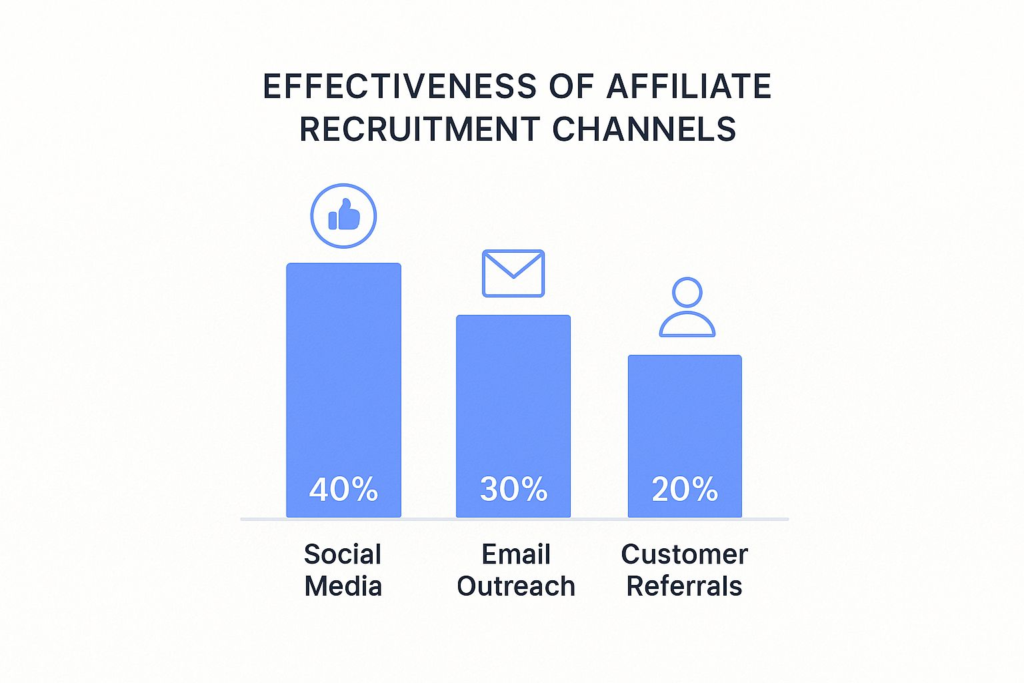
- Your Existing Customers: As they already have faith in the product, satisfied customers become affiliates more quickly than cold prospects. Instead of sending out a bulk email blast, segment your power users. Those with high usage, positive support tickets, or high NPS scores. Then send them a customized invitation.
- Your existing traffic and audience: Warm leads are readily apparent and include blog commenters, newsletter subscribers, community members, social media followers, and webinar attendees.
The recruitment pitch is much simpler than cold outreach because these individuals have already chosen to hear from you.
- Competitor affiliate research: Determine who is endorsing rival goods, examine their content and sources of traffic, and present them with a more compelling value proposition than what they are now receiving.
Use keywords like “review,” “vs,” or “discount code” in conjunction with competitor brand names to quickly find active affiliates. - Content creators and bloggers: The audience and SEO authority you require are already possessed by SEO publishers, review sites, YouTube channels, newsletter operators, and specialty websites.
Because a single piece of ranking material can generate referrals for years, these are often the most valuable recruiters. - Social media: Different affiliate accounts appear on LinkedIn, YouTube, Instagram, TikTok, X, and specialty groups; adapt the platform to your product category. While consumer goods frequently do better on TikTok and Instagram, B2B SaaS typically recruits well on LinkedIn.
- Influencer partnerships: In addition to outperforming broad-reach influencers in terms of conversion, micro-influencers, industry experts, and educators with high-intent audiences are usually much more receptive to performance-based agreements than macro-influencers who demand fixed fees.
- Affiliate networks and marketplaces: Helpful for discoverability and volume, but you’re up against every other program on that list. Make a statement with a program description that starts with the value proposition rather than generic boilerplate, a more transparent commission structure, and quicker payouts.
- Affiliate communities: Serious affiliates compare programs and exchange notes in conferences, industry forums, and private Slack and Discord groups.
Before you ever deliver a pitch, establishing a regular presence in these areas fosters trust. - An affiliate referral program: Encourage your current affiliates to recommend others. Referrals should be screened as strictly as cold applications to prevent diluting quality, but with two-sided incentives. Bonuses for both the referrer and the new affiliate work best.
- Turn recruitment into a system:
After the second month, manual outreach doesn’t scale.
Create repeatable workflows for prospecting and onboarding, and automate the parts that don’t require human intervention, such as welcome sequences or first application reviews.
Relatable Read: How Affiliate Marketing Boosts Other Marketing Channels?
How to Recruit Affiliates With Cold Outreach?
1. Build a Targeted Prospect List
Keep track of each prospect’s website, audience size, niche, contact details, competition relationships, current promotional methods, and any content holes you could address.
A cold name without any context is far more difficult to close than a prospect who has already reviewed three competitors but missed yours.
2. Write a Recruitment Email That Gets Responses
A strong outreach email follows this structure:
- A genuinely personalized opening (reference their content, not a template variable)
- Why you’re reaching out to them specifically
- Why the partnership fits their audience
- The affiliate value proposition
- Commission or incentive details
- One clear call to action
Keep the email short. Affiliates get pitched constantly, and a wall of text signals a copy-paste campaign before they’ve read a single line.
3. How Many Follow-Ups Should You Send?
The ideal number of follow-ups is two to three, spaced four to five days apart. Spread them out, make each one shorter than the last, and stop after the last follow-up if you don’t hear back. If you continue over that point, it will be seen as spam, which will harm your sender’s reputation and deliverability for subsequent campaigns.
Create an Affiliate Offer People Actually Want
Recruitment gets dramatically easier once your offer is genuinely competitive.
- Design a Competitive Commission Structure
Choose between regular and one-time rewards, percentage-based and flat commissions, and whether tiered commissions or performance bonuses make sense for your margins.
One of the best recruitment tools available is recurring commissions on subscription items, which convert a single conversion into recurring revenue for the affiliate and make your program stickier than a competitor offering a one-time payout.
- Offer More Than Commission
Exclusive promotions, free product access, early access to releases, personalized landing pages, pre-made creative assets, and a dedicated affiliate manager for top performers are all factors that top affiliates consider. As the program grows, affiliate management services can also help keep partner support, communication, and day-to-day program management organized.
Rarely do affiliates who generate the most money for a program pursue the highest commission rate on their own; instead, they select programs that facilitate their work.
- Build a Strong Value Proposition
In your pitch, explicitly address the question, “Why should this affiliate promote your product instead of the dozens of alternatives already in their inbox?”
Your offer needs to be improved before your outreach if you are unable to respond to that in a single sentence.
Relatable Read: How to Find Affiliate Partners That Actually Drive Revenue?
Build an Affiliate Onboarding System That Converts
Recruitment doesn’t end at approval. That’s where most programs quietly lose people.
- Create a Frictionless Application Process
Simplify the form, ask only the questions necessary to make an approval decision, and let them know what comes next as soon as they sign up. An instantaneous confirmation email and a genuine welcome sequence establish the program’s activity and organization.
- Build a 7-Day Activation Sequence.
- Day 0: Welcome email with affiliate link
- Day 1: Product positioning guide
- Day 2: Content and promotional ideas
- Day 3: Creative assets
- Day 5: Best-performing examples from other affiliates
- Day 7: Personal check-in
- Help Affiliates Make Their First Sale
To prevent new affiliates from speculating about what works, provide them with tested content angles, pre-made promotional materials, keyword recommendations, and conversion data from top performers.
The best indicator of an affiliate’s long-term activity is their first sale; retention increases dramatically after they see a commission land.
Your 6-Month Roadmap to 100+ Affiliates
Month 1 – Build the foundation (goal: 10-15 affiliates)
Complete your commission structure, tracking, and IAP. Create your first prospect database and hire from your current customer base.
Month 2 – Launch outbound recruitment (goal: 25-30 total)
Launch targeted outreach, focus on publishers and creators, and evaluate messaging based on response rates. This is the month to give framing and conduct quick A/B tests on subject lines.
Month 3 – Expand channels (goal: 40-50 total)
Incorporate influencer marketing, affiliate communities, and referral recruiting into the mix. Then, focus twice as much on the channel that did the best in the second month.
Month 4 – Improve activation (goal: 60-70 total)
Enhance onboarding, find inactive affiliates, and offer activation benefits to affiliates who refer their first customer within a predetermined time frame.
Month 5 – Scale what works (Goal: 80-90 Total)
Increase outreach volume, organize an affiliate competition, double down on your top-performing channels, and begin hiring niche experts to cover holes in your existing network.
Month 6 – Reach 100+ and Build a Growth Engine.
To ensure that growth continues over the six-month mark, automate tedious recruitment chores, implement a referral system, create a VIP tier for top performers, and establish continuous monthly recruitment goals.
How to Activate the Affiliates You Recruit?
If affiliates don’t promote, a big network is useless. Divide your base into new, activated, high-potential, top-performing, and inactive affiliates.
Then, handle each group differently; for example, a top performer needs better assets and quicker support to continue growing, while a dormant affiliate needs a push to re-engage.
Provide banners, product screenshots, email copy, social media copy, review templates, comparison information, and keyword ideas to each affiliate.
To keep even your best performers motivated and provide them with new motivation to promote after their initial onboarding push, run seasonal campaigns, product launch pushes, and time-limited bonuses.
Common Affiliate Recruitment Mistakes to Avoid
- Hiring all applicants: Without quality, volume creates a network of dormant accounts that boost your overall count but never affect income.
- Focusing solely on commission: Conversion rates, product-market fit, and support are all important to affiliates; a larger reward for a product that doesn’t convert results in a smaller payout for one that does.
- Utilizing general outreach: Affiliates can recognize a template from the first line of mass emails, which significantly underperform compared to tailored recruitment.
- Disregarding activation: Onboarding determines whether a position is successful; therefore, recruiting is only half the work.
- Neglecting to follow up: Since most affiliates don’t reply to the initial email, simple wins are lost if they give up after one try.
- Treating each affiliate equally: Resources, deadlines, and success indicators are different for SEO publishers and micro-influencers.\
Build the System, Not Just the Network
Hitting 100 affiliates in six months is achievable, but only with a system behind it: clear targeting, consistent outreach, a compelling offer, and real activation support.
A smaller network of affiliates who actually promote will always outperform a large list of names that never send a single click.
Start with your Ideal Affiliate Profile with MonsterClaw this week, and build out from there one channel at a time.
Frequently Asked Questions (FAQs)
Start with your audience and current clients, then branch out into affiliate networks, content producers, and cold outreach.
The most trustworthy sources are affiliate networks, rival affiliate pages, specialty content websites, LinkedIn, and devoted affiliate groups.
Provide a fair commission structure, robust creative assets, and prompt, dependable rewards. Reputable affiliates assess programs in the same manner that they assess products.
Usually, less than 10% of affiliates who have enrolled are active. Generally speaking, a program with 50 regularly active affiliates performs better than one with 500 inactive signups.
Recurring commissions for subscription items tend to draw and keep stronger affiliates than flat one-time payouts, albeit this depends on margin and product type.