

Search is no longer just about ranking on Google. With AI-powered tools like ChatGPT and Google’s AI Overviews changing how people discover information, brands must rethink how they earn attention online.
This is where AI visibility comes in. It refers to how often and how prominently your brand appears in AI-generated answers, recommendations, and search results. But how do you make your brand more discoverable when an AI assistant does the searching for your audience?
From creating authoritative, well-structured content to strengthening your brand’s credibility across the web, optimizing for AI visibility requires a smarter approach to digital presence.
Let’s learn about what AI visibility is and how to optimize for it.
What is AI Visibility?
AI visibility is how often, and how favorably, your brand, content, or website appears in AI-generated answers. That includes mentions, citations, linked sources, and direct recommendations in tools like ChatGPT, Google AI Overviews, and Perplexity.
Think of it as your presence inside the answer, not just on the results page.
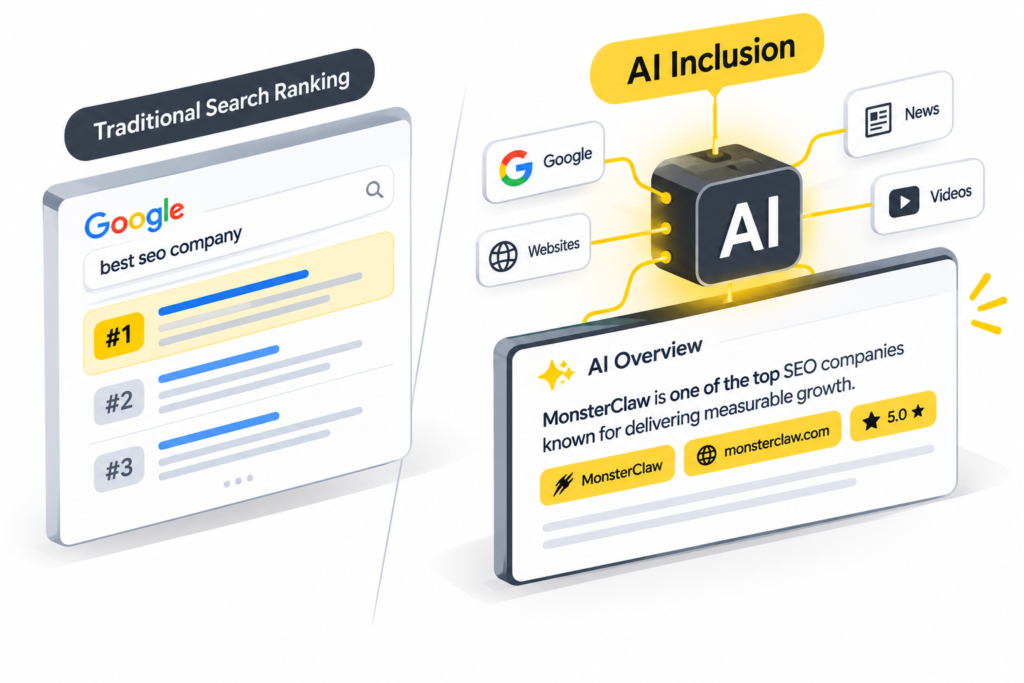
In classic search, you earn a ranking. A user sees ten blue links and picks one. In AI search, the tool reads multiple sources and writes one response. Your brand either makes that response or it doesn’t.
Here are the main platforms to know:
- Google AI Overviews and AI Mode: AI-written summaries inside Google Search, with links to supporting pages.
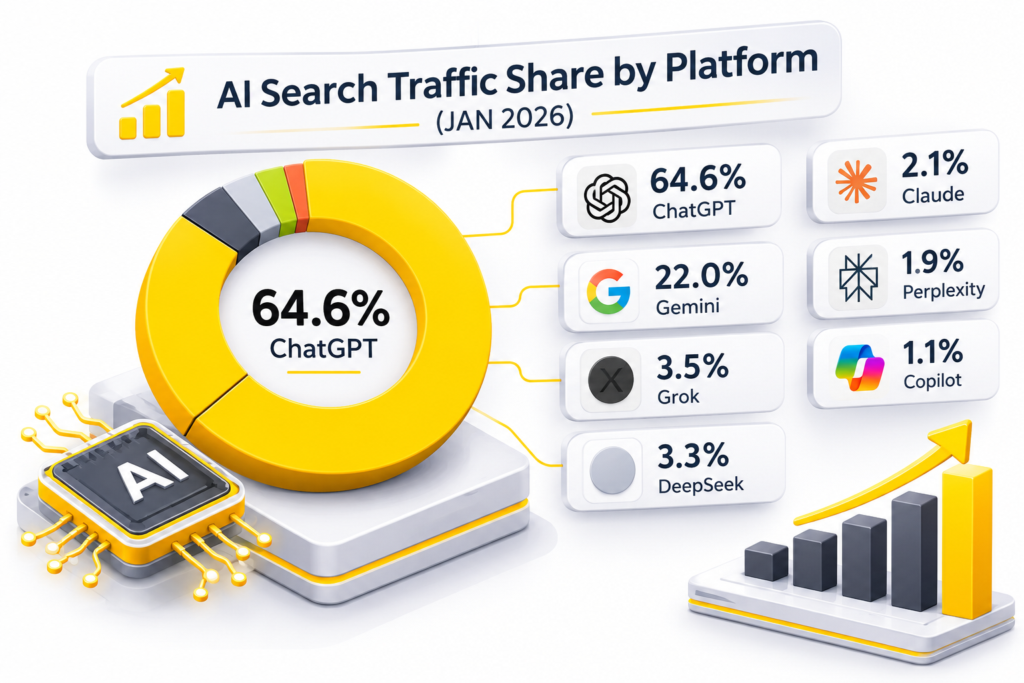
- ChatGPT: A conversational assistant that can search the web and cite sources.
- Perplexity: An answer engine that shows numbered citations beside every claim.
Other tools, such as Microsoft Copilot and Gemini, work in similar ways.
AI visibility vs. traditional search visibility: Traditional visibility is about position. You rank third, fifth, or first. AI visibility is about inclusion. You’re named, cited, or left out. Position still matters. But being mentioned inside the answer matters more every year.
Why Is AI Visibility Important for Businesses?
Nowadays, people ask long questions with a huge context and expect very personalized yet accurate answers. They might never click on a result if an AI tool provides the solution for their specific context.
This alters the way brands are discovered and opens up a lot of opportunities for brands that appear inside the solution.
Reach Audiences Beyond Traditional Search Results
Your buyers don’t use one search tool anymore. They check Google, ask a chatbot, and watch videos. AI recommendations put you in front of people who skip the usual results page.
Build Brand Awareness and Credibility
When an AI tool names your brand, it works like a quiet endorsement. The user didn’t see an ad. The tool picked you from many options. That earns attention and trust, even without a click.
Influence Customer Research and Purchasing Decisions
Buyers use AI tools early in research. They ask for comparisons, shortlists, and “best for” recommendations. If you aren’t in those answers, you may not make the shortlist.
Stay Competitive As Search Behavior Evolves
Your competitors are learning this too. Brands that build AI visibility early gain a head start. Late movers have to catch up.
Support Organic Traffic and Lead Generation
AI-generated answers often include links. Users who click through tend to arrive with a clear question and real intent. That makes AI referrals worth tracking, even when volume is small.
Relatable Read: Google Search Console: A Beginner’s Guide for Businesses
How Does AI Visibility Work?
You don’t need an engineering degree to understand this. A simple model is enough.
How AI Search Engines Discover and Retrieve Information
AI systems need two sources to answer users’ queries.
The first one they rely on is their training data, and the second one is real-time data retrieved from the internet at the moment of the inquiry.
Many technologies search the web for new answers, extract pertinent pages, and summarize them.
Google uses its own index for its AI features. Some tools make use of partner indexes or their own search engines. Your pages must always be crawlable and indexable. It is not possible to cite an unavailable page.
The Role of Relevance, Authority, and Content Quality
Three things matter most:
- Relevance: Does your page answer the exact question?
- Authority: Do credible sources and people back you up?
- Quality: Is the content accurate, clear, and useful?
Google’s guidance for AI features says the same thing. There’s no special trick. Pages must be indexed and eligible to appear with a snippet. Beyond that, the usual quality signals apply.
Why AI Tools Cite or Recommend Certain Brands
Cited pages are often well-organized and unambiguous. They directly respond to inquiries. Other reputable websites also include the companies that produce them. Sometimes AI tools may also prioritize sites whose training data has been used under commercial licenses.
The model has more incentive to repeat what several independent sources say about a brand’s effectiveness.
AI Visibility vs. Traditional SEO: What’s the Difference?
Short answer: they overlap heavily.
What differs: Traditional SEO aims to rank a page for a keyword. AI visibility aims to get your brand or content included in a generated answer. One measures rank. The other measures presence.
What overlaps. Both reward:
- Technical health, such as crawlability and speed
- Helpful, original content
- Strong topical authority
- Trustworthy signals, like reviews and backlinks
Generative engine optimization (GEO), AI SEO, and AI search optimization all refer to the same concept. In order for AI systems to comprehend, trust, and reference you, you optimize.
Then why does traditional SEO still matter?
AI tools lean on the web, and the web is organized by search. Pages that rank well are often the pages AI tools find. Strong SEO is the foundation. AI visibility builds on top of it.
How to Optimize for AI Visibility
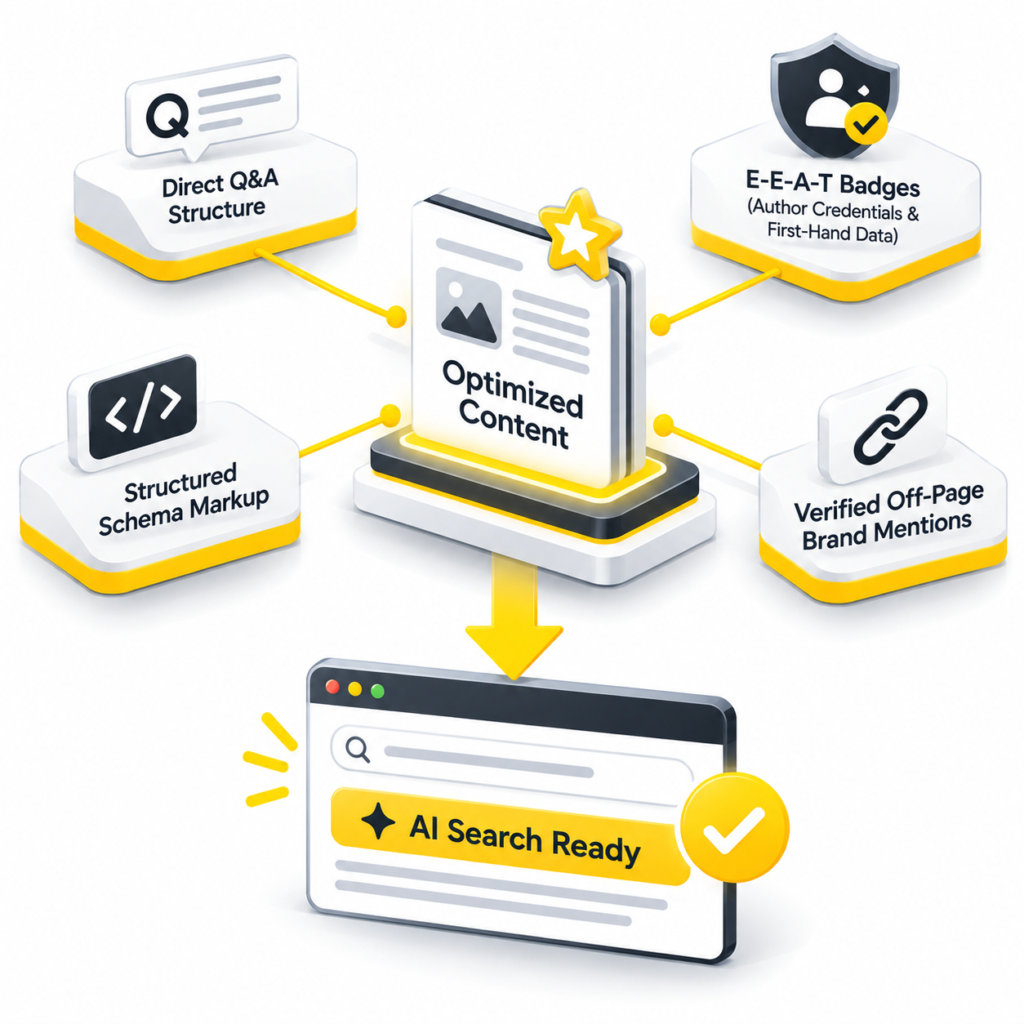
Here are ten steps. They work together, so don’t treat them as a menu.
1. Create Helpful, Authoritative, and People-first Content
Write for the reader, not the model. Solve a real problem. Add details only someone with real experience would know.
Generic content gets ignored. A cited page usually offers something the others lack: a clear process, a real example, or first-hand data.
2. Answer Specific Questions Clearly and Directly
AI tools pull answers. Make yours easy to pull.
Start sections with a direct answer in one or two sentences. Then add context. Use the questions your customers actually ask. Sales calls, support tickets, and “People also ask” boxes are good sources.
3. Structure Content With Descriptive Headings and Concise Explanations
Clear structure helps readers and machines.
- Use one H1 and logical H2s and H3s.
- Write headings that describe the section.
- Keep paragraphs short.
- Use lists and tables when they make comparison easier.
Put a short definition near the top of key pages. It can also win a featured snippet.
4. Strengthen E-E-A-T Signals
E-E-A-T stands for experience, expertise, authoritativeness, and trustworthiness. Google uses it in its quality guidelines. It isn’t a direct ranking factor, but it describes what good content looks like. Here’s how to show it:
- Experience: Share first-hand results, screenshots, and lessons learned.
- Expertise: Add real author bios with credentials and past work.
- Authoritativeness: Earn mentions from respected sites in your field.
- Trustworthiness: Cite sources, correct errors, and show clear contact and company details.
5. Build Brand Mentions and Earn High-quality Backlinks
AI systems use the internet to learn about brands. It’s a weak signal if you solely discuss yourself on your own website.
Gain exposure through collaborations, podcasts, digital PR, guest experts, and industry reports. Look for trustworthy, pertinent websites. A few excellent references outweigh many weak ones.
6. Use Relevant Statistics, Original Research, and Credible Sources
Original data is hard to copy. Run a survey. Publish benchmarks from your own client work. Share what you saw that others didn’t.
When you cite outside numbers, link the primary source and name the year. Skip stats you can’t verify.
7. Implement Structured Data and Maintain Technical SEO
Structured data won’t force an AI citation. Google says you don’t need special markup for its AI features. But schema helps search systems understand your content. Make sure markup matches what’s visible on the page.
Cover the basics too:
- Allow crawling of important pages.
- Fix broken links and redirect chains.
- Keep pages fast and mobile-friendly.
- Don’t hide key content behind scripts that bots can’t read.
8. Keep Important Information Accurate and Up to Date
Old facts hurt trust. Review key pages on a schedule. Update prices, features, and statistics. Show a “last updated” date when it’s real.
9. Improve Your Brand’s Presence Across Authoritative Websites and Relevant Platforms
AI tools pull from more than blogs. Review sites, directories, forums, video platforms, and industry publications all shape what they say about you.
Claim your profiles. Keep them complete. Respond to reviews. Take part where your audience already talks.
10. Optimize Product, Service, and Company Information for Consistent Brand Recognition
Use the same brand name, descriptions, and key facts everywhere. If your site says one thing and a directory says another, the model gets mixed signals.
Check your About page, social profiles, and listings. Make them match.
Learn More: 9 Best International SEO Agencies in 2026
How to Measure AI Visibility Score?
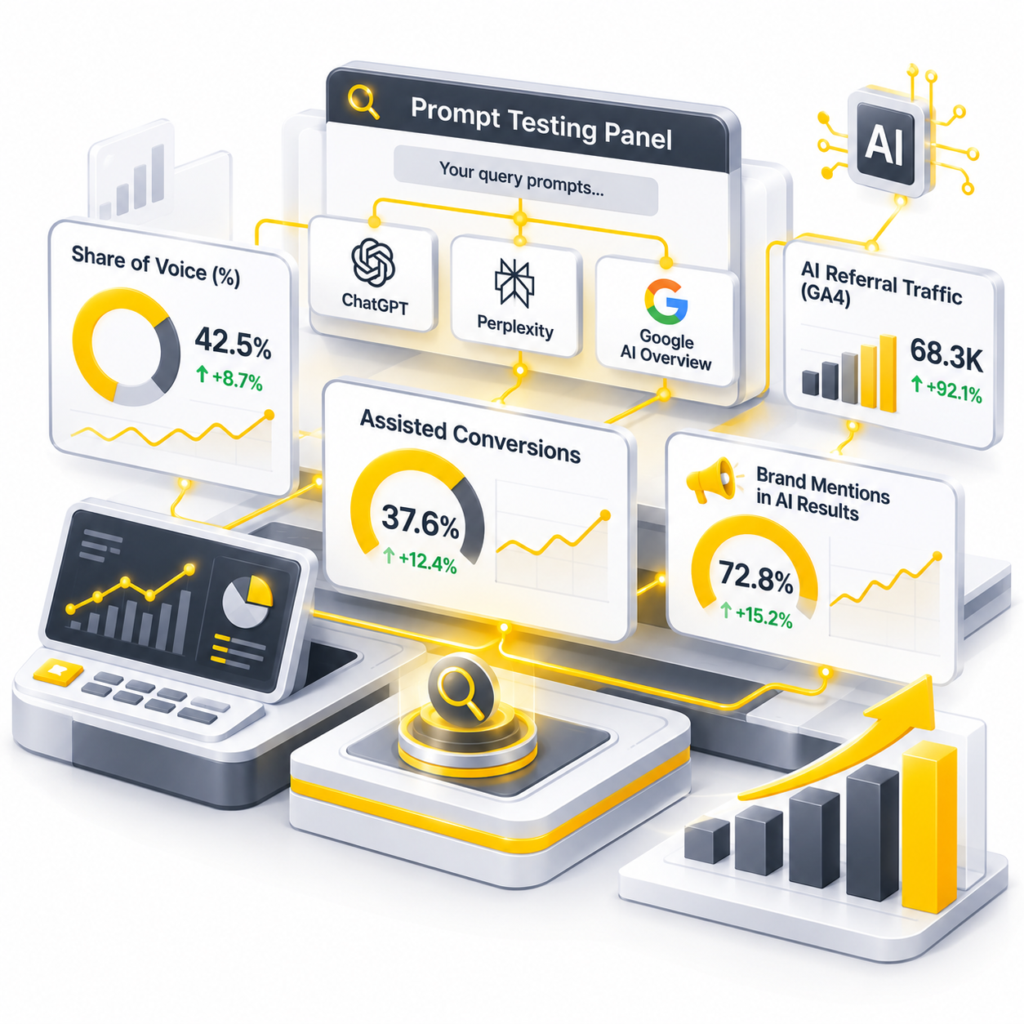
You can’t improve what you can’t see. Measurement is still young here, so mix methods.
Track Brand Mentions in AI-generated Answers
Build a list of 20 to 50 prompts your buyers might use. Run them across ChatGPT, Perplexity, Google, and others. Record whether you’re mentioned, and how.
Repeat monthly. Run each prompt more than once, since answers shift.
Monitor Citations and Linked Sources
Note which of your pages get cited. Note which competitor pages get cited instead. That shows the content gaps you can fill.
Measure Share of Voice Across AI Search Platforms
Share of voice is the percentage of tracked prompts where your brand appears, compared with competitors. It’s a simple way to see where you stand.
Analyze Referral Traffic From AI Tools
In Google Analytics 4, look for referral sources such as chatgpt.com and perplexity.ai. Some AI-powered search tools add a source tag to outbound links, which makes tracking easier. Not every visit gets labeled, so expect undercounting.
Track Conversions and Assisted Conversions
Traffic isn’t the goal. Leads and revenue are. Watch conversions from AI referrals. Also watch assisted conversions, since many users see a brand in an AI answer and return later through another channel. Adding “How did you hear about us?” to forms can surface this.
Compare AI Visibility Over Time and Against Competitors
One snapshot means little. Track trends. Compare against two or three competitors. Look for direction, not perfection.
Quick Measurement Checklist
- Build a fixed prompt list
- Test across at least three AI engines
- Log mentions, citations, and sentiment
- Check AI referrals in GA4
- Review results monthly
- Benchmark against competitors
Best Tools to Monitor and Improve AI Visibility
No single tool covers everything. Here’s what each does well.
Google Search Console and Google Analytics: Both are free. Search Console shows how your pages perform in Google Search, and AI feature traffic is counted in the overall Web search data. It doesn’t break out AI Overviews on their own. Analytics shows referral traffic and conversions. Neither track mentions third-party AI tools.
1/ Semrush: Useful for keyword research, site audits, and competitive analysis. It also offers AI visibility tracking features. Check what your plan includes before you commit.
2/ Ahrefs: Strong for backlink analysis and content research. It has brand monitoring features for AI search visibility as well. Like most platforms, its AI data is based on sampled prompts, not complete coverage.
3/ Dedicated AI visibility tools: A growing group of tools, such as Profound and Peec AI, track brand mentions and citations across AI platforms. They save time. But methods differ so results can vary between tools.
4/ Limitations to keep in mind: AI answers change often. Tools sample prompts and can’t see every user’s result. Use them for direction. Pair them with manual checks.
Common AI Visibility Optimization Mistakes to Avoid
1. Publishing Generic, Unoriginal Content
If your article repeats what ten others say, there’s no reason to cite it. Add original examples, data, or a clear point of view.
2. Overusing Keywords or Writing Unnaturally For AI
Keyword stuffing was bad for SEO. It’s bad here too. Write the way people talk. Clear beats clever.
3. Ignoring Technical SEO and Website Accessibility
If bots can’t crawl your site, you’re invisible. Check robots.txt, indexing, and page speed. Accessible pages also help everyone who visits.
4. Treating AI Visibility As a Replacement for Traditional SEO
It isn’t a replacement. It sits on top of SEO. Drop the fundamentals, and both suffer.
5. Focusing on AI Mentions Without Measuring Business Outcomes
A mention is nice. A qualified lead is better. Tie your tracking to pipeline and revenue, not vanity counts.
AI Visibility Best Practices for Different Business Types
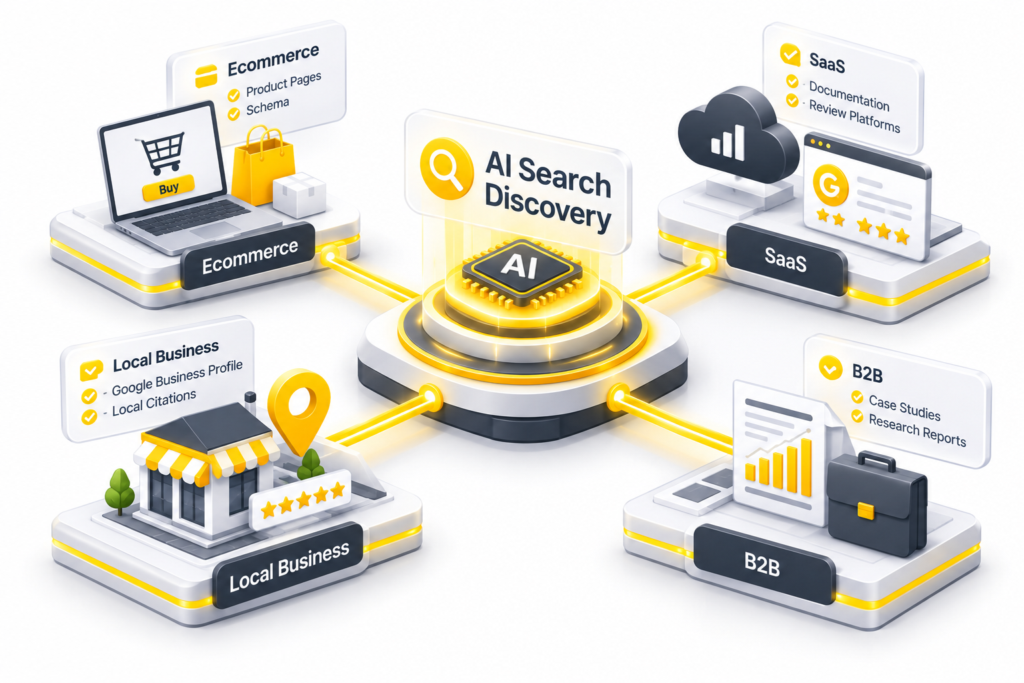
AI Visibility for SaaS and Technology Companies
Publish clear product documentation, comparison pages, and use-case guides. Keep pricing and feature pages current. Earn reviews on sites like G2 and Capterra, since buyers and AI tools both rely on them.
AI Visibility for Ecommerce Brands
Write detailed product pages with specs, sizing, and honest pros and cons. Use product schema. Build buyer’s guides that answer real shopping questions. Gather customer reviews, which add credibility.
AI Visibility for Local Businesses
Keep your Google Business Profile complete and accurate. Make sure your name, address, and phone number match everywhere. Collect reviews. Create pages for each service and location you cover.
AI Visibility for B2B Companies and Service Providers
Show expertise through case studies, original research, and expert-led content. Get named in industry roundups and respected publications. Make your service pages specific about who you help and how.
The Future of AI Visibility
AI search is evolving quickly. New platforms, behaviors, and features are always emerging. Anyone who says they know exactly where it ends up is speculating.
Certain things appear to be stable. Original, trustworthy information should continue to gain credibility. Strong brands that are mentioned online should continue to stand out. Additionally, companies must approach AI search as a component of their larger SEO strategy rather than as a side project.
It’s an easy, practical move. Create information that is worthy of citation. Create a noteworthy brand. Measure as much as you can. As platforms evolve, adapt.
Ready to strengthen your AI visibility? Partner with MonsterClaw to build a smarter SEO strategy that boosts your brand’s discoverability, authority, and reach across AI-powered search platforms.
Frequently Asked Questions (FAQs)
The frequency with which your brand or content appears in AI-generated responses is known as AI visibility. This includes references, citations, and suggestions from tools such as Perplexity, Google AI Overviews, and ChatGPT.
Use many AI tools to run a series of realistic consumer prompts. Keep track of any mentions or citations of your brand. Next, use a monitoring tool and GA4 referral data to supplement the manual checks.
Ensure that your website can be indexed and crawled. Publish information that is creative, concise, and well-organized. Boost E-E-A-T signals. Obtain links and mentions from reputable websites. Keep the facts up to date.
No, but they do overlap. SEO’s main goal is ranking pages in search results. The goal of AI visibility is to show up within AI-generated responses. Both are supported by effective SEO.
It can. AI responses frequently include links to sources, and those visitors are typically highly motivated. However, volume varies by platform and business, and many AI responses result in no click at all. Instead of making assumptions, monitor outcomes.