



Managing a small shop is one thing. Managing thousands of product pages, endless category updates, and fierce competition across search engines? That is where enterprise e-commerce SEO becomes a whole different game. From the technical site structure to scalable content strategies, large online stores need more than basic optimization to stay visible and profitable.
Find out how enterprise ecommerce SEO works, why traditional SEO tactics often fall short for massive ecommerce websites, and the strategies leading brands use to improve rankings, boost organic traffic, and increase conversions at scale.
Relatable Read: eCommerce SEO Strategy: How to Drive More Organic Sales in 2026
What Enterprise Ecommerce SEO Actually Means
Enterprise e-commerce SEO involves optimizing large web stores, typically with thousands to millions of pages, to rank higher in search results and generate steady organic traffic. Adding keywords to product pages is only one aspect of it. It combines authority building, content strategy, technical infrastructure, and site architecture.
Small-Store SEO and Enterprise SEO
Small stores manage a few hundred pages with mostly consistent information. Moreover, while business stores require automated processes and governance, small retailers can rely on manual optimization.
On the other hand, enterprise businesses face challenges like seasonal catalogs, dynamic URLs, and ever-changing inventory.
Smaller websites simply lack the technical sophistication of enterprise-scale websites, such as crawl budget, faceted navigation, and international SEO.
Why Does SEO Matter for Large Retailers?
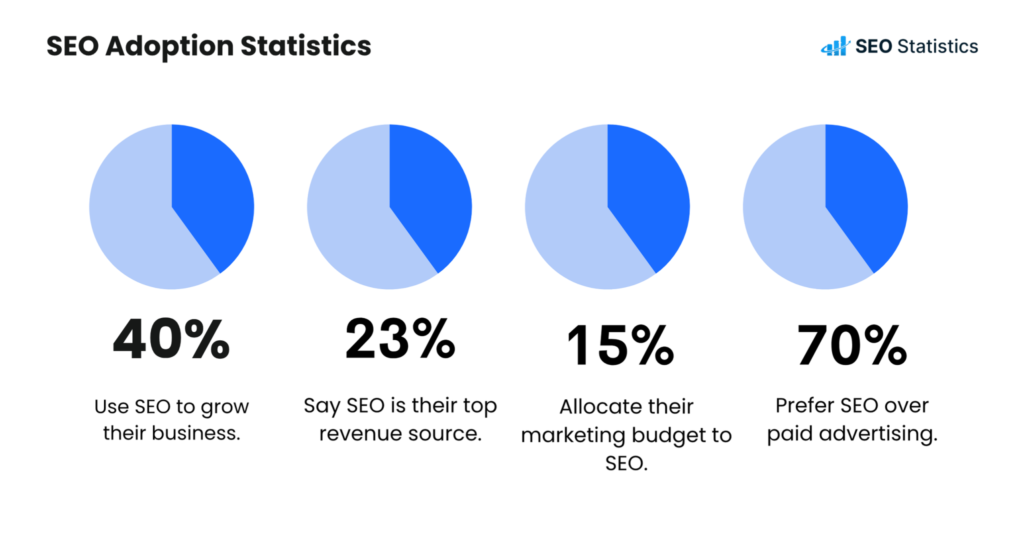
Paid advertisements are costly but effective. The traffic stops as soon as you stop making payments. Over time, organic search traffic accumulates. Without continuing to spend money on advertisements, a well-optimized category page can produce steady income for years.
[Source: SEO Statistics]
Key benefits include:
- Organic traffic that is scalable and expands with your catalog
- Reduced costs for acquiring new customers in comparison to paid channels
- Long-term revenue growth without commensurate cost rises
- Increased brand awareness in competitive search results
Understanding Enterprise E-commerce Websites
The size and operational complexity of enterprise stores define them:
- Thousands to millions of pages for products and categories
- Daily or even hourly fluctuations in inventory
- Numerous product variations, subcategories, and categories
- Global businesses with regional prices and multilingual content
Common SEO Challenges
These features lead to certain issues that small businesses hardly ever encounter:
Index bloat: Excessive crawling and indexing of low-value URLs.
Thin content: Manufacturer-copied descriptions on thousands of product pages constitute thin content.
Duplicate content: Nearly identical pages are produced by product variations and filter combinations.
Pagination problems: Crawlers might never be able to access deep category pages
Slow performance: Core Web Vitals are being slowed down by large graphics, third-party scripts, and legacy code.
Inadequate internal linking: Power is not correctly transferred to key pages.
Relatable Read: Shopify eCommerce SEO: Step-by-Step Guide and Checklist
Building an Enterprise E-commerce SEO Strategy
Before any execution, there must be a sound plan. Without it, you wind up solving issues in a haphazard manner and losing out on chances that genuinely increase revenue. Businesses looking for a structured, scalable approach often benefit from professional Ecommerce SEO Services that align SEO initiatives with long-term growth objectives
Setting SEO Goals
Your SEO objectives should be closely related to business results:
- Growth in organic traffic by product category or segment
- Income from organic, non-branded searches
- Rate of conversion from organic sessions
- Share of voice and brand visibility in important SERPs
Conducting Competitive Analysis
- Determine the top competitors’ rankings for the product keywords and your target category.
- To uncover terms they rank for that you do not, run a keyword gap study.
- Assess their SERP feature presence, including product listings, image packs, and rich snippets.
- Determine which categories they predominate in and where their coverage is lacking.
Defining SEO Priorities
It’s not possible to fix everything at once. Set priorities based on impact:
- Pages in high-value categories come first since they get the greatest traffic.
- Technical SEO solutions that prevent indexing
- Product-level optimization for your best-selling items
- Authority-building via links and content
Relatable Read: How to Outrank a Tough Competitor in Search Engine Rankings
Enterprise Keyword Research at Scale
You cannot do keyword research page by page when you have a million products. You need a system.
[Source: SEO Statistics]
Keyword Mapping for Large Catalogs
- Category keywords: Broad, frequently used terms such as “office furniture” or “men’s running shoes” are category keywords.
- Subcategory keywords: More focused phrases with a higher propensity to buy
- Product-intent keywords: Brand names, model numbers, and specific characteristics are examples.
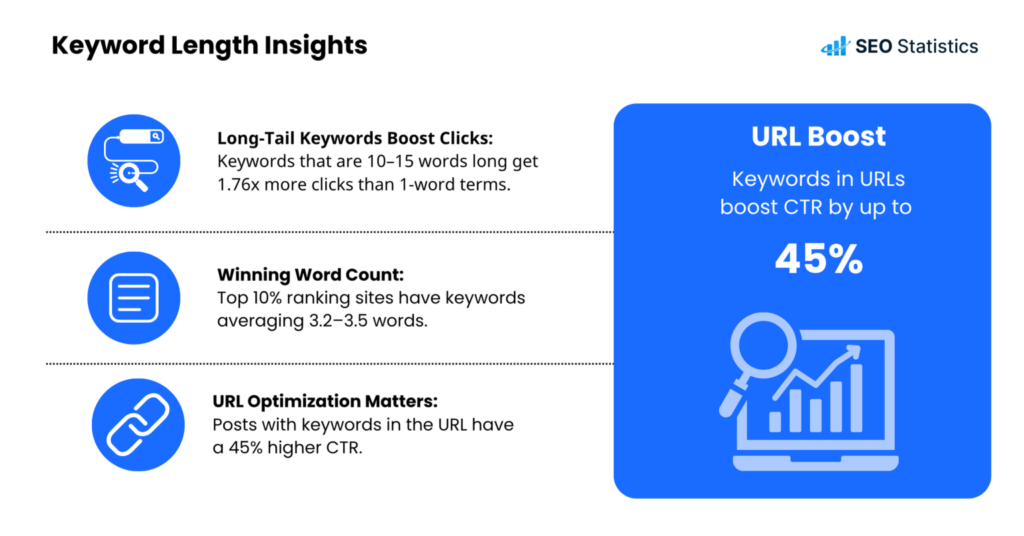
- Long-tail opportunities: Long-tail opportunities are often less competitive and have low volume but high conversion rates.
Search Intent Optimization
Every keyword has a purpose. Rankings are determined by how well your page aligns with that purpose.
- Informational: Provide users with guidance and instructional materials while they are learning.
- Commercial research: When a user is researching options, provide them with purchase guidance and comparative pages.
- Transactional: Show the user product and category pages with obvious calls to action when they are prepared to make a purchase.
- Navigational: Make sure your branded pages are optimized because users are searching for a certain brand or page.
Using Automation and SEO Tools
- For large-scale keyword clustering, use tools like Semrush, Ahrefs, or BrightEdge.
- AI-assisted grouping may automatically segment thousands of keywords by topic and purpose.
- To identify emerging search phrases before rivals do, set up automated trend tracking.
Site Architecture for Large E-Commerce Stores
Creating an SEO-Friendly Structure
How authority moves throughout your website and how well Google can crawl it depend on your architecture.
- Important pages should be accessible from the homepage in three to four clicks.
- Make advantage of a logical hierarchy of categories that reflects how consumers view your offerings.
- Make sure URLs are readable and clear.
Internal Linking Strategy
One of the most underused tools in e-commerce SEO is internal links:
- Include relevant category pages with contextual links from blog posts and purchasing guides.
- Product page links to related products and parent categories
- Every page should have breadcrumb navigation because it benefits both users and crawlers.
- Create cross-category connections where goods in use cases naturally intersect.
Optimizing Navigation
- Deep category pages that might otherwise be difficult to locate can be made visible with the use of mega menus.
- Ensure that each page has at least one internal link pointing to it; orphan pages score poorly and are crawled less frequently.
- Don’t include links only for bots; instead, strike a balance between crawl efficiency and user experience.
Technical SEO for Enterprise Ecommerce
Large retailers often face both the greatest challenges and the greatest potential in this field.
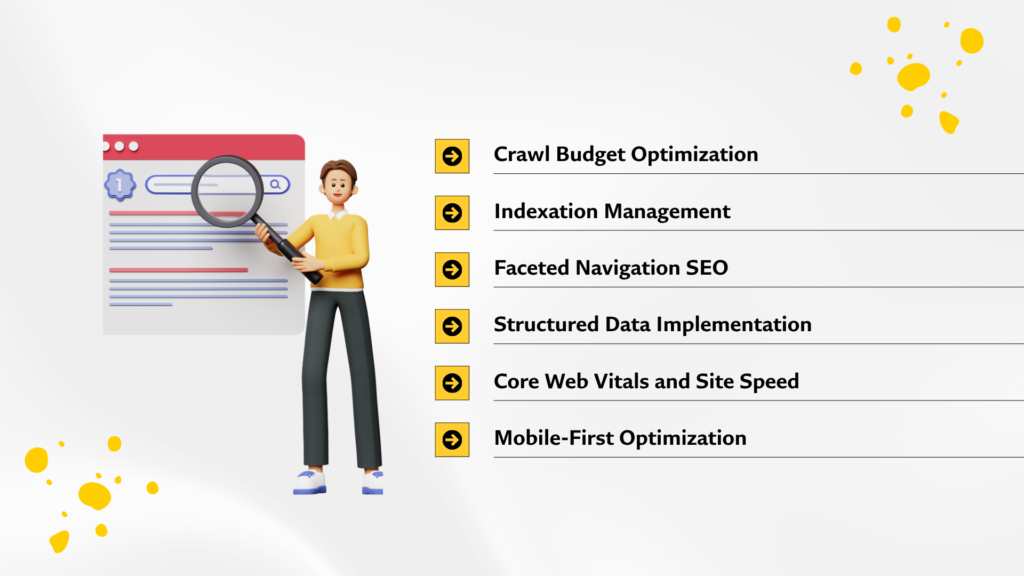
Crawl Budget Optimization
Google gives each website a limited crawl budget. Big-box retailers must handle it carefully:
- Use robots.txt to block low-value URLs, such as session IDs, tracking parameters, and filtered views.
- Only indexable, high-priority pages should be included in XML sitemaps.
- Regularly check the crawl statistics in Google Search Console.
Indexation Management
- To combine duplicate or almost duplicate pages, use canonical tags.
- Use noindex for staging environments, internal search results, and thin pages.
- In Google Search Console, handle URL parameters to avoid repeated indexing.
Faceted Navigation SEO
One of the main technical issues with e-commerce SEO is faceted navigation, which includes product filters for size, color, and price:
- Every combination of filters has the potential to produce a distinct URL, resulting in thousands of nearly identical pages.
- On filtered pages that return to the primary category URL, use canonical tags.
- Think about JavaScript-based filtering that doesn’t alter the URL in any way.
- Permit only filter combinations with actual search volume to be indexed.
Structured Data Implementation
Structured data gives Google richer context and can trigger enhanced search results:
- Product schema – Name, price, availability, and ratings
- Review schema – Star ratings displayed in search results
- Breadcrumb schema – Path shown in the search listing
- FAQ schema – Expandable questions directly in SERPs
Core Web Vitals and Site Speed
Core Web Vitals are a confirmed ranking factor:
- LCP (Largest Contentful Paint): How fast your main content loads; target under 2.5 seconds
- INP (Interaction to Next Paint): Responsiveness to user input; replace slow JavaScript
- CLS (Cumulative Layout Shift): Visual stability; reserve space for images and ads
Mobile-First Optimization
Google indexes the mobile version of your site first:
- Make use of a responsive design that is compatible with all screen widths.
- Reduce friction for mobile buyers and increase tap target sizes
- For mobile connections, aggressively compress photos.
Relatable Read: Technical SEO for eCommerce: A Complete Step-by-Step Guide
On-Page SEO for Enterprise Ecommerce
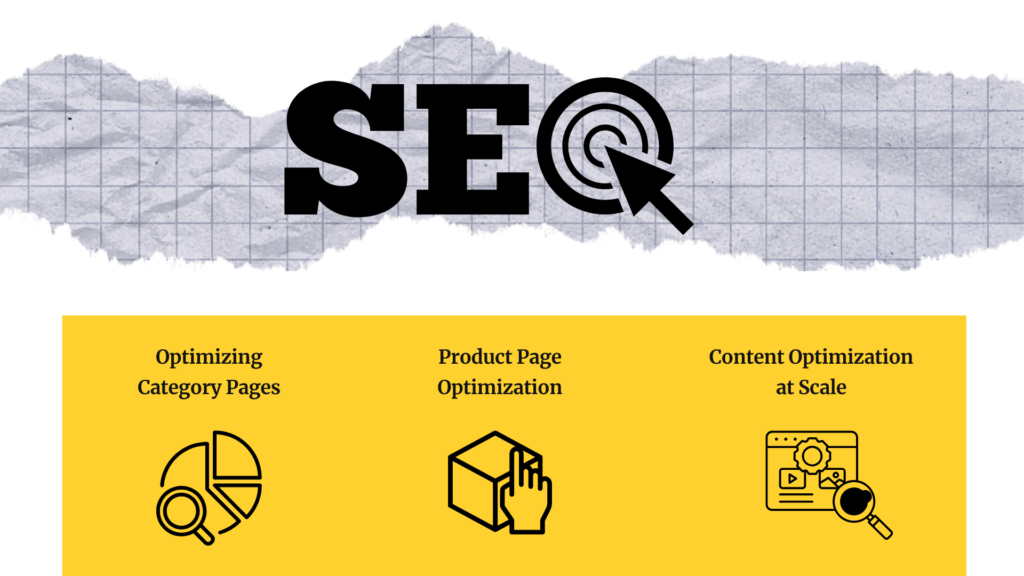
Optimizing Category Pages
On the majority of e-commerce websites, category pages are the most valued pages:
- Create unique, keyword-rich title tags for each category.
- Include a brief introduction at the top of the page; even 100 words will help Google comprehend it.
- Add buyer-focused language outlining the category’s offerings and the reasons to shop here.
- Include internal links to featured products and subcategories.
Product Page Optimization
- Never use a manufacturer’s copy when writing your own product descriptions.
- Add product FAQs that answer frequently asked questions by customers.
- Add meaningful, keyword-relevant alt text to every product image.
- Customer reviews bring original material and foster confidence, so encourage them.
Content Optimization at Scale
At a business scale, you cannot handwrite every page. Make use of a clever combination:
- Programmatic SEO: Templates that dynamically retrieve product data, category names, and specifications
- Dynamic content blocks: Introductory paragraphs constructed from structured data are called dynamic content blocks.
- Human review layers: Before publication, have editors examine high-value and high-traffic pages.
Content Marketing for E-commerce SEO
Building Topical Authority
Strong topical authority makes it considerably easier to rank for commercial keywords. Build it with:
- Purchasing guidelines for every significant product category
- Comparison articles (“X vs Y”) aimed at searches for commercial investigations
- Resources for education that address queries from your customers
- Blog posts related to new product interest and seasonal trends
User-Generated Content
UGC is an effective, low-cost method of adding original material to thousands of product pages:
- Product pages immediately receive new, keyword-rich text from customer reviews.
- Q&A sections can rank for long-tail searches and provide answers to actual buyer queries.
- Customer photos lower return rates and increase authenticity.
Seasonal and Trend-Based Content
- Make holiday landing pages weeks in advance of the busiest time of year, so Google has time to index them.
- Create and update yearly evergreen category pages for enduring search trends.
- Keep an eye on your own search data and Google Trends for new product demand.
Relatable Read: Future of Content Marketing: What Actually Comes Next
International SEO for Enterprise E-commerce
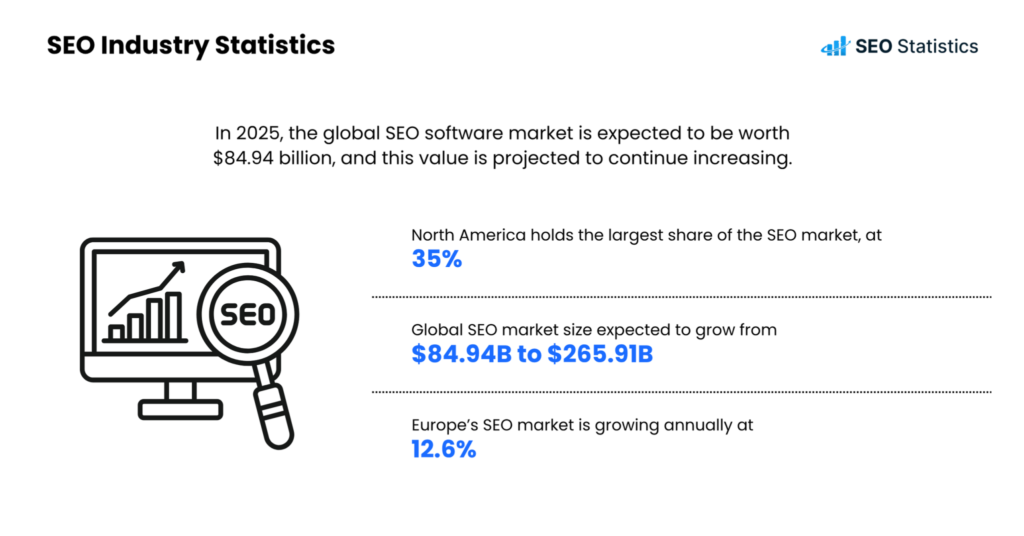
[Source: SEO Statistics]
Multi-Regional SEO
A thoughtful URL approach is necessary when selling in various countries:
- The strongest spatial signals are sent by country-specific domains (example.de), but they need more infrastructure.
- For most enterprise stores, subfolders (example.com/de/) are the best option because they are simpler to maintain and consolidate domain authority.
- Google handles subdomains (de.example.com) just like it does subfolders.
Hreflang Implementation
Hreflang instructs Google on the version of a page to display for each language or geographical area:
- Hreflang tags for any pertinent regional variations must be included on every page.
- The most frequent issue is missing return tags; if page Page B must refer to page A, as page A mentions page B.
- Make proper use of ISO 3166-1 country codes and ISO 639-1 language codes.
Localization Strategies
Translation is insufficient on its own:
- Adjust prices and exchange rates for every market.
- Use keywords that are pertinent to your area; direct translations frequently fail to capture how local users actually search.
- Consider cultural variations in the tone, iconography, and presentation of products.
Enterprise Link Building Strategies
Digital PR Campaigns
High-authority links can be obtained at scale by large retailers using:
- Original data studies and industry research that journalists wish to reference
- Campaigns that are noteworthy due to industry insights or consumer trends
- Annual reports and surveys that are recognized as industry resources
Scalable Link Acquisition
- Request that manufacturers and suppliers provide links to your store on their “where to buy” pages.
- Investigate affiliate relationships that produce links and relevant traffic.
- Obtain a listing in buying guides and industry directories for your product categories.
Content-Led Link Building
- Make interactive resources that generate passive links, such as product finders, calculators, and sizing guides.
- Create resource pages on your expertise that serve as sources of reference.
- Create visual resources that may be shared, such as infographics related to product categories.
Measuring Enterprise E-commerce SEO Performance
Essential SEO KPIs
- Organic sessions broken down by category
- Revenue from organic search (non-branded)
- Keyword rankings across priority terms
- Conversion rate from organic traffic
SEO Reporting Dashboards
- For traffic, interaction, and conversion metrics, use GA4.
- For impressions, clicks, indexation, and Core Web Vitals, use Google Search Console.
- Integrate data for cross-channel reporting with business BI solutions.
Monitoring Technical Health
- Use programs like Screaming Frog or Sitebulb to do routine crawls.
- Set up warnings for crawl faults or abrupt drops in indexed pages.
- Monitor Core Web Vitals not just at launch but also throughout time.
Common Enterprise E-commerce SEO Mistakes
Big-box retailers frequently commit the same errors:
- Product pages that are duplicates due to variations, filters, or parameter combinations
- Ignoring crawl budget until a noticeable decline in ranks
- Inadequate multifaceted navigation management that generates thousands of bogus URLs
- Thin category content that consists only of a product grid and no text
- Inadequate internal linking results in pages lacking authority
- Slow mobile experience that negatively impacts conversions and rankings
- Overuse of automation in the absence of editorial quality control
Relatable Read: eCommerce SEO Case Study: $30k to $700k Sales Journey
Final Words
Success in enterprise ecommerce SEO comes from more than just ranking higher on Google. Large online stores need scalable strategies, strong technical SEO, optimized site structures, and content that drives real conversions.
With the right approach, enterprise brands can turn organic traffic into long-term revenue growth.
That’s where MonsterClaw helps businesses grow. By combining technical expertise with data-driven strategies, MonsterClaw helps brands simplify complex SEO challenges.
Ready to scale your online store faster? Partner with MonsterClaw and turn your e-commerce SEO strategy into measurable growth.

Frequently Asked Questions (FAQs)
Enterprise e-commerce SEO is the process of optimizing large-scale online stores with comprehensive product catalogs to increase organic search exposure and generate consistent revenue from search engines.
The scale of the challenges is completely different. Small retailers never have to deal with the level of crawl budget, index bloat, faceted navigation, international hreflang, and content that enterprise stores do.
Crawl budget management and faceted navigation are always the most effective. Over time, unmanaged filter URLs might subtly reduce your organic visibility.
Within four to eight weeks, technical adjustments can yield quantifiable gains. It usually takes six to twelve months for content and authority building to demonstrate significant ranking increases.
Indeed. SEO experts, developers, content creators, and product merchandisers must work closely together at this size. It is too much for one individual to handle successfully.