



Most businesses invest in SEO hoping for more traffic. But traffic alone doesn’t pay the bills. What turns organic visitors into leads, customers, and revenue is a well-structured SEO Funnel.
Think of it as a system that guides people from their first Google search to their final purchase decision. Instead of chasing rankings for random keywords, an effective SEO Funnel aligns content with every stage of the buyer’s journey.
Let’s see how to build an SEO Funnel from scratch, map content to user intent, and create an organic conversion machine that constantly attracts qualified traffic and turns it into measurable business growth.
Relatable Read: B2B SaaS SEO: The Ultimate Guide for 2026
What Is an SEO Funnel Framework?
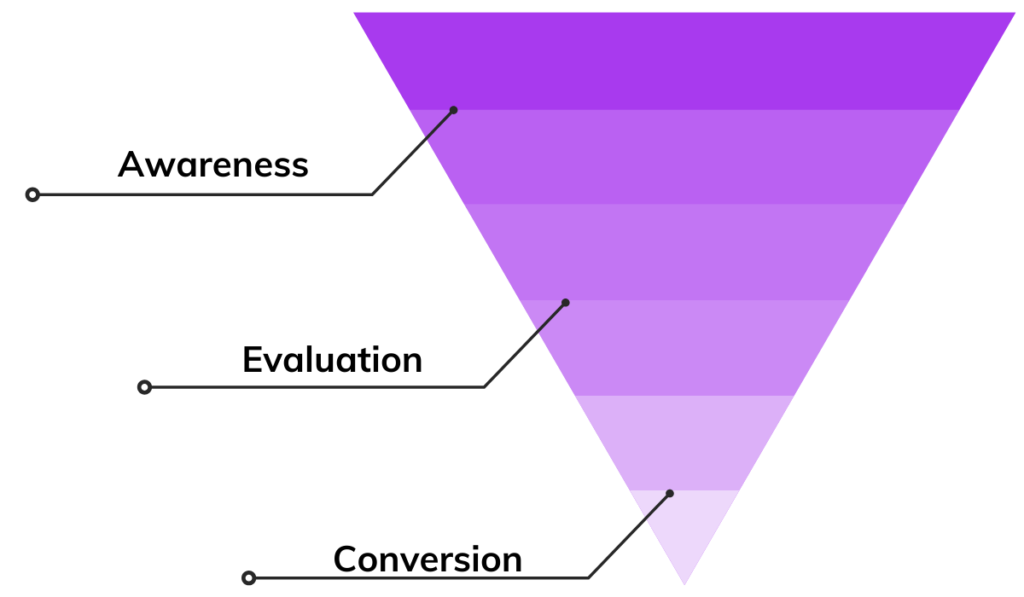
An SEO funnel maps your content strategy to the customer journey. Instead of creating content randomly and hoping people convert, you deliberately match search intent to where someone actually is in their buying process. That is, awareness, consideration, or decision.
[Source: Botify]
Why Traditional SEO Often Fails?
Volume is the goal of traditional SEO. Write a blog article about a term that receives 10,000 monthly searches, then watch for leads to come in. The issue? High-volume keywords are frequently research-stage inquiries from consumers who are far from making a purchase.
In the end, you have bouncing traffic. Pages that are ranked but fail to convert. Content that informs readers while directing them to a rival business with a more compelling call to action.
SEO turns into a costly content treadmill if conversion paths aren’t incorporated into your content strategy.
Benefits of an SEO Funnel Strategy
Higher-quality Leads & Conversions: An SEO funnel directs user intent to the appropriate site instead of merely focusing on high-volume keywords. When visitors arrive at your website, they are given all the information they require to proceed.
Accelerated Brand Trust: You develop authority long before consumers decide to buy when they come across your brand at every level of their research, from product comparisons (Bottom of Funnel) to instructive blog posts (Top of Funnel).
Compounding Organic ROI: Evergreen SEO content offers an unrivaled long-term return on investment by generating visitors for years without constant ad spending.
Reduced Friction and Lower Bounce Rates: You may optimize specific pages to lead consumers through the purchasing process in a logical and seamless manner by understanding precisely where visitors stop.
Stronger Website Architecture: By strengthening your site’s internal linking structure, funneling makes it easier for search engines to crawl and comprehend the hierarchy of your material.
Understanding the Three Stages of the SEO Funnel
[Source: Funnel.io]
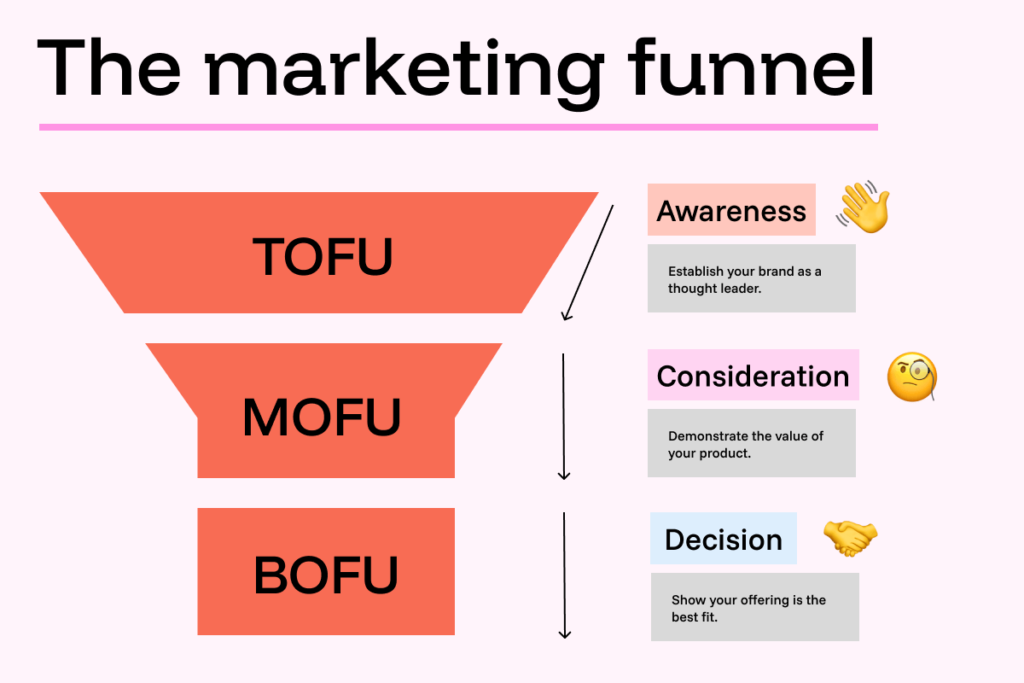
Top of Funnel (TOFU): Awareness
TOFU is where people are just starting to understand they have a problem. Instead of looking for answers, they are looking for knowledge. It is your responsibility to show up, be helpful, and gain trust rather than to sell.
At this point, keywords are informative and broad. Consider: “how to improve website traffic,” “what is conversion rate optimization,” or even “content marketing tips for small business.” Instead of buying, the searcher wants to learn.
Middle of Funnel (MOFU): Consideration
At this point, people are aware of their issue and are investigating possible fixes. They are attempting to determine what is truly worth their time and money by comparing possibilities and reading reviews.
Case studies, solution-focused manuals, and comparative pieces are examples of MOFU material. The most popular keywords now include “best CRM software for agencies,” “HubSpot vs. Salesforce,” and “how to choose an SEO tool.” They are making a decision, which is a sign of business intent.
Bottom of Funnel (BOFU): Decision
Money is exchanged at BOFU. These searchers are assessing where to find what they desire. They are looking for direct substitutes, your brand name, your price, or your particular product.
Here, some examples of keywords are “[Your Brand] pricing,” “hire SEO agency,” and “buy project management software.” This material, which includes landing pages, product pages, and service pages, must be optimized for both conversion and rankings.
Related Read: Shopify vs WooCommerce: Which One is Better for SEO in 2026?
Step 1: Conduct Intent-Driven Keyword Research
Start with Business Goals
Before using a keyword tool, determine your true goals. Are you producing leads for a sales force? Encouraging purchases made online? Creating a list of subscribers? Which keywords are worthwhile to pursue should be determined by your income objectives rather than just search traffic.
A keyword with 500 monthly searches and a high level of purchase intent will nearly always perform better than a term with 10,000 searches, where users are only perusing.
Identify Funnel-Based Keywords
Make a conscious map of your keyword research for each level of the funnel. Look for “what is,” “how to,” and “tips for” questions in your area to raise awareness. Take into account “best of” lists, solution-specific searches, and comparative queries. When making a choice, focus on high-specificity product or service searches, pricing inquiries, and branded alternatives.
Analyze Search Intent

[Source: Travelpayouts]
Launch a Google Incognito tab and conduct a keyword search. What does ranking mean? Google has determined that a query is informational if all of the top results are informational guides. It’s transactional if you look at product pages and reviews.
Don’t try to outrank a product page with a blog post; instead, align your content structure with what is already successful.
Build a Keyword Funnel Map
Sort your keywords into topic clusters after segmenting them by intent and funnel stage. Every cluster contains a pillar page (often MOFU or BOFU) that is linked back to by relevant TOFU content. This structure facilitates users’ natural progression through your funnel and aids Google in understanding your topical authority.
Relatable Read: Brand Keywords Not Appearing On Google? Here is the Fix!
Step 2: Create Content for Every Funnel Stage
TOFU Content Types
Reach and trust-building are key components of top-of-funnel content. The ideal formats are glossary-style tools, industry information roundups, instructional blog entries, and starter guides. These items only need to be truly helpful; a strong sales push is not necessary.
Being the most beneficial resource for someone who is just starting in your field is the straightforward objective.
MOFU Content Types
The hard work of persuasion is done by middle-of-funnel content. Here, case studies, expert roundups, comparison articles (“X vs. Y”), and solution-focused guides all function nicely.
Objections should be addressed, results should be shown, and someone should be assisted in reducing their selections.
Case studies are particularly effective since they present actual outcomes in actual settings, which is just what a customer is looking for.
BOFU Content Types
This is where your product, service, pricing, and demo/consultation landing pages are located. From an SEO standpoint, teams frequently overlook these sites since they believe they are merely “sales pages.” However, BOFU pages must rank for high-intent and transactional keywords.
Make sure these pages are optimized as if your income depended on them.
Content-to-Conversion Alignment
Making a hard pitch to someone who merely wants to learn is one of the worst funnel blunders. The call to action (CTA) for a TOFU blog post about “how email marketing works” should be “Book a Demo Now” rather than a pertinent content upgrade or newsletter signup.
Adapt your offer to the reader’s current stage of the journey.
Relatable Read: The SaaS Content Marketing Strategy No One’s Talking About (But Everyone Should Steal)
Step 3: Build Strategic Internal Linking Paths
Why Internal Linking Matters for Conversions
Internal linking is the foundation of your funnel, not just an SEO strategy for dispersing PageRank. When done correctly, it takes a visitor from an awareness piece to a comparison guide to a product page without requiring them to consider what to click next.
TOFU-to-MOFU Linking Strategy
At least one contextual link directing to an article that focuses more on solutions should be included in every awareness item. If someone is reading your guide on “what is lead generation,” make a natural connection to your comparison of the top lead generation solutions or a case study that shows how a client resolved the issue.
MOFU-to-BOFU Linking Strategy
You should include explicit links to decision-stage pages in your contemplation content. You should provide a link to your product or service site in a comparative article. There should be a straightforward way to schedule a consultation in a case study. Make the connections for them instead of forcing them to hunt.
Creating Content Hubs and Topic Clusters
Pillar pages, which cover a wide topic in detail, are located in the middle of a topic cluster. Subtopics are thoroughly covered in surrounding cluster content, which also connects to the pillar. This architecture gives Google topical authority signals and gives users a natural content path.
Step 4: Design High-Converting Lead Capture Assets
Choosing the Right Lead Magnets
While not all visitors are prepared to make a purchase, they may be prepared to provide you with their email. Templates, checklists, booklets, and industry reports are examples of lead magnets that encourage individuals to stay in touch. The best lead magnets are very particular and practical right away. These days, generic ebooks hardly ever convert well.
Optimizing Calls-to-Action
“Click Here” and “Learn More” are examples of generic CTAs that are a waste of time. Every call to action should be contextual, meaning it should be directly related to what the reader has just read. The call to action should provide an SEO audit checklist rather than a generic newsletter signup if they have completed a guide on SEO audits.
Placement is also important. For the simple reason that not everyone reads to the end, mid-content CTAs frequently perform better than bottom-of-post ones.
Reducing Conversion Friction
Conversions are killed by long forms. You’re asking for too much if you’re requesting more than just a name and email at the beginning of the funnel. Save the in-depth qualifying questions for a later stage of the partnership. Every extra field is an excuse to bounce, especially on mobile.
Relatable Read: High-Paying Affiliate Offers With Quick Approval in 2026
Step 5: Optimize BOFU Pages for Revenue
Essential Elements of High-Converting Landing Pages
A unique, well-defined value proposition must be at the center of a high-converting BOFU page. Not “we help businesses grow” but something specific, like “Cut client reporting time by 60% with automated dashboards.”
Testimonials, client logos, case study excerpts, and review ratings are examples of social proof that cannot be compromised. People desire proof that other people have chosen this course of action and are satisfied with it. FAQs help resolve the final concerns that prevent a visitor from becoming a convert.
Conversion-Focused SEO Best Practices
Page speed is not only a ranking factor, but also a conversion factor. Conversions can be considerably decreased with a one-second load time delay. In addition to speed, your BOFU pages must match the search intent of the query that directs visitors to them; a discrepancy between what a user searches for and what they see results in an immediate bounce.
Building Trust Signals
The perceived risk of converting is decreased by security badges, certificates, media attention, and clear pricing. Trust signals can be the difference between a lead and a lost prospect, particularly in business-to-business transactions.
Step 6: Measure Funnel Performance
Key SEO Funnel Metrics
Traffic is only the beginning. You must monitor lead generation metrics (form fills, resource downloads, demo requests), engagement metrics (time on site, scroll depth, bounce rate by funnel stage), and, in the end, revenue attribution from organic channels.
Tracking Micro and Macro-Conversions
Email signups, material downloads, and chatbot engagements are examples of micro-conversions that indicate the funnel is operating at an engagement level. Sales, qualified leads, and paid memberships are examples of macro-conversions that indicate it’s operating at a revenue level. Both are important. Early markers of funnel health are micro-conversions.
Setting Up Funnel Reporting Dashboards
To link organic traffic to income, use the funnel exploration report in Google Analytics 4 in conjunction with your CRM data. Create dashboards that display the points at which visitors enter and exit the funnel, as well as the content pieces that are generating real conversions rather than just pageviews.
Common SEO Funnel Mistakes to Avoid
- Focusing solely on traffic. Sessions and rankings are inputs, not results. You’re optimizing for the wrong thing if your reporting stops at traffic.
- Ignoring search intent. Your pages will either not rank or rank and bounce right away if you publish content that doesn’t fit what Google (and your audience) expects for a particular query.
- Weak internal linking. It’s like establishing a business without any signs directing customers to the checkout if excellent material is published in silos with no routes to deeper pages.
- Missing CTAs on informational content. Even if it’s merely signing up for a newsletter, TOFU content should still have an impact. A dead end is the absence of a CTA.
- Neglecting BOFU material. Because awareness material is simpler to produce, most content teams overinvest in it. However, the real source of income is your product and service pages. They merit equal consideration in terms of SEO.
Relatable Read: 14 Reasons to Hire an SEO Agency for Your Business
Building Your Organic Conversion Machine
Four steps make up the entire SEO funnel blueprint: use intent-matched content to draw in the proper visitors, educate them throughout their trip, nurture them with relevant offers and internal links, and convert them with optimized BOFU pages and CTAs.
Process is what gives this system its scalability. Keep records of your internal linking rules, content brief templates, conversion tracking setup, and keyword research process. You don’t have to start from scratch every time you replicate it across various topic clusters and funnel phases once it’s systematized.
The compounding effect of increasing conversion rates and organic traffic over time produces a predictable, self-sustaining development engine that is unmatched by most paid channels.
Final Words on SEO Funnel
Building an organic growth system doesn’t happen by chance. It’s engineered. The SEO funnel framework turns scattered traffic into a predictable conversion engine by aligning intent, content, and user journey from discovery to decision.
If you are ready to move beyond traffic vanity metrics and build a system that consistently converts, it’s time to rethink how your funnel is structured.
MonsterClaw specializes in building performance-led SEO systems that don’t just rank. They convert.
Frequently Asked Questions (FAQs)
An SEO funnel framework maps content to each stage of the buyer journey from awareness to conversion.
Identifying your target audience, mapping search intent across funnel phases, producing pertinent content, and establishing distinct conversion routes between pages are the first steps.
Product pages, case studies, and conversion-driven assets are the focus of bottom-of-funnel content; middle-of-funnel material contrasts solutions; and top-of-funnel content instructs.
To assess funnel performance, monitor organic traffic, interaction metrics, lead generation, assisted conversions, and customer acquisition rates.
Common errors include ignoring conversion optimization on high-traffic sites, failing to integrate content phases, and focusing on keywords without conducting search intent analysis.