


Don’t get left hanging forever.
75% of shoppers never look past the first few results. Hence, your clothes and accessories both deserve a top spot. To get there, you need to work on your SEO. It simply means helping shoppers find your store when they search on Google.
Most SEO advice is written for simple stores. But fashion brands play by different rules. You have multiple colors, several sizes, and fast-changing seasons. One plain SEO plan rarely fits all of that.
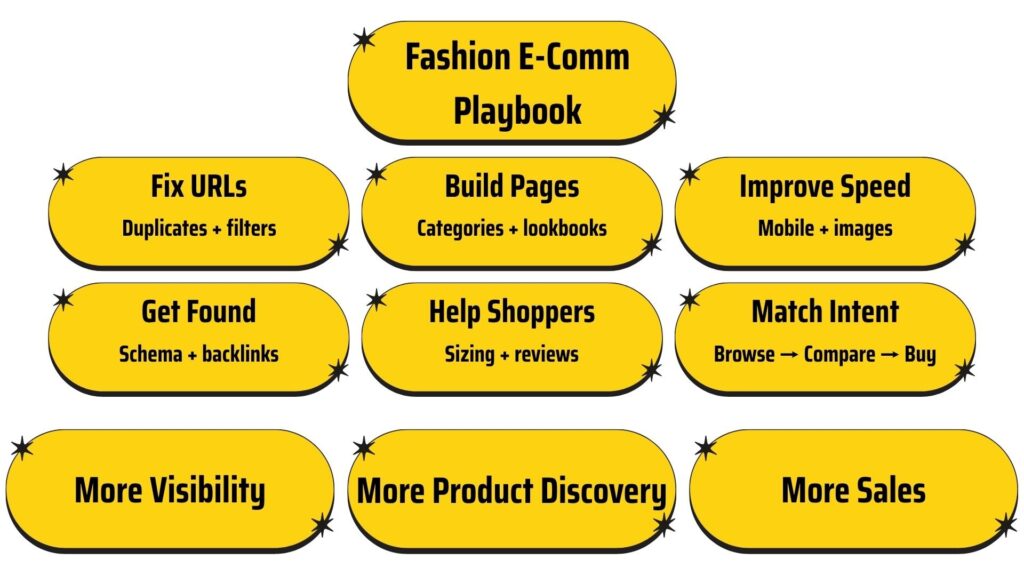
That’s why DTC brands need a fashion-first plan. Fix duplicate pages, tame filters, and speed up mobile pages. A good fashion ecommerce playbook looks like this.
Rankings start to rise, and more shoppers find you. As a result, your brand sees better conversions.
Ultimate Playbook With 15 Fashion Ecommerce SEO Strategies
1. Fix Product URL Duplicates
Duplicate URLs split your ranking power.
A dress in 6 colors and 8 sizes creates 48 messy URLs. Google doesn’t know which one to rank. Eventually, none of them stand out in the SERP.
This happens because ecommerce platforms auto-generate a new URL for every variant. You end up with near-identical pages competing against each other.
Here’s the fix-
- Set canonical tags for size-only variations
- Build unique URLs for high-demand colors
- Check “Search Console” for duplicate warnings
- Audit your Shopify or Magento settings
Size variations should point to the main product page. But colors with real search demand get their own URL.
For instance, a “sage green midi dress” deserves its own page. Same goes for “tan leather tote.” This tells Google exactly what to rank.
Clean and specific URLs help reduce crawl waste. It concentrates authority on pages that matter. Your clothing and accessories rank higher with less confusion.
2. Build Evergreen Category Pages
Stop deleting your seasons.
Deleting seasonal pages each year can reset your SEO progress. Once removed, Google forgets everything. Your competitors continue benefiting from the rankings while you start over.
Follow this simple plan-
- Choose permanent category URLs
- Keep them live year-round
- Swap in new products each season.
- Rotate inventory and refresh copy underneath.
- Refresh the top text and banner.
That way, the page stays the same. Only the products inside change. Google continues to reward the link history you built.
Evergreen URL Examples
| Do’s | Don’ts |
| /collections/dresses | /fall-2025-dresses |
| /collections/handbags | /summer-sale-bags |
The page grows stronger each year. Your team also skips the yearly rebuild and saves hours.
3. Complete Product Schema Details
Give Google the full story.
Schema is extra product info that sits behind your page. It tells Google details like color, size, price, and stock.
When fields are missing, Google guesses and may interpret missing product information incorrectly. So, complete the fields.
Focus on these-
- Add color, size, and material for clothing
- Add material, dimensions, and metal type for jewelry
- Include price and availability
- Add aggregate ratings from reviews
Fields Google Rewards the Most
| Clothing | Color, size, material, pattern |
| Bags | Material, dimensions, closure type |
| Jewelry | Metal type, gemstone, carat weight |
This hands Google exact data for rich results. Star ratings and price ranges show up in search. Fashion buyers see these details and click more.
Complete product schema details help bring fashion e-commerce brands better visibility. Search engines can then show stars, price, and stock on results pages. Those listings often get more clicks.
4. Control Filtered URL Growth
Filters help shoppers narrow choices.
But they create chaos for Google. A catalog with color, size, price, and material filters can spawn millions of junk URLs. Each filter combination creates a new page.
Google tries to crawl them all. Consequently, your real product pages get ignored.
So, what to do?
- List your filter pages.
- Don’t index pages with lots of filter combinations.
- Send single-filter pages to the main category page with a canonical tag.
- Keep only 1-2 high-demand filters indexable.
- Block all other filter combinations from being crawled.
This keeps Google focused on pages that actually sell products. Only your highest-demand filtered pages stay indexable. The rest get cleaned up.
5. Keep Sold-Out Products Live
Never 404 a product just because it sold out.
Because a 404 tells Google the page is gone forever. All those backlinks and rankings disappear. You lose trust you spent months building.
Here’s what to do when stock runs out-
- Keep URL live with OutOfStock schema
- Add a “notify me” button.
- Link to similar in-stock products
- Only redirect to a related category if the product is truly discontinued
Say your bestselling blazer sells out. Show other blazers in the same color. Shoppers sign up for a restock alert.
The page keeps its ranking. The restock then sells faster. You also build a free email list.
Fashion cycles fast. Most products come back. Protect that SEO value. This keeps the page indexed and useful.
6. Improve Mobile Page Speed
Phones run your store.
Most fashion shoppers browse on a phone. Google also judges your mobile site first. It punishes slow, image-heavy pages with lower rankings.
Speed things up with this quick list-
- Shrink your photo file sizes. Formats like WebP and AVIF are lighter.
- Remove heavy pop-ups and chat boxes.
- Make the page or photo load in under 2.5 seconds.
- Load images only when needed.
- Test on a real phone.
Google has a number for this. A page taking 10 seconds to load sees bounce risk rise 123% compared with a 1-second load time.
Besides, a page with 6,000 elements converts much worse than one with 400. Conversion drops 95%.
A fast page:
- Reduces bounce rates
- Improves shopping experiences
- Increases product discovery
- Boosts conversions
7. Optimize Image / Visuals For Search
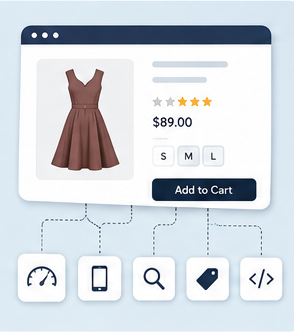
Fashion is visual.
Google Lens and Pinterest send buyers straight to product pages. But only if they can find them.
Most fashion e-commerce stores use file names like “IMG_4821.jpg.” Google has no idea what that image shows. Descriptive names and alt text fix this.
Do that in 5 steps-
- Rename photo files with clear words
- Write alt text (a short photo description) with color, material, and occasion.
- Include both clean product shots and on-model lifestyle images
- Compress every image before upload
Alt text examples:
- “gold hoop earrings for everyday wear”
- “black midi dress for wedding guest”
Optimized images and visuals boost your fashion SEO and help products appear in image search results.
Better visibility attracts shoppers ready to buy exactly what they see. Strong visual SEO ultimately turns browsing into buying for your fashion store.
8. Simplify Your Site Structure
Buried pages rarely rank.
This happens when products sit deep, filters hide collections, URLs bloat, and deep pages lose crawl frequency. Google stops visiting them often. That means your best products never show up in search.
A clean site structure can help. It keeps every page close to the homepage and easy to reach. Google crawls your store more often and indexes new styles faster. Shoppers also move through your catalog without confusion.
Try these moves-
- Keep every product within 3 clicks of the homepage.
- Use plain menu names like Women, Bags, and Jewelry.
- Find pages that nothing links to. A site checker like Screaming Frog can help.
- Add links to those pages.
Say a wallet hides under Accessories, then Small Goods, then Filters. Move “Wallets” to the main menu.
A simple site structure helps fashion pages get found and ranked faster. Easy navigation keeps shoppers moving toward checkout. That way, new styles gain visibility and sales sooner.
9. Create Shoppable Lookbook Pages
A lookbook isn’t just pretty photos.
It works like a content funnel that guides shoppers toward buying. The best ones style a complete look, not just one item.
Shoppers want to see how a dress pairs with a bag and earrings. When they see the full outfit, they buy more pieces at once. That’s the real power of a shoppable lookbook.
How to fix it?
- Pick a theme or color story.
- Style a full look with clothes, a bag, jewelry, and a belt.
- Link each item to its product page.
- Finish with a short intro that names the theme.
- Build a terracotta-and-cream fall edit.
- Aim at searches like “wedding guest outfits summer” or “everyday jewelry stacking”.
Lookbook page ideas: “Wedding guest outfits”, “Festival jewelry stacks”, or “Travel bag essentials”.
This captures browsers and passes authority down. Your accessories get discovered alongside clothing. That’s how you increase average order value through SEO.
10. Target Shopping Occasions & Trends
Shoppers shop moments.
They type “workwear,” “festival outfits,” “wedding guest jewelry,” “carry-on travel bags.”
Your category pages don’t match that intent. But a cross-category landing page does. It pulls from multiple collections to answer the exact question.
Build these pages in 4 steps-
- Build landing pages around occasions, not products
- Pull items from multiple collections onto one page
- Fold micro-trends into your closest evergreen category
- Refresh trend pages every 4-6 weeks
Examples: “Wedding guest guide”, “Festival outfit ideas”, or “Travel accessories”.
Occasion pages capture shoppers searching for specific moments and events. Matching their intent brings higher-quality traffic ready to buy. Besides, fresh trend content keeps your fashion store visible all season long.
11. Earn Fashion Press Backlinks
Pitch a story, not a product.
A backlink is a link to your site from another site. The strongest fashion backlinks point to stories rather than the items.
Journalists don’t link to product pages. They link to interesting stories. For instance, a designer collab. A jewelry line launch. A styling interview.
That’s where your link building should focus.
To earn backlinks-
- Pitch journalists with editorial angles, not product pushes
- Prioritize bloggers with real domain authority over big social followings
- Direct every link to content pages, never the homepage
- Build long-term relationships with 10-15 writers in the fashion niche
Link building targets-
- Fashion bloggers with real authority
- Journalists covering launches
- Styling interviews
- Editorial collaborations
This builds domain strength that paid ads can’t buy. Over time, this authority flows to your product pages.
12. Develop Helpful Sizing Tools
Fit worries kill sales.
Sizing uncertainty always tops purchase anxiety. Shoppers fear buying the wrong size in clothes and accessories. They even abandon carts when they don’t know their size.
This is also one of the primary reasons for returns. Stats say 50% of all online returns happen due to fit issues.
A simple tool removes that doubt. Some ideas are-
- A clothing size calculator by brand and body type.
- A printable ring size chart
- A bag dimension guide with real-world comparisons
- A sunglasses face-shape finder
Don’t forget to include real measurements in cm and inches. Finally, link the tool on your product pages.
Bloggers and stylists cite these tools for years. You don’t even have to ask. They drive backlinks and reduce returns. Both help your SEO and your bottom line.
13. Use Descriptive Anchor Text
Say what you mean.
Anchor text is the clickable words in a link. Terms like “click here” give little context. And this weakens your fashion category and product page relevance.
How to fix it?
- Swap “shop now” for descriptive anchors sitewide
- Use “shop women’s denim” or “shop leather handbags”
- Apply the same logic to every internal link
- Vary anchor text so it reads naturally
| Weak Link | Strong Link |
| Click here | Shop women’s denim |
| Read more | Browse leather handbags |
| Shop now | Explore gold hoop earrings |
This helps Google learn what each page is about. Your strength spreads across the homepage and the catalog. Shoppers also click with more confidence.
14. Turn Reviews Into Content
Let feedback write your copy.
Reviews with star ratings feed your aggregateRating schema. That’s the code behind the stars in search results.
Pages with stars get more clicks. So reviews do double duty. They help shoppers decide, and they help Google rank your page.
Reviews also add fresh words to your product page. Every new review changes the page slightly. Google notices when a page keeps changing. That signals the page is active and worth ranking. You get unique content without writing a single word.
So, to collect and show reviews:
- Ask for a review 7 to 10 days after delivery.
- Ask buyers to add a photo.
- Show fit notes on clothes and quality notes on accessories.
- Add a simple Q&A box to the product page.
Turning reviews into content earns star ratings that boost clicks and shopper confidence. Fresh content keeps pages active, which further helps Google rank them higher.
15. Map Content To Buyer Intent
Match content to mindset.
Buyers are at different steps. Some just started browsing. Some are weighing two options. Some are ready to check out. One blog post can’t serve all three. So build content for each stage.
- Sort your topics into browsing, comparing, and ready to buy.
- Write one page for each topic.
- Link every page to a matching collection.
Example-
| Top-of-funnel | “how to style linen this summer” |
| Mid-funnel | “midi vs maxi dress for weddings” |
| Bottom-funnel | “does this bag fit a laptop” |
This guides shoppers through the journey. They move from browsing to buying naturally. Your content does the selling before they even reach your product page.
Over to You
If you can implement the above 15 fashion ecommerce SEO strategies, your website will always be prioritized by search engines. If you do not have the time and expertise, you may get help from MonsterClaw to help execute the strategies on your behalf to boost your fashion store’s organic SEO performance.
FAQs on Fashion Ecommerce SEO
Review important pages every 3 months. Update product availability, seasonal references, search terms, images, and outdated information based on current customer behavior.
Study customer searches first. Use Google Search Console, keyword tools, competitor pages, and product data to find searches around styles, occasions, materials, and products.
Create a permanent “Drops” category page. Announce drops there with countdown timers, then redirect sold-out product URLs to this page instead of deleting them.
Target conversational long-tail phrases like “where to buy white sneakers near me.” Use FAQ schema, natural language alt text, and answer common styling questions directly on category pages.