



Affiliate marketing can look like a numbers game: clicks, conversions, commissions, and revenue all neatly lined up in a report. But here’s the catch! More clicks don’t always mean better results.
If you really want to know whether your partnerships are driving profitable growth, you need to look beyond surface-level metrics and understand your affiliate marketing ROI.
The real question is: which affiliates are actually bringing in valuable customers, and which ones are simply eating into your budget?
Let’s see how to measure affiliate marketing ROI, identify the metrics that matter, and separate campaigns that look good on paper from those that generally move the needle.
What is Affiliate Marketing ROI?
Affiliate marketing ROI measures the profit your affiliate program returns compared to the total cost of running it. It’s shown as a percentage.
People mix up four terms. Here’s how they differ:
- Revenue: total sales generated.
- Profit: what’s left after costs.
- ROI: profit as a percentage of what you spent.
- ROAS (return on ad spend): revenue earned for every dollar spent on advertising.
High ROI is not a prerequisite for high income. Imagine a campaign that generates 2,000 purchases. However, it has a high refund rate, a deep coupon discount, and a 40% fee. The sales appear to be remarkable. The margin is either negative or very thin.
The average affiliate marketing ROI is a ROAS number, not a profit number. The PMA’s 2021 study, built on PwC data, put average ROAS at 12:1. The newer figure is lower. The PMA’s 2025 study says affiliate programs drove $113 billion in e-commerce sales in 2024, about $8 for every $1 invested. The PMA’s own studies cover the full range of the channel, so your program may land well above or below that average.
The 2018 edition already warned that ROAS varied greatly by advertiser sector. Treat $8 as a ceiling for expectations, not a promise. It also hides a tracking problem. Only 54% of publishers say they trust the accuracy of their affiliate tracking, and just 2% feel very confident.
That gap is why naive ROI and honest ROI differ. Naive ROI divides revenue by commissions paid. That is ROAS on a partial cost base. Most brands miscalculate affiliate ROI because they count only commissions as cost.
Honest ROI starts with margin-adjusted affiliate ROI: take revenue, subtract COGS, returns, discounts, and coupon leakage, then subtract commissions, network fees, and agency or management costs. Divide the net profit by total investment. Then go one level deeper with contribution margin per affiliate.
Calculate each partner’s profit after product costs and payouts, and divide by that partner’s orders. A coupon site with a 12:1 ROAS can lose to a content publisher at 6:1 if the coupon site mostly captures buyers who were already at checkout.
Rank partners by contribution margin, not by ROAS, and you will see which ones actually earn their commission.
Why Affiliate ROI Matters?
ROI turns raw numbers into decisions. It helps you:
- Allocate budget to what works
- Identify your most profitable affiliates
- Find the content and channels that perform
- Set smarter commission rates
- Decide if affiliate marketing is sustainable for your business
Without it, you’re guessing.
How to Calculate Affiliate Marketing ROI?
Affiliate marketing ROI formula:
ROI = (Net Profit ÷ Total Affiliate Costs) × 100
Your revenue, less all affiliate-related expenses and the cost of goods or services, is your net profit. Set precise guidelines for what constitutes a cost. That’s where the majority of individuals make mistakes.
Missing:
- net vs gross affiliate roi
- true affiliate roi formula (with COGS)
What to Include in Affiliate Marketing Costs?
Count everything tied to running the program:
- Affiliate commissions
- Network or platform fees
- Software and tracking tools
- Content production
- Paid traffic
- Salaries or agency fees for program management
- Creative and promotional expenses
- Discounts and coupons
Leave one out, and your ROI looks better than it is.
Commissions are only part of what an affiliate program costs. Most brands miss the rest, and it changes the ROI math.
Total cost formula: Monthly cost equals approved commissions, platform or network fees, management, recruitment, creative, payment costs, and compliance and fraud control.
Hidden costs: Recruitment, creative production, payment fees, and fraud tools. Recruiting top-tier affiliates through agencies and influencers can run $5,000 or more per month.
Software vs. network fees: Software runs a flat $89 to $599 per month with no transaction fees. Networks charge a percentage of your volume instead.
Network override: Awin, CJ, and Rakuten typically charge a 20 to 30% override on top of publisher commissions. Software vendors publish that range, so confirm it in your own contract.
Manager salary: Experienced in-house managers earn $75,000 to $120,000 or more in base pay, before benefits. Outsourcing to an agency typically runs $2,000 to $10,000 per month
Total per month: Most businesses spend $5,000 to $15,000 per month once agency fees, network costs, software, and commissions are combined.
Affiliate Marketing ROI Example and Step-by-Step Calculation
We already know the formula for Affiliate Marketing ROI.
Affiliate marketing ROI formula:
ROI = (Net Profit ÷ Total Affiliate Costs) × 100
Here’s a simple monthly example for an online store:
| Line Item | Amount |
| Affiliate-driven revenue | $50,000 |
| Product costs | $20,000 |
| Affiliate commissions | $7,500 |
| Network fees | $1,500 |
| Tracking software | $500 |
| Content and creative | $2,000 |
| Program management | $2,500 |
Step 1: Add the affiliate costs: $7,500 + $1,500 + $500 + $2,000 + $2,500 = $14,000
Step 2: Find net profit: $50,000 − $20,000 − $14,000 = $16,000
Step 3: Calculate ROI: ($16,000 ÷ $14,000) × 100 = about 114%
For every $1 spent on the program, the business earned $1.14 in profit after covering costs. Swap in your own numbers to test your program.
In case, you may check out: Learn affiliate marketing from scratch as a complete beginner.
ROI vs. ROAS in Affiliate Marketing
These metrics answer different questions. Use them together.
| Metric | What It Measures | Best Used For |
| ROI | Profitability after all costs | Overall business performance |
| ROAS | Revenue per advertising dollar | Campaign efficiency |
| Conversion Rate | Share of visitors who convert | Traffic quality |
| EPC | Earnings per click | Comparing affiliates and offers |
ROAS overlooks margin. Your ROAS is 4:1, and if you spend $5,000 on advertisements and make $20,000. That sounds powerful. However, you can still lose money if your margins are narrow. ROI reveals the reality.
The PMA’s 2025 study found affiliate programs drove $113 billion in e-commerce sales in 2024, about $8 for every $1 invested. That is down from 12:1 in the PMA’s 2021 study. The channel is still growing. Spend rose 49.8% to $13.62 billion between 2021 and 2024.
One 2026 guide projects it will pass $15.5 billion this year. The PMA’s newest data covers 2024. Remember that $8 is revenue per dollar, not profit.
A good ROI is one that beats your break-even point. To find it, divide 1 by your margin after product costs. With a 40% margin, you break even at 2.5:1, so anything above that is profit before program costs. As a rough guide, one benchmark calls 3:1 to 8:1 realistic in year one and 8:1 to 15:1 once a program matures. That range comes from a software vendor, so use it as a guide only.
The newest PMA study covers 2024, so 2026 figures are mostly projections. Affiliate spend grew 49.8%, from $9.1 billion in 2021 to $13.62 billion in 2024. That growth rate is twice the pace of the broader e-commerce market. Affiliate drove $113 billion in sales, or 9.4% of all US e-commerce sales. One 2026 guide projects spend will exceed $15.5 billion to $16 billion this year.
Affiliate ROI benchmarks by industry
The PMA’s 2025 study found travel returns $19 per dollar and retail $11. Inside retail, department stores lead at $21:1, then office supplies at $20:1 and automotive parts at $19:1. Compare your results to your own vertical, not to the overall average.
Affiliate ROI: first year vs. mature program
First year: Expect roughly 3:1 to 8:1. New programs usually need 6 to 12 months to ramp up.
Mature program: Expect 8:1 to 15:1. Another source says programs with optimized partner mixes routinely reach 9:1 to 12:1 by year three.
Both ranges come from vendors, so treat them as estimates.
In 2024, affiliate programs returned an average of $8 in sales for every $1 invested. That is down from $12 per dollar in the PMA’s 2021 study. This is revenue per dollar, not profit per dollar. Subtract product costs and program costs to see what you actually keep.
Relatable Read: Affiliate Outreach Email Templates That Actually Get Replies
The Most Important Affiliate Marketing Metrics to Track

You don’t need fifty metrics. You need the right ones, such as affiliate revenue, conversion rate, Earnings Per Click (EPC), and a few other KPIs. Learn them all in the following.
1/ Affiliate Revenue
Track total revenue, then break it down by:
- Affiliate
- Product
- Campaign
Totals hide the story. Breakdowns show where growth comes from.
2/ Conversion Rate
Conversion Rate = (Conversions ÷ Clicks) × 100
If 1,000 people click and 25 buy, your rate is 2.5%.
Don’t read this metric alone. A partner with a high rate and tiny traffic may add little. Also compare rates by traffic source. Email traffic and social traffic behave differently.
3/ Earnings Per Click (EPC)
EPC = Total Earnings ÷ Total Clicks
EPC shows the value of each click. It helps when comparing offers and affiliates on an equal footing. Merchants use it to determine which partners generate valuable traffic. It helps affiliates choose which offerings to advertise.
4/ Average Order Value (AOV)
AOV = Total Revenue ÷ Number of Orders
Your fixed costs are distributed over greater revenue with a larger AOV. Verify the affiliates that send larger baskets. Even with lower order counts, certain partners might merit greater consideration.
5/ Customer Acquisition Cost (CAC)
CAC = Total Acquisition Costs ÷ New Customers
Calculate it independently for affiliates. Next, contrast it with the client lifetime value. If clients continue to make purchases, a CAC that appears high can nevertheless be acceptable.
6/ Customer Lifetime Value (LTV)
Revenue from initial purchases rarely provides a whole picture. Certain affiliates draw one-time shoppers. Others attract devoted, recurring customers. You see the difference with LTV. Consider long-term value while evaluating partners, not simply the initial order.
7/ Refund and Cancellation Rate
Refunds lower actual profit.
Even though a significant portion of those sales are returned, a partner may report high conversion rates. Prior to evaluating performance, always deduct refunds and cancelations. ROI is frequently overstated by reported conversions.
8/ New vs. Returning Customers
Ask one question: did this affiliate bring someone new?
If most affiliate sales come from existing customers, you may be paying commission on sales you’d have earned anyway. Segment new and returning buyers to measure real, incremental growth.
If you are interested in learning more about affiliate marketing key performance indicators (KPIs), check this article out.
How to Track Affiliate Marketing Performance?
Good decisions need clean data. Here’s how to get it.
Use Affiliate Tracking Software
Solid tracking software should cover:
- Click tracking
- Conversion tracking
- Commission tracking
- Sub-ID tracking
- Attribution
- Fraud detection
- Performance reporting
Sub-IDs are particularly noteworthy. Partners can tag traffic by placement, post, or page. The precise placement that influences sales may then be seen.
Use UTM Parameters
UTM parameters are tags added to your URLs. They tell your analytics tool where visitors came from. Standard UTM fields include:
- utm_source: where the visit came from
- utm_medium: the channel type
- utm_campaign: the campaign name
- utm_content: the specific link or creative
- utm_term: a keyword, if relevant
Add a partner ID as a custom parameter. Keep naming consistent. “Email” and “email” can show up as separate rows in reports.
Connect Affiliate Data With Analytics and CRM Data
Affiliate platforms show clicks and sales. They often miss the rest. Connect them with:
- Website analytics
- Your e-commerce platform
- Your CRM
- Payment data
- Refund data
- Customer lifetime value
This gives you a complete picture, from first click to repeat purchase.
Track Performance by Affiliate
Build a simple scorecard for each partner. Compare:
- Traffic
- Conversions
- Revenue
- Costs
- Profit
- ROI
Review it side by side. Patterns jump out fast.
Relatable Read: Affiliate Recruitment Strategy: How to Build a 100+ Affiliate Network in 6 Months
Affiliate Marketing Attribution: Who Actually Gets Credit?
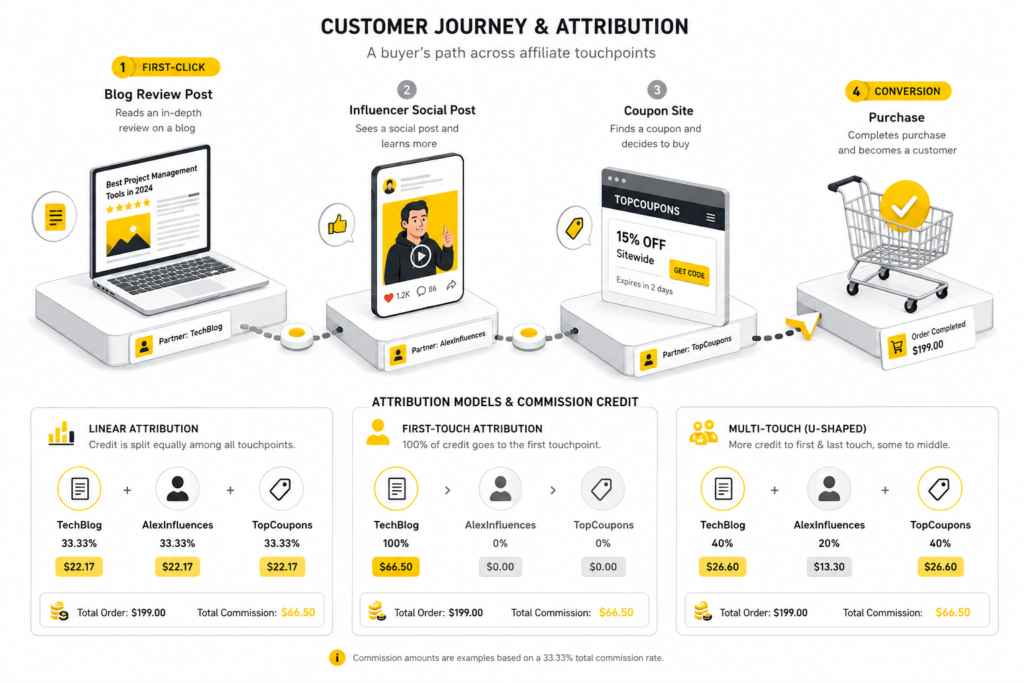
A customer rarely clicks once and buys. They read a review. They see a comparison. They return through a coupon site. Which partner earns the credit?
That’s an attribution. The model you choose changes who looks like a winner.
Last-Click Attribution
The final touchpoint gets 100% of the credit.
Pros: It’s simple and widely supported.
Cons: It ignores everything that happened earlier. Coupon and deal sites often win under this model, even when a review site did the persuading.
First-Click Attribution
All credit is given to the initial touchpoint. This methodology is useful for determining which partners raise awareness and attract new audiences.
Linear Attribution
Credit is distributed equally throughout all touchpoints. It recognizes the entire voyage. However, it does not distinguish between a decisive review and a casual mention.
Multi-Touch Attribution
The technique evaluates a number of touchpoints according to their impact. It most accurately depicts actual consumer journeys. Better tracking and data are also required.
Coupon Code and Influencer Attribution
Some channels are harder to measure:
- Coupon sites may grab last-click credit from a shopper who was already about to buy.
- Creators and influencers often drive purchases through codes, not links.
- Cross-device journeys break tracking. Someone reads a post on their phone and buys on a laptop.
No model is perfect. Pick one, understand its blind spots, and stay consistent.
How Attribution Changes Your Affiliate ROI
Your attribution model decides who gets paid, so it changes your ROI before a single sale happens. Last-click gives 100% of the commission to the affiliate whose link was clicked most recently. That is how coupon sites steal credit. Coupon sites, loyalty programs, and toolbar extensions insert themselves at checkout, so they capture last clicks.
They can intercept a shopper who is already buying and claim a sale they never influenced. Commission dollars drift away from the reviewers and creators who built the intent. Your ROAS looks fine, but your margin-adjusted ROI drops.
Three multi-touch models spread the credit instead:
- Linear: Every touchpoint gets equal credit.
- Time decay: Credit grows the closer a touchpoint sits to the sale
- Position-based: The first and last touchpoints usually get 40% each, and the middle touches split the rest.
No model wins everywhere. Start with last-click, then test position-based or time decay once your partner mix includes content creators and comparison sites. Match the model to your goal.
If the program exists to create demand, lean toward first-click or position-based. If it drives late-funnel conversion, last-click with strong de-duplication works. De-duplication means one order pays one partner, even when several channels claim it. Pair it with a rule for coupons. Code attribution works differently from link attribution.
A code credits whoever’s code was used at checkout, no matter where the click came from. A shopper can read a creator’s review, click a coupon site, and leave with the creator’s code. The link says coupon site. The code says, creator. Decide in advance which one pays.
The same problem exists across channels. A buyer can reach a product page from Perplexity on Monday and buy from a branded Google search on Thursday. Last-click credits Google. Review affiliate results next to your other channels, not in isolation.
Tracking Affiliate Sales After iOS Changes and AI Search
Browser privacy rules have weakened cookie tracking. Apple’s ITP now blocks third-party cookies and deletes script-writable storage after seven days of Safari use without a visit to the site. A sale that closes on day eight can lose its affiliate. Cookieless tracking fixes this by moving the handshake to your servers. With server-to-server postbacks, your server sends the click ID and conversion data straight to the tracking platform. Coupon-based attribution also works without cookies. These claims come from tracking-software vendors, so test them on your own traffic.
AI search adds a newer gap. Copying a link out of an AI answer and pasting it into a new tab removes the referrer. Google AI Overviews carry the same google.com referrer as a normal organic click. Only ChatGPT’s web search mode and Microsoft Copilot add UTM parameters automatically. So some AI-driven sales show up as direct traffic or as someone else’s last click. Report what you can confirm. Classify sessions by UTM and referrer together, not referrer alone. Then report confirmed AI referrals separately from estimated, unattributed traffic.
How to Measure Affiliate Content ROI?
If you publish affiliate content, treat each piece as an investment.
Identify Content That Drives Conversions
Compare formats:
- Product reviews
- Comparisons
- Tutorials
- Buying guides
- Listicles
- Case studies
Some formats attract traffic. Others convert it. Know which is which.
Measure Content-Assisted Conversions
Not every article closes the sale. Some start the journey. Track:
- Direct conversions
- Assisted conversions
- Organic traffic
- Returning visitors
An article with few direct sales may still be an important first step.
Compare Content Cost Against Long-Term Revenue
Content keeps earning over time. So include:
- Production costs
- Update costs
- Link-building and promotion costs
- Revenue earned over months, not days
A guide that costs $800 and earns steadily for a year may beat a quick post that spikes and fades.
Unit Economics: LTV, CAC & Payback
Relatable Read: High-Ticket Affiliate Marketing: 20 Programs to Try in 2026
Common Affiliate Marketing ROI Mistakes
Avoid these errors:
- Measuring revenue instead of profit. Revenue is only the starting line.
- Ignoring affiliate and network fees. They add up.
- Using vanity metrics. Clicks and impressions don’t pay bills.
- Skipping refunds. Returned sales aren’t real sales.
- Ignoring customer lifetime value. You may cut a partner who brings your best long-term buyers.
- Relying on last-click alone. It hides the partners who build demand.
- Not tracking at the affiliate level. Blended averages hide problems.
- Mixing new and returning customers. You can’t see true growth that way.
Revenue ignores product costs, discounts, and program costs. A 10:1 ROAS sounds strong. On a 30% margin, $10 of revenue is only $3 of gross profit per $1 spent, before platform fees and salaries.
Refunds cancel the sale, but the commission may already be paid. Fake or returned orders are a known route to unearned commission, so your terms should allow commission reversal. Subtract returns before you calculate ROI.
Last-click rewards whoever appears last. Coupon sites are structurally positioned to claim the last click on demand your paid media, email, or organic search already drove. Your content partners look weak, and your coupon partners look brilliant.
An affiliate can bid on your brand terms, intercept a customer already looking for you, and collect a commission. You pay for the ad click and the commission on one sale. That double-counted payout distorts your ROI calculations. Ban brand bidding in partner terms, including brand-plus-coupon variants and misspellings.
A private code meant for email subscribers can end up on a public coupon site, and you pay commission on a sale the affiliate did not influence. Customers who would have bought anyway also use the code, which leaks margin. Partner-locked codes and redemption tracking by source close the gap.
The PMA’s 2025 average of about $8 per $1 invested blends every sector and measures revenue, not profit. Beating it does not mean your program makes money.
Published benchmarks define ROI differently. Many come from software vendors with something to sell. Most count revenue per dollar and ignore refunds, margin, and incrementality. Use them as a rough range, not a target.
EPC is total affiliate earnings divided by total clicks. Coupon partners post high EPC because shoppers go looking for codes at the moment of purchase. A review site that builds demand earlier scores lower. EPC also reflects your commission rate and order value, not profit. Compare EPC only within the same partner type.
Verticals differ widely. Travel returned $19 per dollar and retail $11, and within retail, department stores hit $21:1. A retail brand judged against a travel benchmark will always look weak.
One benchmark puts year one at 3:1 to 8:1 and a mature program at 8:1 to 15:1. New programs usually need 6 to 12 months to ramp up. Judging month six against a mature benchmark makes a healthy program look like a failure.
How to Improve Affiliate Marketing ROI?
Once you know where you stand, improve what matters.
Focus on High-Performing Affiliates
Give your best partners more support. Share early product news, exclusive offers, and fresh creative. Strong partners grow when you invest in them.
Increase Conversion Rates
Small fixes add up:
- Faster, clearer landing pages
- Stronger offers
- Better product pages
- Clearer calls to action
Increase Average Order Value
Try bundles, upsells, and cross-sells. A higher AOV makes every affiliate sale more profitable.
Negotiate Commission Structures
Flat rates rarely fit everyone. Consider:
- Tiered commissions that reward volume
- Performance bonuses for hitting targets
- Product-specific rates that reflect your margins
Eliminate Low-Quality Traffic
Cut what drains your budget:
- Fraudulent traffic
- Incentivized traffic, where it doesn’t fit your program rules
- Placements that never convert
Invest in High-Intent Content
Shoppers who search for “best,” “vs.,” and “review” terms are close to buying. Support content built around:
- Comparison keywords
- “Best” keywords
- Review searches
- Product-specific searches
An Affiliate Marketing ROI Dashboard: What Should You Track?
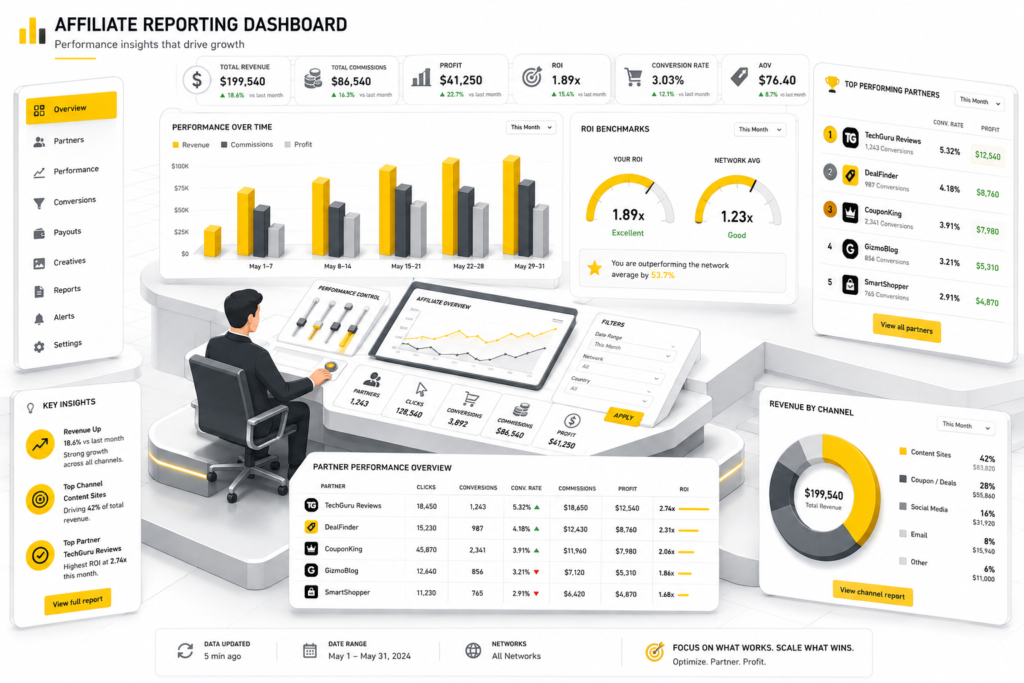
One dashboard should answer most of your questions. Include:
Top-level KPIs
- Affiliate revenue
- Affiliate profit
- ROI
- ROAS
- Total conversions
Performance metrics
- Clicks
- Conversion rate
- EPC
- AOV
- CAC
- LTV
- Refund rate
Partner metrics
- Revenue per affiliate
- Profit per affiliate
- ROI per affiliate
- New customers per affiliate
Content metrics
- Revenue per article
- Conversion rate by page
- Assisted conversions
- Revenue per visitor
Keep it simple. A dashboard nobody reads is useless.
How Often Should You Measure Affiliate Marketing ROI?
There’s a healthy way to measure affiliate marketing ROI. If you track one metric in today’s morning and another the next afternoon, it will just waste your time.
Weekly
- Traffic
- Conversions
- Revenue
- Tracking issues (broken links or missing conversions)
Monthly
- Affiliate profitability
- Campaign performance
- Commission costs
- ROI trends
Quarterly
- Partner portfolio
- Customer LTV
- Attribution model
- Budget allocation
- Overall program strategy
Affiliate Marketing ROI Benchmarks: What Is a Good ROI?
There’s no universal answer. Anyone who gives you one number for every business is guessing.
A good ROI depends on:
- Your industry
- Gross margins
- Product price
- Customer lifetime value
- Commission structure
- Traffic acquisition costs
A software company with high margins and recurring revenue can accept a very different ROI than a retailer selling low-margin goods.
Instead of chasing an outside number, compare against:
- Your own history: Are you improving?
- Other acquisition channels: Is affiliate beating paid search or email?
- Internal profit targets: Does it meet what your business needs?
Missing Points:
- How to set an affiliate roi target
- Internal affiliate roi baseline
- Blended marketing roi vs affiliate roi
- affiliate roi target from unit economics
Affiliate Marketing ROI Measurement Checklist?
Use this as a quick ROI measurement audit:
- Track every affiliate and campaign
- Calculate revenue and profit separately
- Include all affiliate-related costs
- Track conversion rate and EPC
- Measure CAC and LTV
- Account for refunds and cancellations
- Use an attribution model that fits your program
- Segment new and returning customers
- Evaluate profitability by affiliate
- Review ROI on a regular schedule
- Scale profitable campaigns
- Optimize or remove campaigns that stay unprofitable
Relatable Read: 12 Best B2B Affiliate Programs in 2026 (With Buyer’s Guide)
Final Words on Affiliate Marketing ROI
Judge affiliate marketing on profit, not revenue.
Track results by affiliate, campaign, content piece, product, and customer. Pair short-term metrics like conversion rate and EPC with long-term ones like CAC and LTV. Choose your attribution model carefully, and know its limits.
Then act on what you find. Put more resources behind what’s earning real profit. Fix or drop what isn’t.
If it feels daunting to balance the intricacy of profit, loss, and ROI calculations, do not worry. MonsterClaw can help!
Our team of expert marketers will treat your business as your own and provide you with the maximum return on your investment within 3 months. Book a call now.