


Affiliate marketing can drive serious revenue, but not every conversion is as clean as it looks.
Fake leads, cookie stuffing, misleading promotions, and other tactics can quietly eat into your budget.
Let’s explore how to spot affiliate marketing fraud, stop suspicious activity, and keep your program profitable without slowing down legitimate partners.
What is Affiliate Marketing Fraud?
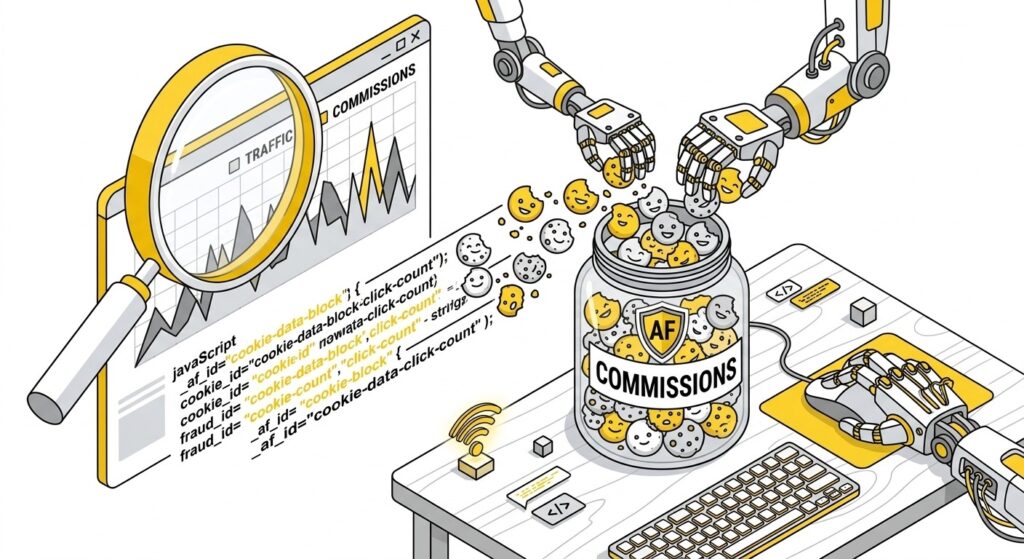
Affiliate marketing fraud is the manipulation of tracking, traffic, or conversions to collect commissions that were not legitimately earned.
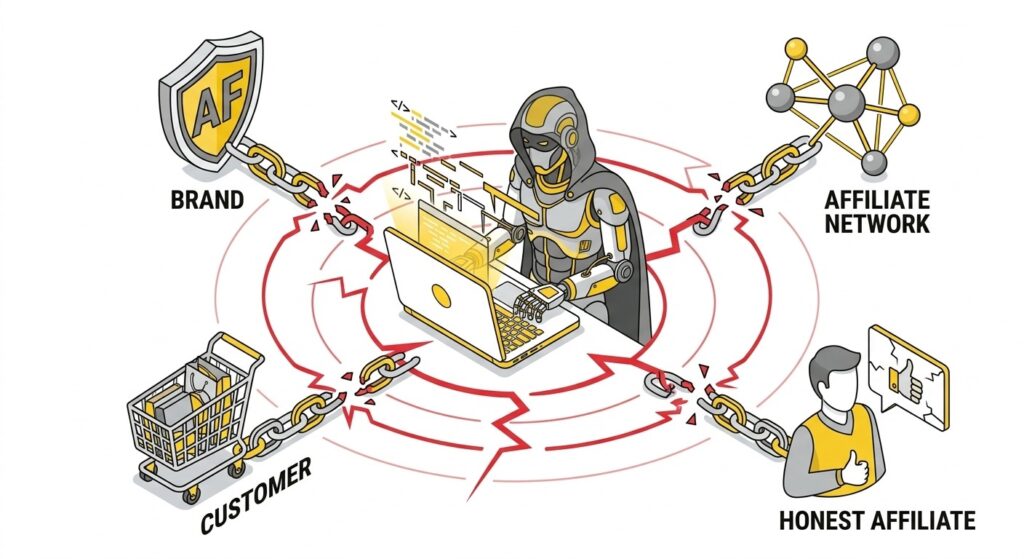
Fraud hurts more than the advertiser:
- Brands pay for fake or stolen sales.
- Affiliate networks lose credibility.
- Honest affiliates lose commissions to cheaters.
- Customers may get misleading offers or spam.
How Does it Work?
Most schemes fall into a few buckets:
- Fake traffic: Bots or click farms generate clicks.
- Cookie and link manipulation: Affiliate cookies get set without a real click.
- Fake or incentivized conversions: Bogus leads, stolen card orders, or users paid to sign up.
- Attribution hijacking: A fraudster inserts themselves at the last click.
- Commission abuse: Self-referrals, duplicate orders, or sales that get refunded after payout.
Why Affiliate Fraud is a Problem for Brands
The commission is just the beginning. Additionally, fraud brings:
- Reduced income and increased expenses for acquiring new clients
- You finance the wrong channels because of incorrect attribution.
- Commission leakage on sales that would have occurred anyway
- Customers of poor quality who charge back, cancel, or refund
- Risk to one’s reputation and legal standing if partners violate advertising regulations
The most expensive aspect can be poor data. A program that you don’t trust cannot be optimized.
Common Types of Affiliate Marketing Fraud
Fraudulent affiliates around the world use many shady tactics to cash in on the system.
Such as:
1. Cookie Stuffing
Without the visitor visiting an affiliate link, the affiliate places a tracking cookie on the visitor’s browser. The fraudster is rewarded if the person goes on to make a purchase.
Warning signs: high conversions with very few clicks, traffic from pages with hidden iframes or pixels, and conversions from users who never visited the affiliate’s site.
Example: In a well-known U.S. case, Brian Dunning pleaded guilty to wire fraud in 2014 over a cookie stuffing scheme that targeted eBay’s affiliate program. Prosecutors said it defrauded the company of more than $5 million.
2. Click Fraud
Bots or low-quality traffic generate clicks to inflate numbers or trigger payouts, especially in pay-per-click deals.
Watch for:
- Bursts of clicks in short windows
- Clicks from data-center IP ranges
- Near-zero time on site
- Identical user agents or devices
3. Conversion Fraud
Someone fakes the action you pay for. That could be fake purchases, duplicate conversions, or automated form fills.
Common signs are the same email pattern repeated, matching payment details, and orders that later get refunded or charged back.
4. Adware and Browser Extensions
Affiliate links are injected during the checkout process by certain browser extensions and adware. They take the credit at the last minute and replace the partner’s referral that actually led to the transaction.
The tell is a conversion that frequently comes from a partner with no actual content and occurs seconds after an extension-style event.
5. Brand Bidding and PPC Abuse
When your rules prohibit it, affiliates bid on your trademarks or brand name. They take advantage of people who were already searching for you in order to profit from a sale that you would have made anyhow.
Regularly look up your brand terms in search results. Search for advertisements that lead to affiliate links.
6. Coupon and Promo Code Abuse
Coupon sites can be legitimate. Problems start when they:
- Publish codes they were never given
- List expired or fake offers
- Insert themselves at checkout after the customer has already decided to buy
If a coupon site shows a high share of conversions on customers who were already in checkout, take a closer look.
7. Domain and Traffic Source Fraud
Some partners hide where their traffic really comes from. They use misleading sites, cloaked pages, or banned tactics like spam or incentivized traffic.
Approve traffic sources in writing, then verify them.
8. Self-Referral and Transaction Fraud
An affiliate can make purchases using their own link, pals, duplicate accounts, or fictitious identities. Keep an eye out for cyclical purchases, shared IP addresses, and repeated shipping information.
9. Lead Fraud
Fake names, repeated submissions, forms filled out by bots, and leads with no intention of making a purchase are examples of fraud in lead-generation systems. Sales teams are the first to notice. Their rates of contact decline.
How to Detect Affiliate Marketing Fraud
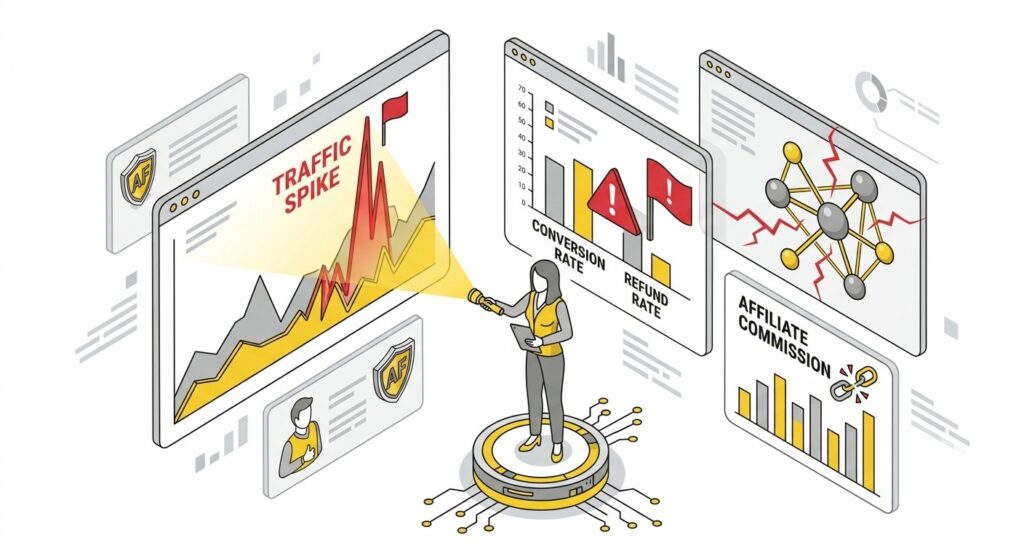
No single metric catches everything. Combine several signals and look for patterns.
Monitor Unusual Traffic Patterns
Watch for:
- Sudden spikes with no campaign to explain them
- Unexpected countries
- Very high click volume with low engagement
- Traffic at odd hours
Analyze Conversion Rates
Assess each affiliate’s rate in relation to both their own past performance and that of comparable partners. Examine abrupt leaps. Next, divide the traffic by device, geography, affiliate, campaign, and traffic source. A bad part can be concealed by a rate that appears fine overall.
Check Click-to-Conversion Timing
Real buyers take time. Flag:
- Conversions seconds after the click
- Repeated identical intervals
- Suspiciously consistent behavior
Look for Duplicate or Repeated Customer Data
Run checks for duplicate emails, shared payment details, repeated IP addresses, similar device fingerprints, and multiple accounts tied to one source.
Monitor Customer Quality After Conversion
Fraud often looks great at the point of sale. It falls apart afterward. Track:
- Refund and chargeback rates
- Cancellations
- Trial-to-paid conversion
- Lifetime value
- Repeat purchases
Analyze Affiliate-Level Anomalies
Create a single dashboard for each affiliate. Clicks, revenue, commission, refunds, chargebacks, EPC (profit per click), customer quality, and traffic sources should all be included. When everything is arranged side by side, outliers quickly become noticeable.
Investigate Attribution Anomalies
Check for these patterns:
- Affiliates winning last-click credit far more often than peers
- Cookie activity you can’t explain
- Conversions right after unrelated touchpoints such as an email or paid ad
- One partner taking a disproportionate share of credit
Relatable Read: High-Ticket Affiliate Marketing: 20 Programs to Try in 2026
Affiliate Fraud Detection Tools and Technologies
Affiliate Tracking Platforms
Basic problems like duplicate orders, click spikes, and strange geos are flagged by the majority of tracking tools. Your first line of defense is them. Examine what is and is not covered by yours.
Fraud Detection Software
Dedicated tools add layers such as:
- Bot detection
- IP analysis
- Device fingerprinting
- Behavioral analysis
- Traffic-quality scoring
- Automated anomaly detection
Analytics and BI Tools
Link affiliate data to chargeback records, payment information, site analytics, your CRM, and support tickets. The holes between systems are where fraud lurks. These gaps are filled with joined-up data.
Manual Affiliate Audits
Software looks for trends. Context is judged by people. A bot burst can be distinguished from a viral blog article by a human reviewer. Include both in your procedure.
How to Prevent Affiliate Marketing Fraud
Create Clear Affiliate Program Rules
Put it in writing. Cover:
- Allowed traffic sources
- Banned promotional methods
- PPC and brand bidding rules
- Coupon policy
- Incentive restrictions
- Self-referral rules
Clear terms also give you the right to withhold commissions when someone breaks them.
Vet Affiliates Before Approval
Review each applicant’s:
- Website quality
- Traffic sources
- Audience fit
- Promotion methods
- Past performance
- Reputation
Visit the site. Read the content. Search their name.
Use Tiered Affiliate Access
Not every partner takes the same level of investigation. For new affiliates, seasoned partners, high-volume partners, and high-risk traffic sources, establish distinct levels of approval and monitoring.
Implement Conversion Validation
Before you pay:
- Validate transactions
- Catch duplicates
- Check for refunds and cancellations
- Review suspicious orders
- Use a holding period, such as your refund window
Set Up Real-Time Alerts
Set off alarms for unexpected geographic locations, high refund rates, chargebacks, abrupt commission increases, traffic spikes, and conversion anomalies.
Conduct Regular Affiliate Audits
Set a rhythm:
- Monthly performance reviews
- Traffic-source audits
- Compliance checks
- Commission reviews
- Random transaction sampling
Relatable Read: 12 Best B2B Affiliate Programs in 2026 (With Buyer’s Guide)
Affiliate Fraud Red Flags: A Brand-Side Checklist
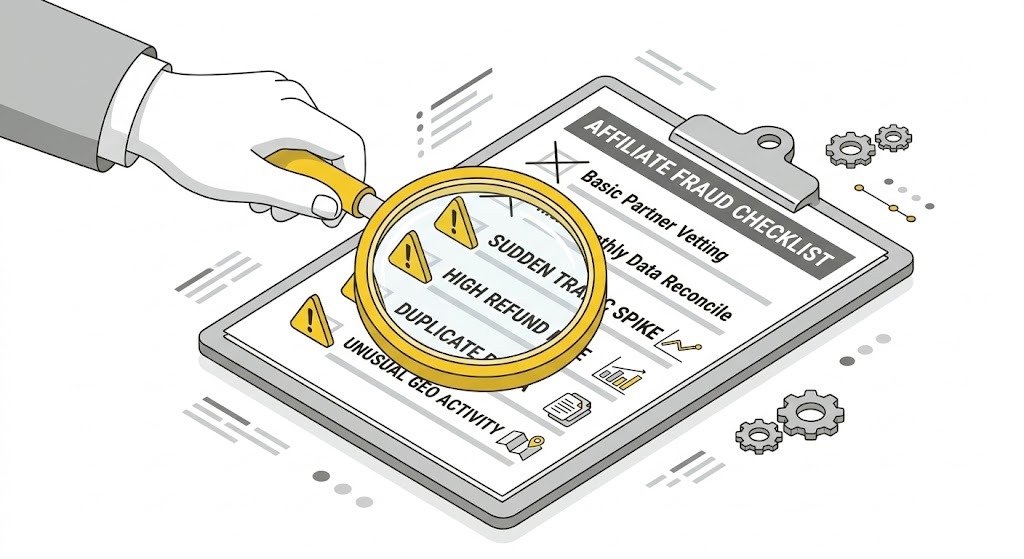
| Red flag | What it may indicate | What to check |
| Sudden traffic spike | Automated or low-quality traffic | Traffic source, server logs |
| Extremely high conversion rate | Conversion manipulation | Conversion events |
| High refund rate | Low-quality or fraudulent sales | Order data |
| Duplicate customer information | Self-referrals or fake accounts | CRM, payment data |
| Unusual geo activity | Proxy/VPN use or traffic manipulation | Geographic reports |
| Repeated click patterns | Automation | Click timestamps |
| Brand PPC violations | Unauthorized bidding | Search and ad monitoring |
| Unexpected coupon usage | Coupon attribution abuse | Promo-code data |
How to Investigate a Suspicious Affiliate
Use the same steps every time. It keeps you fair and gives you a paper trail.
Step 1: Identify the Anomaly
What changed? When? Which affiliate or campaign?
Step 2: Segment the Data
Analyze performance by landing page, campaign, customer, device, location, traffic source, and conversion time. Usually, the issue is limited to one slice.
Step 3: Validate the Conversions
Verify actual transactions. Examine the client’s information. Compare your internal records with the affiliate’s reported data.
Step 4: Review Traffic Sources
Find where the traffic actually came from. Confirm the methods match your program terms.
Step 5: Review Commission Eligibility
Where your terms allow it, hold questionable commissions. Remove invalid transactions. Document everything.
Step 6: Decide on Remediation
Pick the response that fits the evidence:
- Warning
- Commission adjustment
- Temporary suspension
- Termination
- Further investigation
Relatable Read: Affiliate Marketing KPIs: 14 Metrics, Benchmarks + Formulas
How Much Does Affiliate Fraud Cost Brands?
It costs more than the commission.
Direct Costs
- Fraudulent commissions
- Fake leads
- Invalid sales
- Chargebacks
Indirect Costs
- Distorted analytics
- Higher acquisition costs
- Staff time spent investigating
- Missed opportunities because budget went to the wrong partners
- Strained relationships with honest affiliates
How to Calculate Affiliate Fraud Losses?
Use this simple formula:
Estimated fraud loss = invalid commissions + associated transaction losses + operational costs
The details depend on your model. A SaaS brand will count refunded subscriptions. An ecommerce brand will count product, shipping, and chargeback fees. Treat the result as an estimate, not an exact number.
Affiliate Marketing Fraud Prevention Best Practices
Keep this list handy:
- Vet affiliates before approval.
- Set explicit program terms.
- Monitor traffic continuously.
- Validate conversions before paying.
- Track customer quality after the sale.
- Watch PPC and brand bidding.
- Audit coupon and incentive activity.
- Use automated anomaly detection.
- Keep detailed records.
- Review high-volume affiliates regularly.
- Update your rules as new abuse patterns appear.
How to Build an Affiliate Fraud Monitoring System?
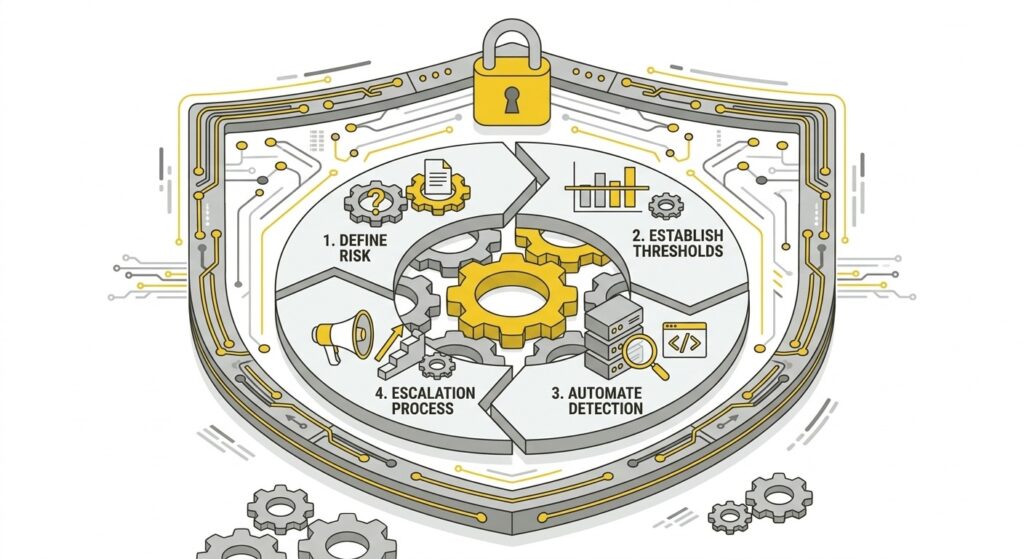
Define Your Risk Signals
Group them into five buckets:
- Traffic anomalies
- Conversion anomalies
- Customer-quality anomalies
- Attribution anomalies
- Compliance violations
Establish Thresholds
Establish trigger points for abrupt increases in traffic, odd shifts in conversion rates, high rates of refunds or chargebacks, and rapid commission growth. Make them based on your personal past. It is not possible to replicate the numbers of another brand.
Automate Detection
Use real-time alerts, rules-based monitoring, anomaly detection, and automated transaction review. Let software do the watching.
Create an Escalation Process
Decide in advance who handles:
- Low-risk anomalies
- Suspicious affiliates
- Commission disputes
- Serious fraud cases
Name owners. Set response times.
Final Thoughts on Affiliate Marketing Fraud
Affiliate fraud is a monitoring, attribution, and data-quality problem. No single metric catches every bad actor.
Combine affiliate-platform data with transaction, customer, traffic, and behavioral data. Start prevention before approval and keep going through validation and ongoing review.
Want a second set of eyes on your program? MonsterClaw’s performance and affiliate marketing team can run an affiliate program review and fraud audit, so you know exactly where commissions are leaking and how to stop it. Book your affiliate fraud audit with MonsterClaw today.
Frequently Asked Questions (FAQs)
It involves manipulating clicks, conversions, or attribution to obtain commissions that weren’t rightfully earned.
There is no one trustworthy figure. Published estimates differ greatly depending on the approach and source. Monitoring should be considered routine procedure because any program that rewards success is a potential target.
Examine a number of indicators at once, such as strange traffic, abnormally high conversion rates, quick click-to-sale timing, duplicate client information, and high refunds.
Adware hijacking, brand bidding, coupon abuse, self-referrals, click fraud, conversion fraud, cookie stuffing, and lead fraud.
Examine partners, draft precise conditions, verify conversions prior to payment, keep a close eye on things, and conduct regular audits.
In order for the affiliate to receive credit for subsequent sales, it involves installing an affiliate cookie on a user’s browser without a real click.
Typically, networks employ manual review, publisher screening, duplicate identification, and traffic analysis. Each network has different capabilities, so find out what yours includes.
Yes. Bots are capable of creating clicks, filling out forms, and mimicking visits. Behavioral and device-level inspections are important because of this.