


You are a business owner trying to grow organic traffic. Now you are stuck on a decision: build the skill inside your company, or bring in outside specialists who already have it.
Think about what you actually need. Do you want someone who lives and breathes your brand, sits in on product meetings, and answers to you directly? Or do you want a full bench of specialists — technical SEOs, content strategists, link builders — without the cost of hiring five people?
Do you need speed, or do you need control? Do you have the budget for one strong in-house hire, or would that same money buy you a team’s worth of expertise through an agency? Can you afford to wait out a hiring process, or does your competitor’s site already outrank yours today?
The SEO agency vs. in-house debate isn’t just about comparing monthly costs. It’s also about weighing expertise, hiring overhead, scalability, tools, and the results each model can realistically deliver for a business like yours.
Let’s break down the true costs and benefits of both approaches, so you can decide which setup fits your business, your budget, and where you want to be in a year.
TL;DR
- Agencies provide broad, scalable expertise and tools, while in-house teams offer deep brand knowledge, direct control, and faster internal collaboration.
- Agencies bring scale and expertise; in-house teams bring brand depth and faster execution.
- The best choice depends on your company’s stage and industry, with a hybrid approach often working best.
SEO Agency vs. In-House: What’s the Difference?
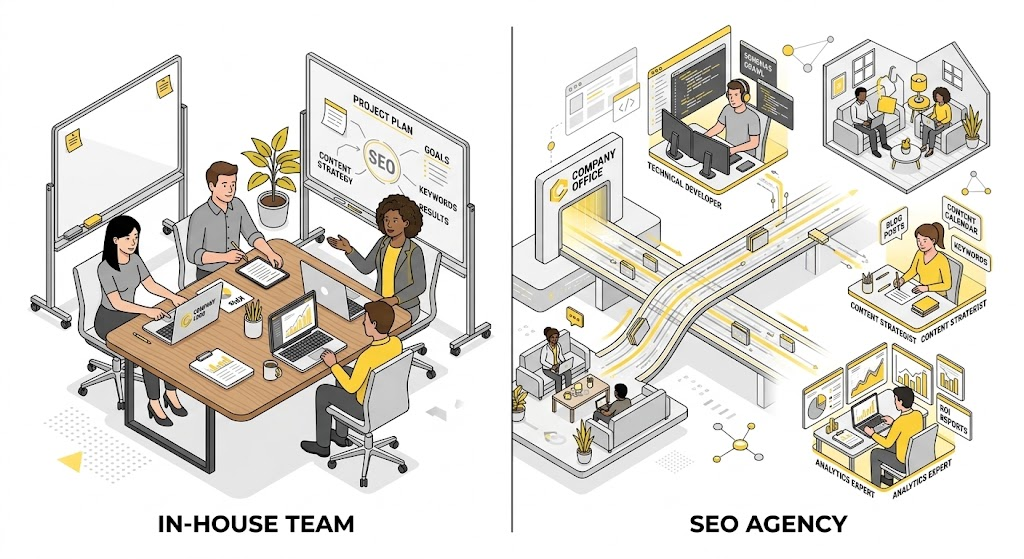
| Factor | SEO agency | In-house team |
| Upfront hiring | Lower | Higher |
| Ongoing labor costs | Predictable fee | Salary + benefits |
| Specialized expertise | Broad access | Depends on the team |
| Brand knowledge | Takes time to build | Deep |
| Control | Shared | High |
| Scalability | Usually easier | Requires hiring |
| Management | Agency-managed | Internal |
| Tools | Often included | Additional expense |
| Institutional knowledge | Limited | Strong |
| Flexibility | High | Depends on staffing |
What Is an In-House SEO Team?
Your own employees. That could be one SEO specialist or a manager leading specialists in content marketing and technical work. They sit inside your company and work directly with product, sales, and developers.
What Is an SEO Agency?
An outside firm. You get strategists, technical SEOs, writers, and link builders, usually led by an account manager. You’re buying access to a team, not one person’s skill set.
What Is a Hybrid SEO Model?
A mix of both. An internal SEO lead owns strategy and brand fit. An agency handles specialist work like technical audits or digital PR.
Relatable Read: How to Choose an SEO Company: 11 Questions to Ask Before Signing
SEO Agency vs. In-House Cost Comparison
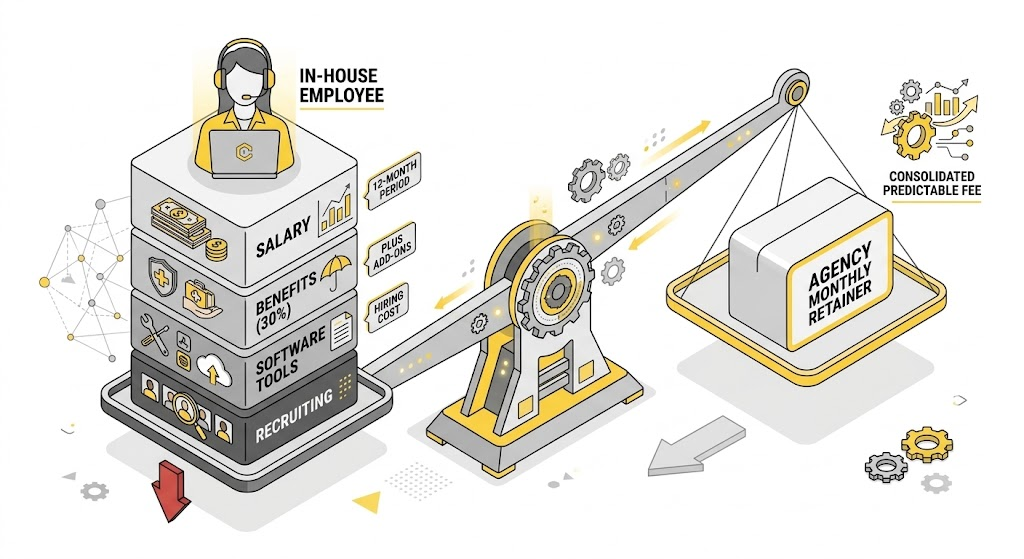
A salary isn’t the full cost of a hire, and a retainer isn’t the full cost of an agency. Both numbers hide extra spending that only shows up once you’re already committed. Here’s what each model actually costs once every line item is on the table.
Direct In-House SEO Costs
Salary is the biggest line. The average annual cost of direct in-house SEO ranges from $65,000 to $180,000+ for a single manager or specialist and from $350,000 to $540,000+ for a small in-house team.
Benefits are bigger than most people expect. In June 2026, benefits made up 30% of private-industry employer compensation costs, and 31.5% for full-time workers. By my math on those BLS figures, a full-time wage dollar costs roughly $1.46 once benefits are included.
Hidden In-House SEO Costs
- Turnover: Replacing a specialist means new recruiting, new onboarding, and lost momentum.
- Management time: Someone has to lead, review, and unblock the work.
- Hiring delays: Every empty month is a month without SEO progress.
- Skill gaps: One person rarely covers technical SEO, content, analytics, and outreach.
- Opportunity cost: Time spent building a team is time not spent ranking.
SEO Agency Costs
Agencies bill in three main ways: monthly retainers, hourly consulting, and projects.
On average, businesses spend between $500 and $5,000 per month on SEO agency services, with global monthly retainers often clustering around $2,917.
Cost Comparison
| Cost category | In-house | SEO agency |
| Salary/retainer | Roughly $62K–$71K for a specialist, on average | About $3,209/month on average (~$38.5K/year) |
| Benefits | Roughly 30% of total compensation cost | Built into the fee |
| Recruiting | Job ads, recruiter fees, interview time | None |
| SEO software | Your budget | Often partly included; confirm |
| Training | Courses, conferences, ramp-up time | The agency’s cost |
| Specialized expertise | One person’s skills | A team’s mix of skills |
| Management overhead | Your manager’s time | An account manager, plus your review time |
| Scalability | Requires new hires | Adjust the scope by contract |
Here’s a quick illustration. Take a $70,000 specialist. At the full-time benefits rate, that’s about $102,000 before software, recruiting, and management time. An agency at the average retainer costs about $38,500 a year.
That gap looks big. But you’re comparing one person against a team, and agency scope varies by retainer. Price the work, not the headcount.
Relatable Read: How Much Does SEO Cost in 2026?
The Benefits of Hiring an SEO Agency
Cost is only half the story. The other half is what that cost actually buys. And agencies tend to earn their fee here.
1. Access to Multiple SEO Specialists
One retainer can bring technical SEO, content strategy, on-page work, digital PR, and analytics under one roof. Hiring that range in-house means several salaries.
2. Faster Access to Expertise
You skip months of recruiting. Good agencies arrive with built workflows and cross-industry experience.
3. Lower Infrastructure Costs
Agencies already pay for crawlers, rank trackers, research tools, and reporting platforms. Ask which of these your retainer includes.
4. Easier Scalability
Need more help for a site migration or product launch? Scope can go up. Slow quarter? It can come back down. Try doing that with an employee.
5. Exposure to Multiple SEO Strategies
Agency teams see patterns across many sites. They spot algorithm shifts, test ideas on several clients, and bring what works to yours.
The Benefits of Building SEO In-House
1. Greater Brand and Product Knowledge
An in-house SEO can walk down the hall and ask the product lead a question. That closeness shows up in content accuracy and customer insight.
2. More Direct Control
You set the priorities, processes, content standards, and reporting. Nothing gets lost in a handoff.
3. Faster Internal Communication
Developers, marketers, and product teams are one message away. Technical fixes often ship sooner when the SEO sits beside the people shipping them.
4. Long-Term Institutional Knowledge
What your team learns stays with you. Documentation, test results, and hard-won lessons build up over the years.
5. Dedicated Focus
Your SEO thinks about one business all day. A digital marketing agency team splits attention across clients.
When Should You Hire an SEO Agency?
Hiring an agency can positively boost your business sometimes. Below is a list of times when you’re better off hiring an agency.
1. You’re Building SEO From Scratch
An agency can set strategy, fix foundations, and start publishing while you figure out what you need long-term.
2. You Need Specialized Technical Expertise
Migrations, JavaScript rendering, and crawl problems call for great skills. Renting them beats hiring for one project.
3. Your Internal Team Is Overloaded
If your marketers juggle SEO with five other jobs, outside help keeps it moving.
4. You Need to Scale Quickly
Launching in new markets or publishing at volume? Agencies can add capacity in weeks, not quarters.
5. You Don’t Have Enough SEO Experience Internally
A junior hire can’t lead what nobody on the team understands. Experienced SEO strategists fill that gap.
6. You Need an Independent SEO Audit
Fresh eyes catch what internal teams stop seeing.
7. You Need Temporary Support During a Major SEO Project
Redesigns, replatforming, and rebrands are short, intense, and risky. Bring in help for the window.
When Should You Build an In-House SEO Team?
In-house makes sense when SEO stops being a project and starts being core infrastructure. Here’s how to tell if you’re there.
SEO Is a Core Growth Channel
If organic search already drives a large share of your pipeline, it’s not a channel you experiment with anymore. It’s one you protect and invest in directly. That’s a strong argument for owning the function rather than renting it.
You Have Significant Organic Search Volume
A small brochure site can run on a part-time retainer. A large site with hundreds or thousands of pages, products, or location pages can’t. At that scale, SEO becomes a daily maintenance job, not a monthly check-in, and that volume of recurring work usually justifies a dedicated hire.
SEO Requires Constant Product Collaboration
Some businesses can’t separate SEO from product. Think about it this way:
- Marketplaces need SEO input on category structure and listing pages as inventory changes.
- SaaS platforms need SEO involved in how new features get documented and indexed.
- Large e-commerce sites need SEO in sprint planning, not in a monthly report.
You Can Support Multiple SEO Roles
One lone SEO hits a ceiling fast. If you can fund a lead plus content and technical support, in-house gets stronger. If it can only support one role, you’re better off pairing that hire with outside support.
You Want Long-Term Internal Expertise
Some companies want to own the knowledge. Every test, every technical fix, and every content win builds into something that stays with the company, not something that walks out the door when a contract ends. That’s a valid reason.
Your Organization Has Strong Recruiting and Management Resources
Hiring and managing SEO talent takes skill. If you already have that, the risk drops. Without that infrastructure, the in-house path gets riskier than it looks on paper.
When Does a Hybrid SEO Model Make Sense?
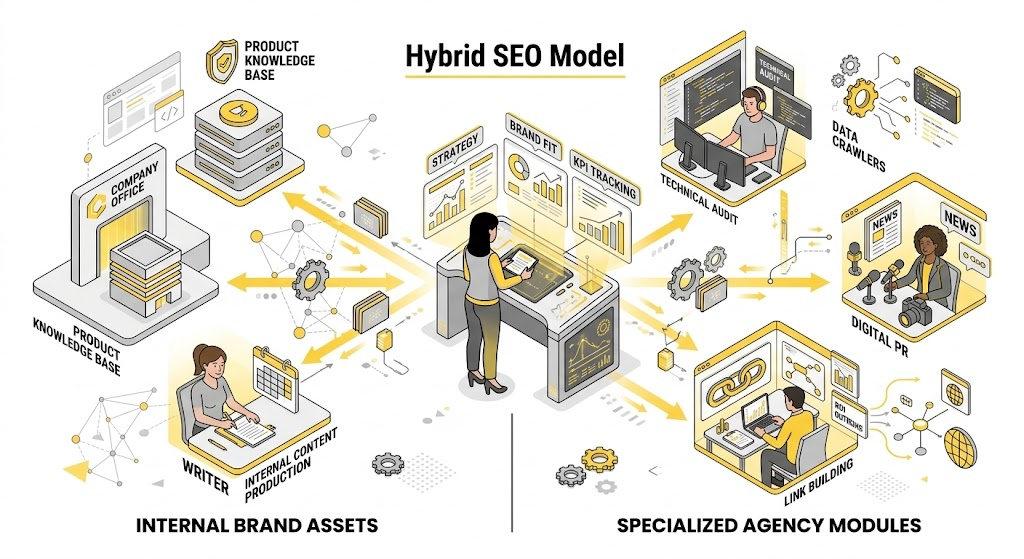
Hybrid setups pair your organizational knowledge with outside specialists. Many mid-sized companies land here.
To illustrate further, here are some exceptional benefits you can get from a hybrid SEO model.
Internal Strategy + External Specialists
Your SEO lead sets direction. Agency experts handle technical, content, or outreach work.
In-House Content + Agency Technical SEO
Your writers know the product. The agency handles crawling, schema, and site speed.
Internal SEO Manager + Agency Execution
One internal owner directs and approves. The agency does the production.
Agency Audit + Internal Implementation
The agency diagnoses. Your team fixes it. It’s a cost-efficient way to get expert insight.
How to Calculate the True Cost of In-House SEO

Calculate Fully Loaded Employee Cost
Salary + Benefits + Payroll Costs + Tools + Training + Recruiting + Management Overhead
Don’t skip management overhead. Estimate the hours your manager spends each month and price them.
Calculate Agency Cost
Monthly Agency Fees + Project Costs + Additional SEO Services
Add the extras: content production, link building, or a separate technical audit.
Compare Cost Per Deliverable
Price the output, not the payroll. Try these:
- Technical audit
- Optimized page
- Content brief
- Published article
- SEO experiment
- Digital PR campaign
Ask each side what one costs. The answers often surprise people.
Compare Cost Against Business Outcomes
Deliverables aren’t results. Track organic traffic, qualified leads, revenue, customer acquisition cost, conversion rate, and organic pipeline. Compare cost to those numbers.
Don’t Compare SEO Costs Without Considering Opportunity Cost
Financial cost is what you pay. Opportunity cost is what you lose.
- Delayed execution. Every month without SEO work is a month competitors gain ground.
- Poor technical decisions. A bad migration can undo years of growth.
- Hiring the wrong specialist. A mis-hire wastes salary and time.
- Understaffing. One person can’t cover everything, so priorities slip.
- Missed organic opportunities. Content you never published earns nothing.
How to Evaluate an SEO Agency Before Hiring One?
Ask About SEO Strategy
How do they prioritize opportunities? How do they set goals? How do they measure success? Good answers mention your business goals, not just keywords.
Ask About Reporting
Which metrics do they report, and how often? Who owns the data? You should own your analytics accounts.
Ask About Execution
Who does the work? What gets outsourced? How do technical recommendations get implemented on your site?
Ask About Communication
Find out the meeting rhythm, response times, who your day-to-day contact is, and how escalations work.
Watch for Red Flags
- Guaranteed rankings
- Vague deliverables
- No clear attribution method
- Outsourced SEO contracts without a defined scope
- Reports that show only rankings or traffic
How to Build a Cost-Effective In-House SEO Team?
Start With the Highest-Impact Role
For most companies, that’s a senior generalist who can set strategy. Specialists come later.
Define Responsibilities Clearly
Write down who owns what. Overlaps and gaps drain budgets.
Avoid Hiring Too Many Specialists Too Early
Prove the channel first. Then add headcount.
Invest in Documentation
Playbooks protect you when someone leaves.
Build Cross-Functional Relationships
SEO wins depend on developers, designers, and product managers. Give the team access early.
Use External Experts Where Specialized Knowledge Is Needed
Bring in help for edge cases. It’s cheaper than hiring for rare skills.
How to Measure SEO ROI Regardless of Your Team Structure?

Track the same core metrics whichever model you pick:
- Organic traffic: the baseline signal.
- Non-branded search growth: shows you’re reaching new people.
- Qualified organic leads: traffic that could actually buy.
- Organic revenue: what SEO earns.
- Conversion rate: how well organic visitors convert.
- Customer acquisition cost: compare organic CAC to other channels.
- Return on SEO investment: the bottom line.
SEO ROI = (SEO-Attributed Revenue − SEO Investment) ÷ SEO Investment × 100
One caution. Attribution changes the result. First-touch, last-touch, and multi-touch models can give very different ROI numbers. Say which one you used.
Agency SEO vs In House: Questions to Ask Before Deciding
- How important is SEO to our growth strategy?
- How quickly do we need to execute?
- What SEO skills exist internally, and which are missing?
- What would an in-house marketing team actually cost?
- Do we have the management capacity to build one?
- How much specialized expertise do we need?
- How easily can we scale resources?
- How much control do we require?
- Would a hybrid model fill the gaps?
Relatable Read: SEO Funnel: What It Is and How to Build It from Scratch?
Does an in-house SEO team or an agency handle AI search visibility better?
An in-house team can handle it better as long as it has solid SEO skills. AI search visibility depends mostly on things that live inside the company, and an agency can only influence those from the outside.
According to a study by Ahrefs on 75,000 brands, web mentions had the strongest correlation with visibility in AI Overviews (0.664), and the data concluded that mentions look more impactful than link building.
The gap is large: brands in the top 25% for web mentions averaged 169 AI Overview mentions, more than 10x the next quartile’s 14. Taking this into account, a hybrid approach may be better, as it removes the tedious link-building process from the in-house team.
People mention a brand when it ships something worth talking about, publishes original data, gets press coverage, earns reviews, or has visible experts. That work runs through product, PR, customer success, and leadership.
An in-house SEO lead can sit in those meetings, request data from the product team, and shape a launch so it earns coverage.
Considering all of the above, an In-house team is far better for handling AI optimization. However, if there’s a budget issue and the company is not active in brand marketing and PR, an agency can deliver better results.
Agency vs In-House SEO by Industry: Which Model Fits Your Business?
There’s no single right answer for every company. The better choice depends on how much SEO work your business generates, how technical your website is, and how much inside knowledge the work needs. The table below gives a sensible starting point for common industries and when it makes sense to change course.
| Industry | Usual Starting Point | Why | When to Reconsider |
| SaaS | Agency early on, hybrid as you grow | Early-stage SaaS companies rarely have enough SEO work for a full-time hire. As the product and content library grow, you need someone inside who understands the product and can work with product and engineering teams. | When content volume grows, SEO starts depending on product knowledge that an outside team struggles to keep up with. |
| Ecommerce | Agency for smaller stores, hybrid or in-house for large catalogs | Smaller stores have a manageable number of pages. Large catalogs mean thousands of product and category pages, frequent site changes, and close work with developers, which is easier with someone on the team. | When your catalog, site changes, or development work outgrow what a monthly retainer can cover. |
| Local businesses | Agency or freelancer | Local SEO focuses on a narrower set of tasks: your Google Business Profile, reviews, location pages, and business listings. For one or a few locations, that rarely justifies a full-time role. | When you expand to many locations and need someone managing listings and location pages consistently. |
| B2B and professional services | Agency, with input from internal experts | These sites usually have fewer pages, but the content needs real subject knowledge. An agency can handle strategy and execution, while your own experts review or contribute to content. | When you publish often enough that coordinating expert input through an outside team slows things down. |
| Healthcare, finance and legal | Hybrid | Content in these areas usually needs internal compliance or legal review before it goes live. Google also applies stricter quality standards to topics that can affect people’s health or money, so accuracy and author credibility matter more. | If internal review becomes a bottleneck, add an in-house owner to manage the process. |
| Media and publishing | In-house | For publishers, search traffic is often central to the business. SEO decisions happen daily, during writing and editing, so they’re best handled by people inside the newsroom. | Bring in an agency for one-off needs such as a site migration or a technical audit. |
Choose the Right SEO Model for Your Business
No structure wins everywhere. Compare fully loaded costs, not just a salary or a retainer. Weigh expertise, control, speed, scalability, and institutional knowledge. Then match the model to your size, SEO maturity, growth goals, and internal capacity.
Revisit the choice as you grow. A startup that needs an agency today may need a hybrid in two years.
Ready to see your real numbers? Calculate your true SEO costs and compare your current setup with an agency, in-house, or hybrid model. If you want a partner that ties SEO to measurable revenue, talk to MonsterClaw‘s SEO team.
Frequently Asked Questions (FAQs)
For small to mid-sized budgets, hiring an SEO agency is typically more affordable and offers superior financial value, whereas hiring an in-house specialist only makes sense for large businesses with heavy workloads.
An SEO agency typically costs between $1,500 and $5,000 per month for a standard monthly retainer.
Not always. In-house wins on brand knowledge and control. Outsourcing wins on breadth, speed, and flexibility.
Access to multiple specialists, faster starts, included tools, and easy scaling.
Less product knowledge at first, shared control, and quality that varies by provider.