




Google AI Mode is like having a research assistant who never sleeps. Instead of links, it gives you insights.
Once upon a time, searching online meant opening 12 tabs, skimming 3 articles, and still wondering if you missed something. Now, along comes AI Mode, and suddenly, search feels less like detective work and more like having the answer delivered on a silver platter (without the chaos).
So, what is AI Mode exactly? It’s a smarter, more intuitive way to search that blends traditional results with AI-generated responses. Instead of just pointing out where to look, it tells you what matters – summarizing, explaining, and connecting the dots in real time.
And how does AI Mode pull that off? Behind the scenes, it uses advanced AI systems that understand context, intent, and even nuance. That means it doesn’t just react to the words you type. It interprets the question you meant to ask.
Whether you are comparing options, exploring a topic, or asking something oddly specific, it processes the information and delivers a cohesive answer instead of a scattered trail of links.
In short, AI Mode turns search into something far more efficient and a lot less exhausting.
What is Google AI Mode?
Google AI Mode is Google’s specialized conversational search feature. It is built right into Google Search and the Google app.
Instead of providing a conventional sorted list of links, it makes use of more sophisticated versions of the Gemini large language model, such as Gemini 2.5 and subsequent iterations. It tends to deliver complete, well-reasoned solutions.
It significantly expands upon AI Overviews, which are condensed summaries produced by AI that occasionally show up at the top of typical search results. AI Mode goes considerably farther than AI Overviews, which only provide a brief overview.
Users can:
- Ask complicated or multi-part questions
- Get thorough responses with citations
- Carry on the conversation with organic follow-up questions in a separate, chat-like interface.
Users can also access it by going to google.com/ai in regions that are supported, or by using a specific “AI Mode” tab or button in Google Search.
With AI Overviews appearing in about 55% of all queries as of early 2026, AI Mode is deeply ingrained in Google Search.
Key Features of Google AI Mode
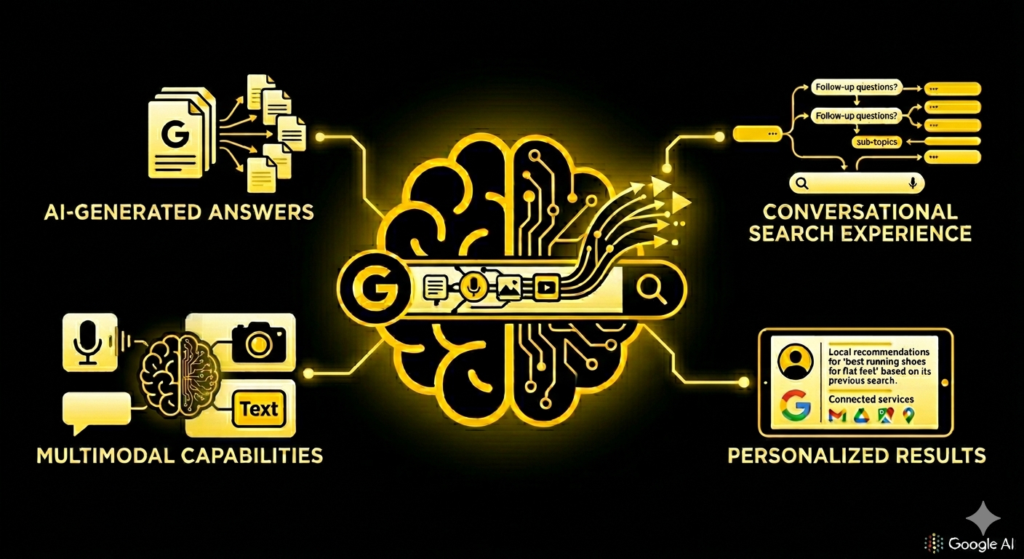
AI-Generated Answers
AI Mode uses massive language models to provide synthetic, overview-style responses. These include explanations, organized reasoning, and a wider context in addition to basic facts. Inline citations to sources, pictures, or structured components intended to improve comprehension and clarity are often included in responses.
Conversational Search Experience
Multi-turn interaction is AI Mode’s most notable feature. AI Mode preserves the entire context of the conversation while allowing users to ask follow-up questions. This makes natural language inquiries such as “Explain quantum computing simply, then compare it to classical computing for everyday tasks” possible. And the system will handle both components logically.
Rather of being a simple, one-time database query, it feels more like a conversation with an experienced professional.
This conversational depth is revolutionary for activities requiring a lot of investigation. In a single, uninterrupted session, a student conducting climate change research can:
- 1. Begin with a general topic
- 2. Dig into regional effects
- 3. Request source comparisons
- 4. Finally, request a summary
Multimodal Capabilities
Support goes much beyond inputting text. In addition to supporting image uploads and real-time snaps via Google Lens integration, AI Mode enables voice searches for hands-free use.
For instance, a user can take a picture of an unknown plant and instantly inquire about its species, how to take care of it, or whether it poses a toxicity risk. More sophisticated visual inputs are anticipated in future expansions. Such as live video or augmented reality overlays. AI Mode is incredibly adaptable across a variety of real-world situations thanks to these features.
Personalized Results
AI Mode integrates contextual information, including the user’s location, search history (if allowed), and expressed preferences to provide more relevant results.
For instance, a user will get very different results while searching for “best restaurants” due to both location and the type of follow-up preferences the system has picked up.

How Does Google AI Mode Work?
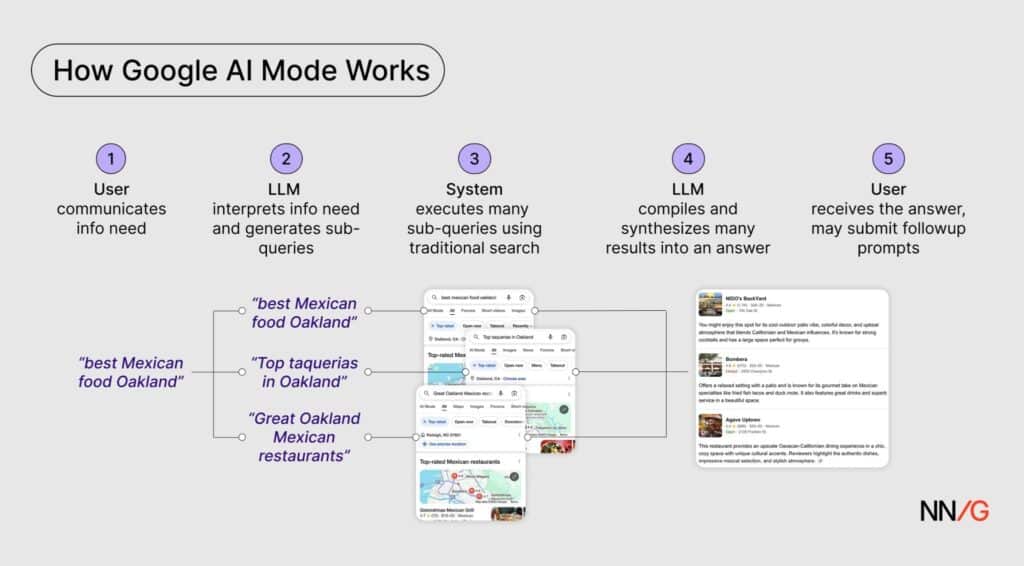
[Source: NN/Group]
Role of AI Models
AI Mode uses Gemini models that have been optimized for search-related activities. These models offer high-quality text production and strong reasoning abilities (often referred to as “thinking” phases when the model solves problems iteratively).
The model analyzes user intent in great detail, manages ambiguity and subtlety, and generates logical, well-organized responses. They are appropriate for the query’s complexity.
Data Sources and Indexing
AI Mode combines real-time retrieval techniques with Google’s conventional web index. It consists of billions of indexed web pages. When a query is received, the system employs AI to synthesize and condense pertinent data from all over the internet into a cohesive result.
By ensuring that outputs are connected to real, verified online information rather than just model-generated assumptions. This process of “grounding” AI replies in actual source material is essential, as it greatly lowers the possibility of hallucinations.
Query Interpretation Process
There are various crucial steps in the query interpretation pipeline:
Intent detection: Instead of only matching surface keywords, the model first evaluates the query, whether it is text, speech, or image, to determine its underlying meaning.
“Is it safe to mix bleach and vinegar?” is an example of a safety question rather than a request for a chemistry lecture.
Query fan-out: The system
- Divides difficult or multi-part queries into smaller questions
- Does several parallel searches throughout the web index
- Concurrently collects complementary and varied data from several sources
Context building and response generation: The algorithm then compiles the fan-out findings, analyzes them to determine what is most pertinent and trustworthy. And then produces a cohesive answer with the proper citations.
For follow-up questions, previous context from the conversation is automatically incorporated. As a result, it enables coherent multi-turn discussions.
Continuous Learning and Updates
Google uses iterative releases, continuous feedback loops, and model retraining to enhance AI Mode.
The system continuously improves accuracy, relevance, and overall quality of results over time by adapting to new trends in user queries and changes in online information.
This indicates that as AI Mode handles more interactions, it is becoming more efficient.
Relatable Read: Top 20 AI Tools for Digital Marketing in 2026
Google AI Mode vs Traditional Search
| Aspect | Traditional Search | Google AI Mode |
| Output | List of ranked links | Synthesized AI response + links/citations |
| Interaction | One-off queries | Conversational with follow-ups |
| Best for | Simple fact lookups | Complex, multi-step, or exploratory questions |
| Speed and depth | Fast for links; user explores | Synthesized answers with deeper reasoning |
| User experience | Click-heavy | Conversational and efficient |
| Source transparency | Direct links visible | Inline citations within AI response |
Research says 88% of consumers click “show more,” even when they have no intention of reading Google AI Overviews.
Benefits of Google AI Mode
Faster Answers
Instead of visiting and reading through five or ten different websites, users receive summarized insights. Answers to complex problems that traditionally took 20 minutes to investigate may frequently be found in a matter of seconds.
Better Context Understanding
AI Mode is significantly more efficient than keyword-based search in handling unclear, complex, or multi-part queries. It doesn’t only interpret what you type; it also interprets what you mean.
Reduced Need To Visit Multiple Websites
AI Mode provides the essential information up front for tasks like quick learning, product comparisons, travel planning, or comprehending medical information, but it also encourages users to look up cited sources for confirmation.
Enhanced Accessibility
AI Mode is more inclusive and helpful for a greater variety of users and circumstances thanks to multimodal inputs, which include text, image, and speech. Voice-driven conversational search is quite helpful for professionals who work hands-free or for people with inadequate typing skills.
Challenges and Limitations
Accuracy Concerns and Hallucinations
AI Mode occasionally produces inaccurate details or overconfidently states unproven facts, just like any generative AI system. Although having a solid foundation in actual search data greatly reduces this risk, users should always double-check crucial information by consulting the cited sources directly. Particularly when it comes to medical, legal, or financial settings.
Reduced Website Traffic Concerns
If customers receive complete answers within the AI interface and never visit their websites, publishers and content providers have expressed justifiable concerns about fewer clicks. This is a serious problem for the larger online ecosystem and reflects those expressed about AI Overviews. High-quality sources can still have significant visibility, though, if they receive citations in AI responses.
Transparency and Source Attribution
Even though AI Mode responses include citations, the synthesis process can occasionally make it more difficult to pinpoint the precise source. That provided a given piece of information, rather than it would be if you just clicked on a direct link. It is anticipated that citation clarity will continue to increase.
Impact on SEO and Content Strategy
The AI Mode accelerates the long-term transition from pure keyword optimization to user intent and semantic relevance. In this new environment, content that provides comprehensive, authoritative, and unambiguous answers to inquiries does far better.
Shift from Keywords to Intent
Natural language, thorough topic coverage, and answering the associated sub-questions that AI Mode’s inquiry fan-out procedure is likely to investigate must become the main priorities. Creating a page that comprehensively covers a subject from several perspectives is significantly more beneficial than focusing only on one keyword.
A study says AI Overviews are triggered by 88% of informative terms.
Content Optimization for AI Results
Structured data and schema markup are incorporated into effective content for AI Mode so that computers may correctly parse and cite it. It is crucial to prioritize writing that is fact-based, authoritative, and unambiguous. E-E-A-T signals.
Actual author expertise, verified citations, frequently updated information, and reliable sourcing that Google’s systems can assess and validate must be the primary focus of content.
Importance of Featured Snippets and Authority
More than ever, topical authority is important. AI Mode replies are much more likely to cite websites that establish themselves as trustworthy, go-to sources in a specific niche. Because they provide something that pure AI synthesis cannot, high-quality sites with original research, exclusive data, or unique insights are particularly desired.
How to Optimize for Google AI Mode?
A combination of structural, technical, and qualitative enhancements is needed to modify the content strategy for AI Mode:
- Write with clear headings and concise answers: Make use of H2 and H3 headings that clearly indicate the topics covered in each section. Before going into further detail, address the central question at the beginning of each section.
- Add FAQ-style sections: Conversational queries handled by AI Mode are directly aligned with questions framed in natural language, or the way people actually speak. FAQPage schema markup ensures these are machine-readable.
- Provide in-depth, well-researched content: Generic, thin content is ignored. Comprehensive pages are much more likely to be cited if they cover a subject from all relevant angles, include supporting data, and provide links to reliable outside sources.
- Implement structured schema markup: Use HowTo, FAQPage, Article, and other relevant schema types to give AI systems clear, parseable signals about your content’s purpose and structure.
- Ensure mobile-friendliness and fast load times: Technical performance continues to be a fundamental ranking and citation element, and AI Mode is utilized across devices.
- Focus on original analysis and unique data: Your work will be much more likely to be cited if it contains unique survey data, private research, or expert commentary that cannot be produced by AI synthesis.
- Monitor and adapt continuously: Use Search Console and third-party analytics to monitor your content’s performance in AI-influenced search results. Content plans will need to change as AI Mode does.
Future of Google AI Mode
AI Mode’s evolution suggests deeper, more seamless integration throughout the Google ecosystem as a whole. Anticipate more developments in Gemini model capabilities, such as multimodal elements like live video input, augmented reality overlays, or interactive simulations right within search, as well as more complex reasoning.
The next logical step is to provide agentic capabilities. In this mode, AI does more than simply respond to queries; it also performs actions on behalf of the user, such as making a reservation or comparing and buying a product. Beyond the initial US launch, AI Mode will be available in more languages, geographical areas, and cultural situations, necessitating specialized content strategies from multinational corporations.
AI Mode is already having an impact on Google’s whole product line, including Google Maps, Google Shopping, Google Workspace, and more. Search will probably become more proactive as technology develops, anticipating user demands instead of just answering specific questions.
FAQs on AI Mode
Research, comparisons, planning, problem-solving, and any other scenario where a synthesized response is more helpful than a list of links are among the complicated, exploratory, or conversational queries for which it is intended.
As of 2026, AI Mode was gradually introduced, beginning in the US and continuing to spread to other areas. Location determines availability, which keeps increasing with every update.
AI Mode is not perfect, though. Because it is based on actual online data, it is generally strong. When making financial, legal, or medical decisions, users should always double-check important information with the referenced sources.
AI Mode has a big impact on what content is mentioned and appears in AI answers, but it doesn’t directly replace conventional search rankings. The main levers are intent-focused content, organized data, and strong E-E-A-T.


