



If bigger always meant better, choosing an affiliate marketing partner would be easy.
But in reality, businesses often face a different question: Does massive scale outperform hands-on execution? That’s exactly what makes Rakuten advertising vs MonsterClaw such an interesting comparison.
So, when it comes to Rakuten advertising vs MonsterClaw, which one delivers better results? The answer depends on whether your business needs the power of a global network or the agility and personalized attention of a dedicated affiliate marketing agency. Let’s find out.
MonsterClaw vs Rakuten Advertising at a Glance
| Feature | MonsterClaw | Rakuten Advertising |
| Platform Type | Affiliate Tracking & Partner Management | Enterprise Affiliate Network |
| Primary Focus | Performance & Control | Network Scale |
| Best For | Brands, SaaS, DTC, Agencies | Enterprise Retailers |
| Network Size | Smaller Curated Ecosystem | Large Global Publisher Network |
| Publisher Recruitment | Automated | Network-Based |
| Tracking Technology | First-Party Tracking | Network Tracking |
| Customization | High | Moderate |
| Pricing Structure | Subscription-Based | Enterprise Pricing |
| Ease of Setup | Fast | Complex |
| Ideal Business Size | Startup to Enterprise | Mid-Market to Enterprise |
Understanding the Core Difference
What Is MonsterClaw?
MonsterClaw is a reputable B2B digital marketing and advertising agency. The business was founded by Rifat Ahmed and focuses on lead generation, affiliate marketing, search engine optimization (SEO), and comprehensive IT and software development solutions.
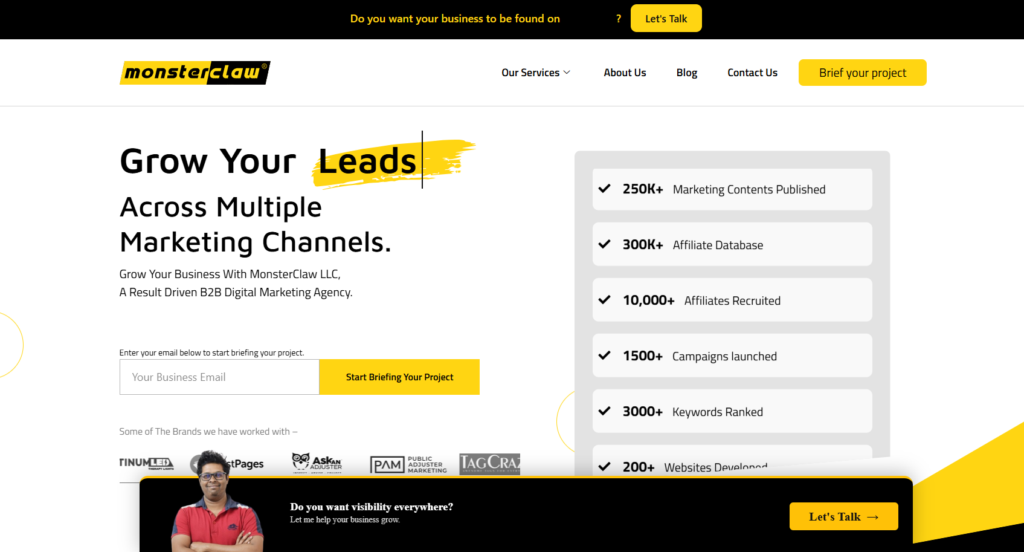
The company works all around the world and offers multi-channel marketing to help companies maximize their online growth and digital strategy.
For brands, SaaS firms, DTC retailers, and agencies seeking a hands-on approach to affiliate growth, it is ideally positioned.
What is Rakuten Advertising?
Rakuten Advertising, formerly known as Rakuten Marketing, is a worldwide provider of affiliate and performance marketing services. In order to increase online sales, raise brand awareness, and foster consumer loyalty, it links brands with publishers, influencers, and content producers.
Access at scale is the value proposition; by joining Rakuten’s ecosystem, you can take advantage of their worldwide publisher relationships without having to start from zero. It has strong roots in the retail, travel, and financial verticals and is a well-known quantity in enterprise marketing circles.
Relatable Read: Why Your Digital Marketing Strategy Isn’t Working?
Network Size Comparison
MonsterClaw’s Quality-First Approach
MonsterClaw maintains that having more affiliates does not guarantee higher profits. Their approach places a higher value on carefully chosen, high-intent collaborations than on the size of the network. This isn’t a vulnerability for firms in specialized verticals or those that have already suffered from affiliate fraud; rather, it’s a strength.
You often see cleaner traffic, higher conversion quality, and less unnecessary commission expenditure when each publisher in your program has been carefully chosen and screened.
Rakuten’s Biggest Strength – Scale
Over the course of its more than 25 years in business, Rakuten Advertising has created one of the biggest worldwide publisher ecosystems in the affiliate sector. Rakuten has a real edge in this situation if publisher volume is important to your program, which it is for certain verticals.
With well-established connections among premium content producers, loyalty programs, and deal sites, their network encompasses several industries and regions.
The current infrastructure can significantly shorten the time-to-market for large retailers starting international marketing.
Affiliate Recruitment and Partner Discovery
How MonsterClaw Helps Recruit Partners?
Outreach workflows, partner communication, permission management, and CRM-style relationship tracking are all integrated into MonsterClaw. This automates most of the tedious work associated with affiliate recruitment. This is really helpful for teams who wish to develop a carefully chosen network on their own terms.
The platform is built on the premise that establishing direct connections with affiliates improves program performance over the long run compared to depending on a network’s broad marketplace.
Relatable Read: What is Affiliate Program Management?
How Rakuten Provides Instant Network Access?
Rakuten’s hiring strategy operates in the other way. You list your program in their marketplace, and publishers apply to partner with you instead of searching for affiliates. This is a significant time-saver for programs that lack the capacity to launch active recruitment operations.
Working within Rakuten’s approval procedures and compliance criteria is a trade-off that causes some tension on both sides of the partnership.
| Capability | MonsterClaw | Rakuten Advertising |
| Publisher Marketplace | Limited | Extensive |
| Automated Outreach | Strong | Moderate |
| Relationship Management | Advanced | Standard |
| Partner Segmentation | High | High |
| Recruitment Speed | Fast | Fast Through Network |
Relatable Read: 11 Affiliate Marketing KPIs and Benchmarks to Track in 2026
Tracking Accuracy and Attribution
Why Tracking Matters More Than Network Size?
In platform comparisons, this is the part that is sometimes overlooked, although it may be the most important. Accurate attribution has become extremely difficult due to iOS tracking limits, browser privacy updates, and third-party cookie deprecation. Your ability to accurately assign revenue and, consequently, optimize is strongly impacted by the platform you select.
MonsterClaw Tracking Technology
As MonsterClaw employs first-party tracking, it is independent of third-party cookies, which are being blocked by more and more browsers. As privacy restrictions continue to tighten, this provides it a significant technical edge in accuracy. Additionally, the platform provides real-time conversion tracking and configurable attribution models so you can understand what’s truly generating revenue rather than just what the default last-click model indicates.
Rakuten Tracking Infrastructure
With decades of network operation under its belt, Rakuten has a solid tracking infrastructure. Although it provides enterprise-grade reporting and cross-device monitoring, its attribution flexibility is more constrained than that of a dedicated first-party tracking system. Rakuten’s reporting system is reliable and well-known for large enterprise accounts.
| Tracking Feature | MonsterClaw | Rakuten Advertising |
| First-Party Tracking | Yes | Partial |
| Cross-Device Tracking | Yes | Yes |
| Attribution Flexibility | High | Moderate |
| Real-Time Reporting | Yes | Yes |
| Fraud Detection | Advanced | Advanced |
Relatable Read: Super Affiliate: Who are They and How to Find Them?
Performance Analysis: Which Platform Delivers Better Results?
Depending on who you ask, performance can signify different things. Rakuten has a case if you define it in terms of brand reach and raw publisher count. MonsterClaw’s model tends to outperform its competitors when measured by CPA efficiency, ROAS, revenue per partner, and conversion rate.
It is structural in nature. You can truly determine which affiliates are providing profitable conversions and which are producing last-click attribution with no real lift when you have complete data ownership and first-party tracking. It’s an important optimization lever.
| Performance Metric | MonsterClaw Advantage | Rakuten Advantage |
| Conversion Quality | ✓ | |
| Publisher Volume | ✓ | |
| Partner Engagement | ✓ | |
| Brand Reach | ✓ | |
| Data Transparency | ✓ | |
| Established Traffic Sources | ✓ |
Reporting and Analytics Comparison
MonsterClaw Analytics
Data-driven digital marketing is the foundation of MonsterClaw LLC’s analytics. To develop strategies and create predictive models, they include competitive intelligence, historical industry data, and current business indicators. The three primary pillars of their analytics infrastructure are as follows:
- Advanced KPI Tracking: In order to optimize campaigns in real-time, Advanced KPI Tracking tracks more than 50 data points, such as traffic, impressions, conversions, and income.
- User Behavior Analysis: User behavior analysis measures how users engage with websites to map buyer journeys, enhance conversion rates, and optimize sales funnels.
- AI-Powered Trend Analysis: Makes use of machine learning to produce structured reports and automated, real-time data for PPC advertising, affiliate marketing, and search engine optimization (SEO).
Rakuten Analytics
The reporting tools from Rakuten are designed for large-scale businesses. It is a good option for big teams overseeing international programs because of its multi-market visibility, historical performance data, and uniform reporting. One of Rakuten’s true advantages is the breadth of enterprise reporting.
| Analytics Feature | MonsterClaw | Rakuten Advertising |
| Custom Reports | Yes | Yes |
| Real-Time Dashboard | Yes | Yes |
| Cohort Analysis | Strong | Moderate |
| Partner-Level Insights | Advanced | Advanced |
Relatable Read: When Linking Google Ads Account to Google Analytics, What Is Not Possible?
Ease of Use and Implementation
It’s not really close. MonsterClaw launches much more quickly. You don’t require a specialized technical resource to oversee the platform daily; the onboarding procedure is simplified, and the user interface is contemporary.
Rakuten’s setup process is more complicated, has a steeper learning curve, and contains network compliance requirements that increase the amount of time it takes for your software to go live, all of which are indicative of its enterprise pedigree. This is doable if your team is a business with committed resources. It’s a major source of friction if you’re a lean team attempting to launch rapidly.
| Factor | MonsterClaw | Rakuten Advertising |
| Setup Time | Short | Longer |
| Learning Curve | Low | High |
| UI Modernity | Modernity | Traditional |
| Technical Resources Needed | Minimal | Moderate |
| Ongoing Management | Easier | More Complex |
Relatable Read: How To Start Affiliate Marketing: A Complete Guide for Beginners
Pricing and Cost Efficiency
MonsterClaw Pricing Structure
As MonsterClaw uses a subscription model, your monthly expenses are predictable, and there are no unforeseen network fees that reduce your profits. This is a significant operational benefit for expanding brands attempting to predict affiliate program expenses.
Rakuten Pricing Structure
Rakuten uses enterprise contract pricing, which usually includes layered publisher transaction costs, network fees, and custom quotations. Rakuten prices aren’t always clear up front, and the overall cost of operating a program is frequently more than it first seems.
| Cost Factor | MonsterClaw | Rakuten Advertising |
| Pricing Transparency | High | Low |
| Monthly Predictability | High | Moderate |
| Enterprise Costs | Moderate | High |
| Startup Accessibility | Strong | Weak |
| ROI Potential | High | High |
Relatable Read: IT Services Pricing Strategy | Tips and Best Practices (2026)
Which Platform Is Better for Different Business Types?
| Business Type | Winner | Reason |
| SaaS Companies | MonsterClaw | Better control |
| DTC Brands | MonsterClaw | Strong Performance |
| Enterprise Retailers | Rakuten | Massive publisher network |
| Agencies | MonsterClaw | Multi-client flexibility |
| Global Retail Brands | Rakuten | Established worldwide reach |
| Startups | MonsterClaw | Lower complexity and cost |
Pros and Cons
MonsterClaw
Pros: These include more control over affiliate relationships, a first-party tracking advantage, improved data transparency, quicker deployment, and predictable expenses.
Cons: Less brand recognition in the market, a smaller current network, and the need for aggressive publisher recruitment.
Learn How MonsterClaw’s Affiliate Management Service Offering Works.
Rakuten Advertising
Pros: These include access to premium publishers, a large established publisher ecosystem, a solid enterprise reputation, and a worldwide reach.
Cons: More costly and less transparent pricing; less tracking and attribution flexibility; more time-consuming and complicated onboarding.
Relatable Read: What To Do When A Competitor Targets Your Brand Keywords
MonsterClaw vs Rakuten Advertising: Final Verdict
| Scenario | Winner |
| Startup or Growth Brand | MonsterClaw |
| Need Better Tracking Control | MonsterClaw |
| Need Immediate Scale | Rakuten Advertising |
| Global Enterprise Expansion | Rakuten Advertising |
| Performance-Focused Affiliate Program | MonsterClaw |
| Publisher Quantity | Rakuten Advertising |
| Publisher Quality & Optimization | MonsterClaw |
In all honesty, these platforms aren’t actually vying for the same clientele. Rakuten is a more sensible place to start if you’re an enterprise merchant who has to connect to a reputable international publisher network right away. MonsterClaw’s methodology is more appropriate if you’re developing a performance-focused affiliate program where data ownership, monitoring accuracy, and cost effectiveness truly matter.
MonsterClaw’s mix of first-party tracking, quicker setup, and predictable pricing makes it the better operational option for most mid-market brands, including expanding DTC companies, SaaS enterprises, and agencies handling numerous clients.
Ready to build an affiliate program that delivers measurable revenue instead of just more affiliates? Partner with MonsterClaw and let a dedicated team help you recruit the right partners, optimize performance, and scale your growth with confidence.
Frequently Asked Questions (FAQs)
It depends on your priorities. MonsterClaw is better for tracking control, cost efficiency, and flexibility. Rakuten is better for immediate access to a large global publisher base.
MonsterClaw has a technological advantage due to its first-party tracking, especially as browsers are still deprecating third-party cookies. Rakuten has a strong tracking infrastructure, but it relies more on conventional network tracking techniques.
Yes, but growth-stage brands, SaaS firms, and agencies are more likely to use it. Rakuten’s established enterprise ties and network scale may be more immediately helpful to enterprise brands with sophisticated worldwide needs.
Both platforms have a high return on investment. For targeted programs, MonsterClaw typically prevails in terms of cost-effectiveness and performance optimization. Rakuten has an advantage in volume-driven promotions where the main lever is publisher scale. Both platforms have a high return on investment. For targeted programs, MonsterClaw typically prevails in terms of cost-effectiveness and performance optimization. Rakuten has an advantage in volume-driven promotions where the main lever is publisher scale.