


When it comes to getting your business in front of the right eyes online, two heavyweights step into the ring.
SEO vs PPC!
One plays the long game, quietly building presence like a well-tended garden. The other is a sprinter, buying instant visibility with the click of a button.
Both can bring you traffic, leads, and sales. However, the way they do it (and how long the results last) couldn’t be more different.
So, which one deserves your investment? Let’s take a look.
| Factor | SEO | PPC | Winner (depends on scenario) |
| Cost structure | Free clicks but requires time, tools, and possibly hiring SEO experts | Pay for each click or impression | SEO for long-term, PPC for quick campaigns |
| Time to see results | Months (3 to 6+ for noticeable growth) | Immediate (ads run instantly) | PPC for speed |
| Sustainability of results | Long-lasting if maintained | Stops the moment you stop paying | SEO for long-term |
| Targeting precision | Less precise | Highly precise | PPC for precision |
| Conversion rates | Often lower initially | Often higher if targeting is strong | PPC for quick conversions |
| Control over visibility | Limited. You can’t “force” Google to rank you | Full control over when and where ads show | PPC for control |
| Trust and credibility | Higher | Lower | SEO for credibility |
| Scalability | Grows steadily with effort | Scales instantly but at a higher cost | Depends on budget and goals |
| Best for | Long-term brand building, consistent traffic | Short-term promotions, product launches | A combination often works best |
Relatable Read: Technical SEO for SaaS from SaaS SEO Experts
Definition of SEO and PPC
SEO is the practice of optimizing your website so it ranks higher in search engines like Google, without paying for the clicks you get once you’re there. The goal is to attract visitors for free by making your content valuable, relevant, and genuinely easy to find, both for the people searching and for the algorithms doing the ranking.
The agenda is to attract more visitors for free by ranking higher! All this just by making your content valuable, relevant, and easy to find.
Core components of SEO
| On-page optimisation |
|
| Off-page optimisation |
|
| Technical SEO |
|
Next up is PPC (pay-per-click). It’s a way to do online advertising where you pay every time someone clicks on your ad.
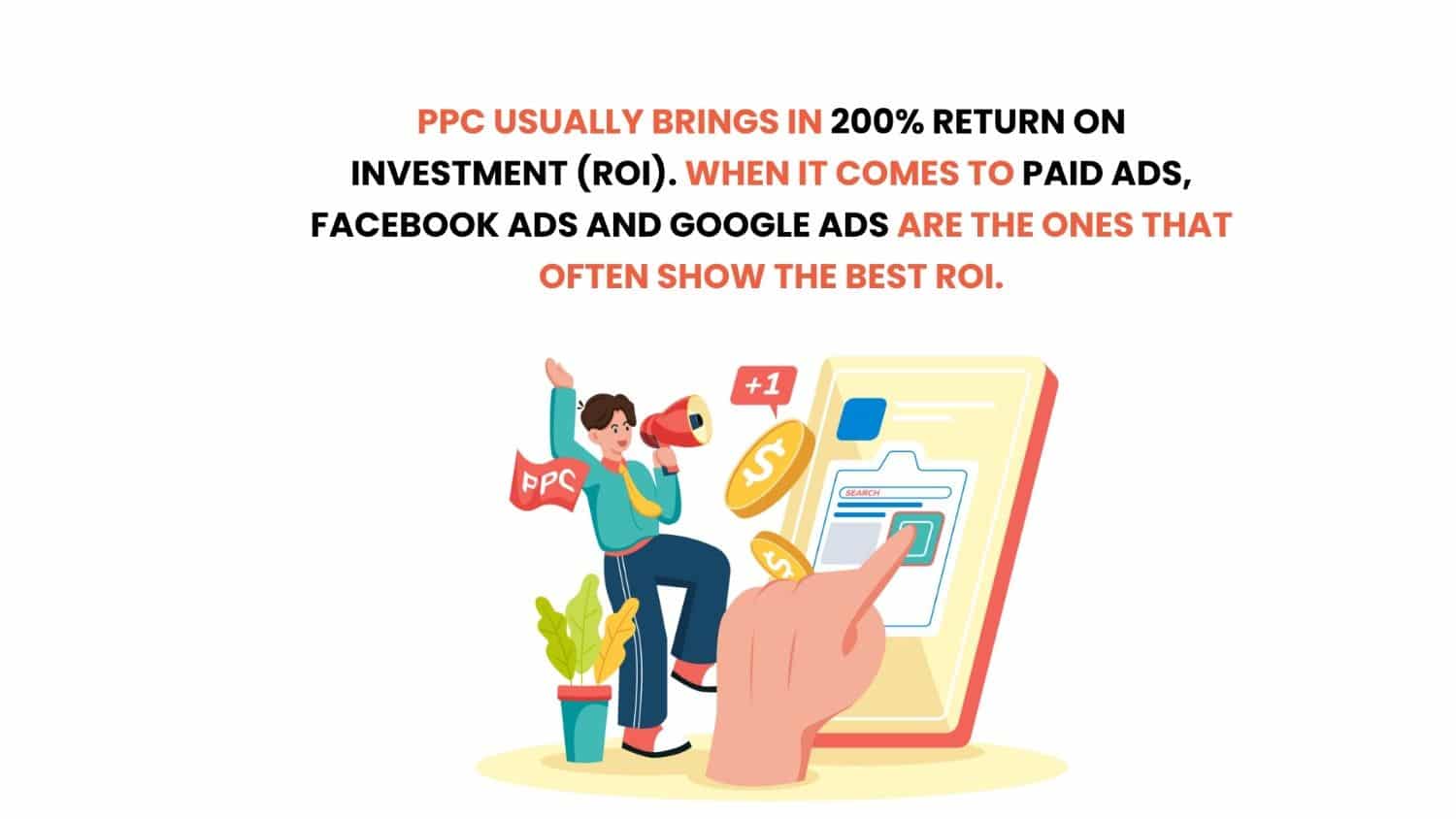
Think of it like paying for a prime spot at the top of search results or on social media. You get instant visibility, but it can get pricey for each visitor.
Common PPC Platforms
- Google Ads (ads on Google search results and partner sites)
- Bing Ads (Microsoft’s ad network)
- Social media ads (Facebook, Instagram, LinkedIn, TikTok, etc.)
Google Ads remains the dominant platform by volume, and 2026 benchmark data puts the average cross-industry cost per click somewhere between $2.96 and $5.42 depending on the source and methodology, with real variation by industry.
Legal services and other high-value B2B categories often pay $6 to $10 per click, while ecommerce frequently sees $1 to $2. That spread matters more than the average, since your actual cost depends heavily on which industry you’re in, not just which platform you choose.
ROI Timeline: When Each Pays Off
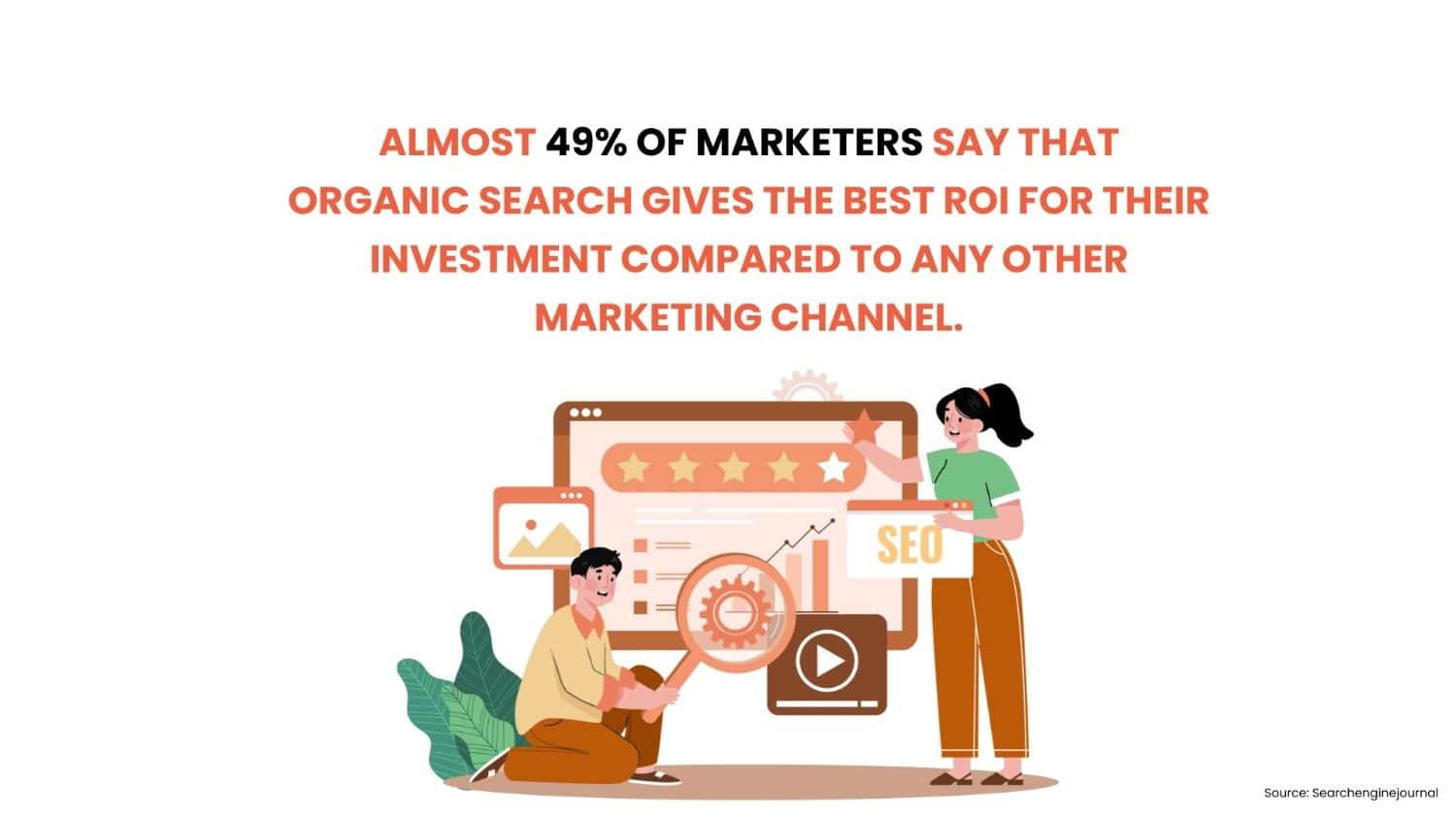
One of the main things that sets SEO apart from PPC is how fast you can start seeing results.
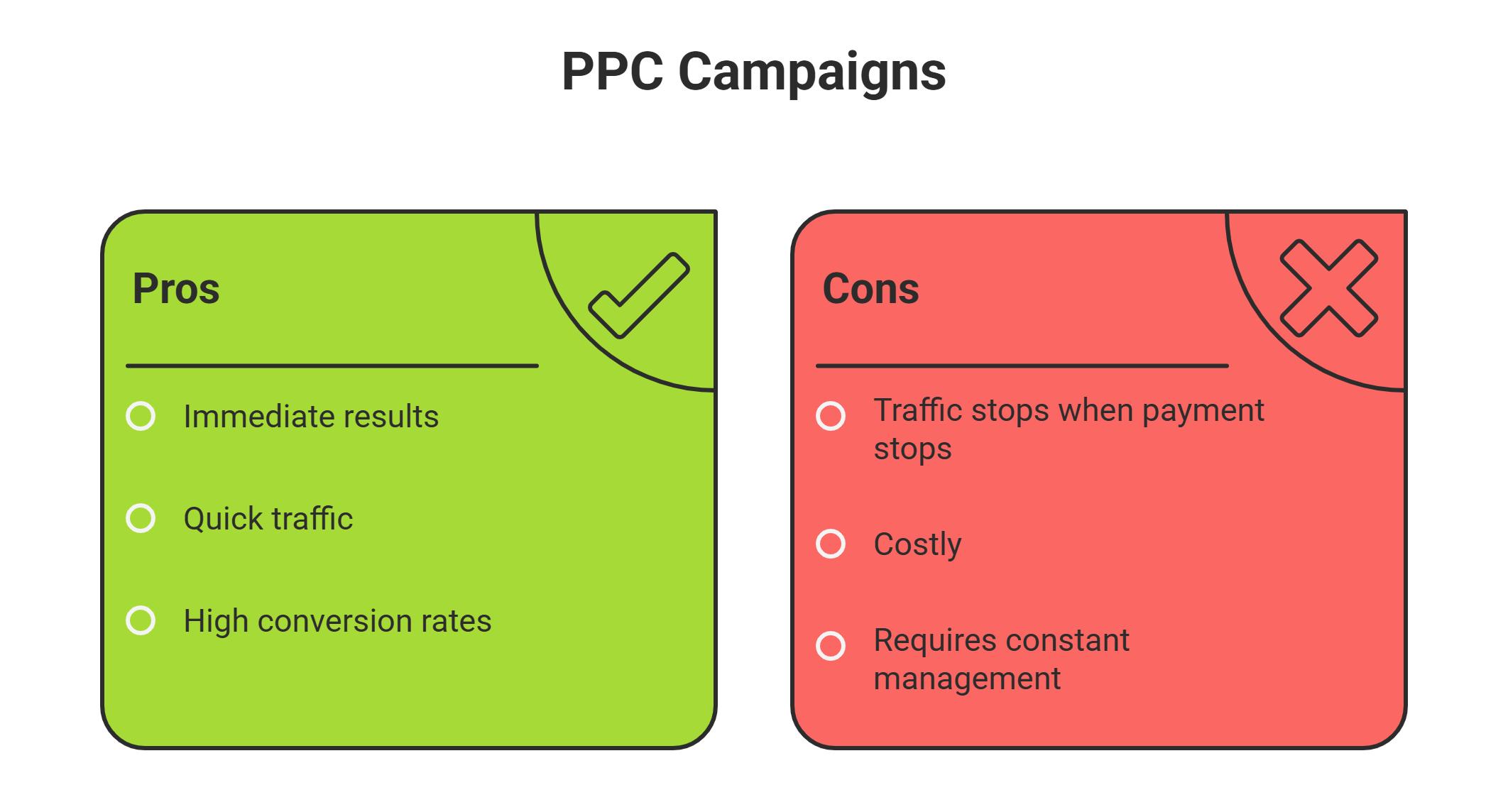
1. PPC
- Can start driving traffic and conversions in 2 to 3 months of launching
- Best for immediate results
- Traffic stops the second you stop paying.
- Think of it like turning on a faucet; water flows immediately, but stops when you close it.
2. SEO
- It may take 3–6 months to see the actual improvements in rankings and traffic.
- The benefits get doubled over time
- The longer you keep it up, the steadier and cheaper your traffic gets.
- It’s kind of like planting a tree. It starts small, but it just keeps getting bigger every year.
Check out Top 10 SaaS SEO Expert Agencies Driving Growth in 2025
SEO vs PPC for Different Goals
| Goal | Better Choice | Why |
| Brand building | SEO | Builds long-term credibility and presence |
| Product launches | PPC | Instant visibility to promote new products |
| Seasonal campaigns | PPC | Perfect for short-lived promotions like holidays |
| Long-term lead generation | SEO | Sustainable, cost-effective over time |
| Emergency visibility | PPC | Immediate presence if a competitor enters the market |
Budget Allocation Framework
Knowing which channel is theoretically better for a given goal is only half the problem. The real question every business asks is more specific: given an actual monthly budget, how much should go to each channel?
Start with your business stage. The right split shifts significantly depending on where you are.
Go with SEO if:
- You have a limited budget and want free traffic long-term.
- Your industry is competitive but not dominated by massive players.
- You sell evergreen products/services that stay relevant for years.
- You’re not in a rush and can wait months for results.
Successfully executing an SEO strategy requires more than publishing content. Technical optimization, keyword research, authority building, and ongoing improvements all work together to produce lasting results. Our Professional SEO Services help businesses develop a customized strategy that drives sustainable organic growth.
Industry-Specific Recommendations
The right channel mix also depends heavily on what you’re actually selling. A framework that works well for a SaaS company can fail for a local service business, and vice versa.
| Industry | Recommended primary channel | Reasoning |
|---|---|---|
| SaaS and B2B software | SEO-led, PPC for demos and free trials | Buying cycles are long and research-heavy, which favors SEO content that ranks throughout the consideration phase. PPC works well specifically for high-intent, bottom-funnel terms like “[category] software” or demo requests. |
| Local service businesses (contractors, clinics, home services) | PPC-led early, SEO for sustained volume | Local intent searches convert fast on PPC, and Google’s local ad inventory is often less competitive than national keywords. Google Business Profile and local SEO should still run in parallel, since they compound while PPC keeps the phone ringing. |
| Ecommerce | Balanced, weighted by product margin | Lower-margin, highly competitive product categories often can’t sustain profitable PPC CPCs long-term, which pushes more weight toward SEO and content. Higher-margin or seasonal products can absorb PPC costs more comfortably. |
| B2B enterprise | SEO-led with account-based PPC | Enterprise buying committees research extensively before ever contacting sales, which rewards deep, authoritative SEO content. PPC still has a role, but it’s usually narrower and more targeted at specific accounts or roles rather than broad keyword volume. |
| Startups pre-product-market-fit | PPC-led | You need fast, honest signal on whether your messaging and offer actually convert, and PPC gives you that in weeks. SEO takes months to generate enough data to be useful for this kind of testing. |
| Legal, finance, and other high-CPC verticals | SEO-led, PPC used surgically | Cost per click in these industries frequently runs $6 to $10 or higher, which makes broad PPC campaigns expensive to sustain. SEO’s higher upfront effort pays off faster here specifically because the alternative is so costly per click. |
None of these are absolute rules. They’re the pattern that holds across most businesses in each category, and your specific competitive landscape, margins, and sales cycle can shift where you land within it.
When to Choose SEO Over PPC?
Go with SEO if the following apply to your business.
You have a limited budget and want free traffic long-term. SEO’s ongoing cost is your time and content investment, not a per-click charge that scales directly with your traffic volume.
Your industry is competitive but not dominated by massive players. Genuinely oversaturated niches with entrenched enterprise competitors make organic ranking slower to achieve, though not impossible with the right strategy.
You sell evergreen products or services that stay relevant for years. Content built around a lasting need keeps earning traffic long after you published it, unlike content tied to a trend that fades.
You’re not in a rush and can wait months for results. SEO rewards patience. If your business can absorb a 3- to 6-month ramp-up period without needing revenue from this channel immediately, SEO’s compounding return becomes worth the wait.
Successfully executing an SEO strategy requires more than publishing content. Technical optimization, keyword research, authority building, and ongoing improvements all work together to produce lasting results. Our Professional SEO Services help businesses develop a customized strategy that drives sustainable organic growth.
When to Choose PPC Over SEO?
Choose PPC if the following apply to your business.
You’ve just launched a new website that currently lacks domain authority. A brand-new site has no ranking history to lean on, and PPC lets you generate traffic while your SEO foundation is still being built.
You’re running time-sensitive promotions, such as sales, events, or product drops. SEO can’t be turned on overnight for a launch happening next week. PPC can.
You don’t want to commit to a long-term SEO investment. That’s a legitimate business decision, not a wrong one, especially for a short-lived campaign or a business testing a specific offer.
You want to test product-market fit. PPC gives you a fast, direct signal on whether your actual offer and messaging convert, since you can see real conversion data within days rather than waiting months for organic traffic to accumulate.
You’re dealing with a hyper-competitive niche. Some markets are dominated by a small number of entrenched organic competitors, and PPC gives you a way to compete for visibility immediately rather than fighting an uphill ranking battle with no guaranteed timeline.
Relatable Read: 6 Effective Shopify SEO Tips in 2025
Does This Actually Work?
It’s fair to want proof before committing budget to either channel, so here’s what that proof should actually look like, and one real example.
For SEO, look for a documented before-and-after over a meaningful timeframe, ideally 12 months or more, since anything shorter doesn’t give the compounding effect enough room to show. Our own eCommerce SEO case study documents a client’s growth from $30k to $700k in sales over 24 months, which is the kind of timeline that actually demonstrates what sustained SEO investment does, rather than a cherry-picked 60-day snapshot.
For PPC, ask for the actual cost-per-lead or ROAS trend over time, not just a single strong month. A campaign that looked great in its first 30 days can quietly become unprofitable by month four as competition and CPCs rise, and a partner who can only show you the good month is showing you a highlight reel, not a track record.
Either way, be skeptical of round, dramatic percentages with no timeframe attached. “300% growth” means very little without knowing over what period, from what starting base, and measured by which metric. A credible partner will show you the underlying numbers, not just the headline.
Execution Roadmap
Here’s a plan that’ll work great with what you’ve got going on in your business.
Short-term (0–3 months)
- Get ready with PPC campaigns to see immediate results.
- Start with keyword research. Then, implement it in your SEO-optimised content.
- Focus on technical SEO to make your site search-ready.
Mid-term (3–6 months)
- Use a PPC campaign smartly to grab better ROI.
- Publish and optimise more SEO content.
- Pay attention to backlinks and work on authority.
Long-term (6–12 months)
- After seeing steady traffic from SEO, stop spending on PPC.
- Put more attention to scaling SEO
- Expand content and optimise it on an advanced level
- Run PPC for occasional promotions or competitive pushes.
Frequently Asked Questions
SEO is all about higher long-term ROI because traffic stays free once ranked. On the other hand, PPC shows instant ROI but stops when ads end.
SEO is more effective for long-term visibility and credibility. Google Ads wins for immediate traffic.
SEO is better for cost-effective traffic, higher trust, and long-term brand authority. PPC only works while you pay, making it less viable.
Actually, Google Ads mostly uses a pay-per-click setup. But you’ll also come across options like cost-per-thousand impressions (CPM) or cost-per-acquisition (CPA).
You can expect to spend anywhere from $500 to $5,000+ per month for a professional SEO partner.
It depends primarily on your business stage. Early-stage businesses generally lean 60-70% toward PPC to generate revenue while SEO ramps up. Established businesses with organic traffic already flowing typically shift that ratio toward 60-70% SEO, since it’s compounding and reducing their cost per lead. See the Budget Allocation Framework above for a fuller breakdown by stage and a formula for calculating your own split.
Yes, significantly. High-CPC industries like legal and finance often benefit more from an SEO-led approach simply because PPC costs per click run so high there. Local service businesses often see faster returns from PPC due to strong local search intent. See the Industry-Specific Recommendations section above for a fuller breakdown.
Most businesses see PPC operating efficiently within the first 1 to 2 months, once initial testing narrows down what converts. SEO typically needs 6 to 12 months before it’s contributing enough steady traffic to meaningfully reduce your PPC dependency. Running both from day one, rather than sequentially, is what gets you to an efficient combined state fastest.