


Are you an entrepreneur looking forward to incorporating search engine optimization (SEO) into your brand, but not sure how?
Search Engine Optimization is an integral part of branding. It might be tough to choose a specific product/service name when you are first getting started. Nevertheless, your search optimization efforts will pay off when you’re building your brand identity.
Your business name, product, and company image will all be tied to your search engine results. All you have to do is make your SEO efforts consistent with your core brand. You can bring customers to your site and encourage them to buy with the right SEO strategies. But if you’re not on the right side of SEO practices, your significant competitors will outrank you in a blink.
Here are some prerequisites to consider while formulating an SEO strategy for your business.
What is SEO for Branding?
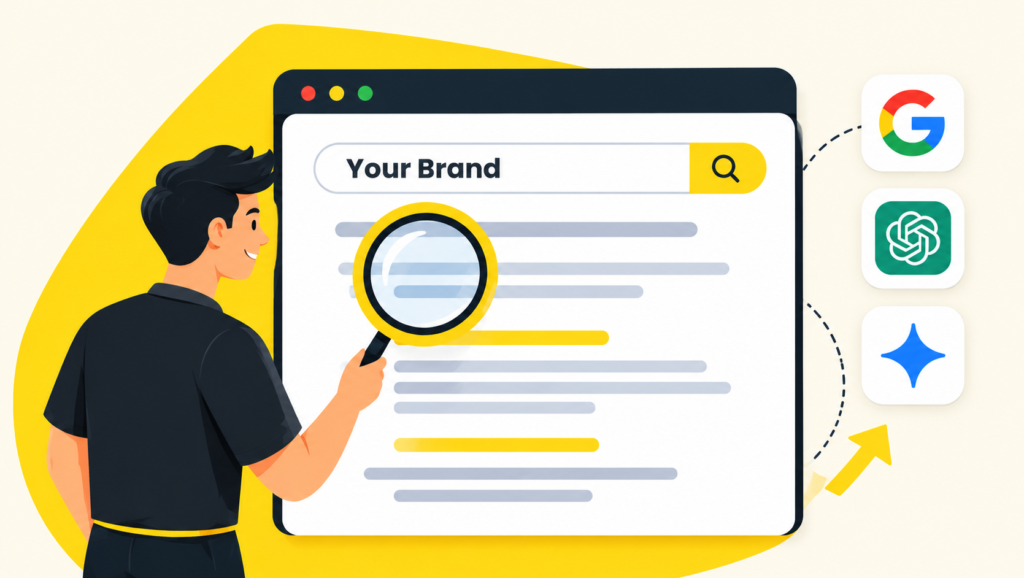
SEO for branding is the practice of using search engine optimization to shape how people discover, perceive, and remember your brand. It goes beyond ranking for traffic. The aim is to build recognition, trust, and brand demand across Google and AI search.
Traditional SEO asks, “How do we rank for this keyword?” SEO branding adds a second question: “What do people learn about us every time they see us in search?”
In practice, that covers three jobs:
1. Visibility: Show up repeatedly for the problems your audience searches for, so your name becomes familiar before they’re ready to buy.
2. Perception: Control what appears when someone searches your brand name: your site, your reviews, your Knowledge Panel, your social profiles, and what AI tools say about you.
3. Demand: Turn that familiarity into more people searching for you by name. That branded search volume is one of the clearest signs your brand is growing.
You’ll also see this called brand SEO or branding SEO.
They all describe the same idea: search as a brand-building channel, not just a traffic channel.
Online Branding and SEO: The Killer Duo
Visibility is the primary requirement for a business to work and grow. Everyone is keen to have a branded product, as they trust what the brand is selling.
If you want this kind of visibility, you cannot deny SEO for your branding.
Some people often misjudge SEO as the cherry on top. The tendency is quite understandable because SEO may not provide you with instant results.
However, as an SEO expert, I can assure you SEO is the MOST CRITICAL STRATEGY for your business, and you need to adopt it sooner rather than later.
SEO strategies combine what your business requires with what your target audience wants, then harmonize both to build a brand that consumers can trust.
If you think about it, SEO is the base of an amazing drink, binding completely different flavors together.
So, if you want to make your brand visible to create more conversions, you need a solid SEO branding strategy. It is the most effective and cost-effective way to expand your brand, and the first step to make your brand a household name.
Relatable Read: SEO for Beauty Brands
Brand Vs. Website
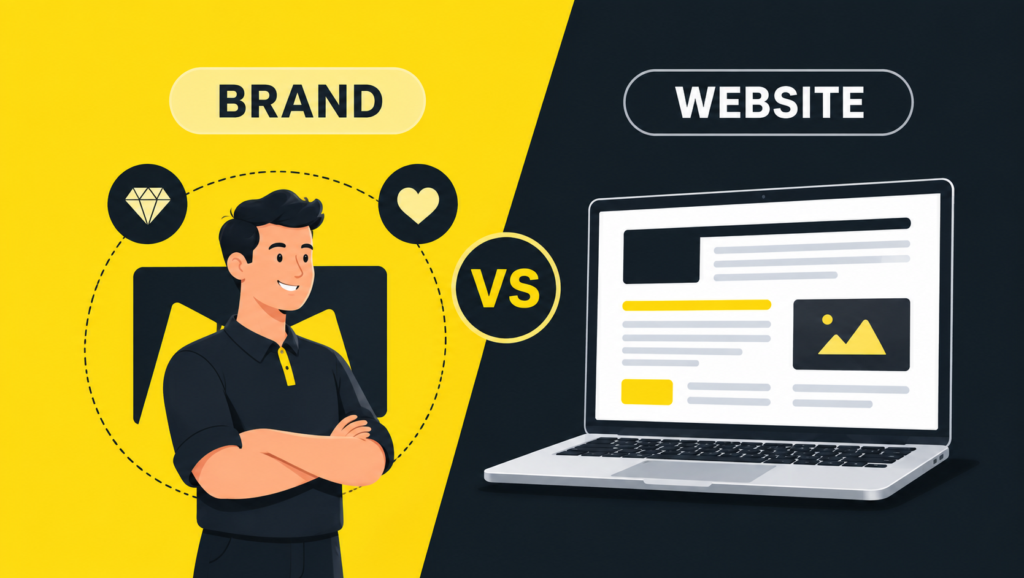
A website is not a brand. A brand is way beyond a website.
It would be best if you used search engine optimization for your brand. It is crucial, especially if you’re a small business. An online brand upholds everything a business claims to be. It is a combination of stories and a unique personality that other people can relate to. It has followers who grow in number continuously.
A brand doesn’t concern itself with rankings for growing and prospering; it already is a giant. More importantly, a brand uses resources to spread a positive business message. Branding can be either for a corporation or an individual. For example, Ferrari is corporate branding. It represents speed and efficiency.
On the other hand, Ryan Gosling is the perfect example of personal branding; he is talented, elegant, and an amazing human being.
In contrast, a website is more of a business center; a business center that has broken the boundary of brick-and-mortar shops, even national boundaries. A website is a place where you demonstrate your branding as well as your professionalism and salesmanship.
Your website cannot do well without proper branding. Also, you cannot demonstrate your branding adequately without a website.
In a nutshell, both your brand and website are intertwined with each other.
The fact is, search engines like Google prioritize branding rather than a website. You can have a user-friendly and excellently designed website. However, without proper branding, it may not do well in ranking higher in search results.
Therefore, you need to prioritize branding more than building a great website.
SEO vs. Branding: Different Jobs, Same Goal
SEO and branding aren’t the same discipline, and treating them as one usually shortchanges both.
Here’s how they split the work:
| Branding | SEO | |
| Core job | Creates demand and preference | Captures demand and grows visibility |
| Main question | Why should people choose us? | Where are people looking, and are we there? |
| Typical timeline | Long-term, cumulative | Compounding, with measurable milestones |
| Key outputs | Positioning, voice, identity, reputation | Rankings, organic traffic, citations, conversions |
| How it’s measured | Awareness, recall, share of voice, branded search | Impressions, clicks, rankings, AI visibility, revenue |
So how important is branding for SEO?
More important than most SEO roadmaps admit. A strong brand helps your SEO in ways technical fixes can’t:
- Higher click-through rates. People click names they recognize, even when you’re not in position one.
- Easier link and mention earning. Journalists and creators reference brands they already know.
- Better conversion from organic. Familiar brands don’t have to rebuild trust on every visit.
- More branded searches. Those searches are the easiest traffic you’ll ever win, and they show search engines people are looking for you specifically.
The reverse is also true. A brand with no search visibility is invisible at the exact moment buyers are researching. That’s why the best programs run the two together, not in separate silos.
Why Brand Strength Now Shapes Rankings (and AI Answers)
First, a straight answer, because this topic attracts a lot of myths: Google doesn’t publish a “brand score,” and there’s no single confirmed “brand signal” ranking factor. What we do have is clear evidence that brand strength and search visibility move together, especially in AI search.
What the data shows
Ahrefs analyzed 75,000 brands to see which factors lined up with being mentioned in Google’s AI Overviews (study). The results:
- Branded web mentions had the strongest correlation, at 0.664.
- Backlinks came in at 0.218, less than a third as strong.
- The top three factors were all off-site: web mentions (0.664), brand anchors (0.527), and branded search volume (0.392).
The gap was also stark by volume. Brands in the top quarter for web mentions averaged 169 AI Overview mentions. The next quarter down averaged just 14.
These are correlations, not proof that mentions cause AI visibility. Still, the direction is hard to ignore: brands that are widely discussed across the web are the ones AI systems bring up.
What a brand mention means for SEO?
A brand mention is any reference to your company, product, or people on another site, whether or not it links to you. A few examples:
- A news article naming you as a source
- A review site comparing you with competitors
- A podcast or YouTube video talking about your product
- A Reddit thread recommending you
Links still matter for traditional rankings. Mentions, though, are increasingly how search engines and language models learn who you are, what you’re known for, and whether people trust you.
Why brand authority helps rankings too?
Google’s Search Quality Rater Guidelines tell raters to research the reputation of a website and its creators when judging quality. Raters don’t rank pages directly. Their feedback helps Google evaluate whether its systems are surfacing trustworthy results. The takeaway is simple: a brand people know, cite and review well is exactly what Google’s systems are designed to reward.
Branded vs. Non-Branded Keywords
Every SEO branding strategy comes down to two types of searches.
Branded keywords include your brand name, its variations or misspellings, or your branded products. Google’s own example: “Google,” “Gogle,” and “Gmail” all count as branded queries for google.com.
Non-branded keywords are everything else: the problem and category searches people make before they know you exist.
| Branded | Non-branded | |
| Example (for a CRM company called “Acme”) | acme crm pricing, acme login, acme vs hubspot | best crm for small business, how to manage sales pipeline |
| Searcher knows you? | Yes | Usually not |
| Typical CTR and conversion | High | Lower, but it’s where new customers come from |
| What it tells you | How strong your brand demand is | How well you’re reaching new audiences |
Why You Need Both
Non-branded SEO is how strangers meet you. Branded SEO is how you close the deal once they remember you.
A healthy brand SEO program looks like a flywheel:
- Non-branded content introduces you to new people.
- Repeated exposure builds familiarity.
- Familiar people come back and search for you by name.
- Your branded SERP convinces them to choose you.
If your branded traffic is growing while non-branded stays flat, you’re living off existing awareness. If non-branded grows but branded never moves, your content is being read but not remembered.
How to Use SEO to Build Brand Awareness: 7 Strategies

These are the moves we prioritize when brand growth is the goal, roughly in the order we tackle them.
1. Own your brand SERP
Your brand SERP is the results page someone sees when they search your name. For many buyers, it’s the first impression of your company, often before they ever reach your homepage.
Search your brand name in an incognito window and ask:
- Is your site on top, with sitelinks?
- Do your social profiles, review pages and YouTube channel show up, or do random directories?
- Is there anything negative, outdated or confusing on page one?
- Do the People Also Ask questions reflect what you want to be known for?
Then fill page one with properties you control or influence: an optimized About page, active social profiles, a YouTube channel, and profiles on the review platforms that matter in your industry. The goal is simple. Anyone searching your name should find a consistent, credible story.
2. Earn and optimize your Knowledge Panel
A Knowledge Panel is the information box Google shows for recognized entities: companies, people, products. It signals that Google understands who you are.
You can’t buy one or switch one on. You earn it by being a clear, well-documented entity. Once one appears, you can claim it through Google’s verification process and suggest updates to keep details like your logo, description, and social profiles accurate.
3. Build Your Entity with schema and consistent profiles
Entity SEO is about helping search engines understand your brand as a distinct “thing,” not just a string of words.
- Add Organization structured data to your homepage or About page. Include your official name, logo, URL, contact details, and sameAs links to your official profiles.
- Add WebSite structured data so Google can display your preferred site name in search results.
- Keep your name, description and details consistent across your site, social profiles, directories, Crunchbase, LinkedIn, Wikidata (where you legitimately qualify) and review platforms.
Consistency is what lets search engines and AI models connect all those mentions back to one brand.
4. Create Topical Authority Content that Sounds Like You
Brand awareness through SEO depends on showing up again and again for the problems your audience cares about. One viral post won’t do it. A deep cluster of genuinely useful content will.
- Pick the few topics you want to be known for, and cover them deeply.
- Add a real point of view: original data, frameworks, examples from your own work.
- Write in a consistent brand voice so each piece feels unmistakably yours.
Generic content ranks less often, and when it does, nobody remembers who wrote it.
5. Use Digital PR to Earn Mentions
If mentions correlate so strongly with AI visibility, digital PR stops being a nice-to-have. It becomes a core SEO channel.
Formats that consistently earn coverage:
- Original research and industry surveys
- Data studies built from your own product or customer data
- Expert commentary for journalists on trending topics
- Free tools, calculators and templates people want to reference
Aim for coverage in the publications, podcasts and YouTube channels your audience actually uses. That relevance matters more than chasing any single metric.
6. Turn Unlinked Brand Mentions into Links
Unlinked brand mentions are places that already name you without linking. They’re the easiest link-building wins you’ll find, because the writer already chose to reference you.
- Set up mention alerts with a tool like Ahrefs, Google Alerts, or a media monitoring platform.
- Filter for relevant, reputable sites.
- Send a short, friendly note asking them to add a link where it helps their readers.
Even when they say no, the mention is still working for your brand.
7. Brand Your On-page Elements
Every listing you earn in search is a branding touchpoint, so make each one count.
- Title tags: Include your brand name where it fits naturally, usually at the end.
- Meta descriptions: Write in your brand voice, not stiff keyword filler.
- Favicon and site name: Make sure both display correctly in search results.
- URLs and headings: Keep them clean and consistent.
Someone who sees your name in five different searches in one week is far more likely to click the sixth.
Brand Visibility in AI Search

AI search changes the branding game in one major way: it often gives people an answer without a click. Ahrefs found that AI Overviews cut the average click-through rate for top-ranking pages by 58%, based on Search Console data across 300,000 keywords (source).
When fewer people click, being named in the answer is the new visibility. If an AI tool recommends three brands and you’re not one of them, you never got a chance.
How AI Tools Decide Which Brands to Mention
Language models don’t have a brand score either. They lean on patterns across the content they were trained on and the pages they retrieve in real time. Ahrefs’ December 2025 follow-up covered ChatGPT, Google AI Mode and AI Overviews.
It found YouTube mentions had the strongest correlation with AI brand visibility (about 0.737), ahead of branded web mentions. Backlinks and content volume were much weaker predictors.
In short, what others say about you tends to matter more than how much you publish about yourself.
How to Improve Brand Visibility in AI Search
- Get mentioned where AI tools look: Editorial coverage, industry roundups, comparison and review sites, Reddit and YouTube.
- Be clear about what you are: Say plainly what you do, who it’s for and what category you belong to, on your site and in your profiles. Vague positioning confuses people and models alike.
- Publish citable content: Original data, clear definitions, and direct answers are easier for AI systems to quote and attribute.
- Keep facts consistent everywhere: Pricing, features, founding year, and leadership should match across every source so AI answers don’t mix them up.
- Invest in video: Given the YouTube findings, product demos, explainers, and expert interviews are worth serious attention.
How to Measure SEO’s Impact on Your Brand
This is where most SEO branding programs fall apart. Everyone agrees brand matters, but few can show it in a report. Here’s how to fix that.
1. Separate Branded and Non-branded Traffic in Search Console
This used to mean building fragile regex filters. Now Google does it for you. In November 2025, Google introduced a branded queries filter in the Search Console Performance report (announcement), and it later expanded to all eligible sites.
- The filter splits your queries into Branded and Non-branded, with impressions, clicks, CTR and position for each.
- The Insights report adds a card showing your click split between the two.
- Google classifies queries with an AI-assisted system, so a few may be misclassified.
- It isn’t available for sub-properties (like example.com/blog/) or for sites with low impressions.
- It’s a reporting feature only. It doesn’t affect rankings.
2. Track branded search demand over time
Rising branded impressions in Search Console, plus rising branded search volume in a tool like Ahrefs or Google Trends, is the clearest proof your brand is growing. Compare it against your PR, content and campaign timeline to see what moved the needle.
3. Measure share of voice, in classic and AI search
- Organic share of voice: your visibility across a tracked set of non-branded keywords, compared with competitors.
- AI share of voice: how often you’re mentioned in AI answers for your category prompts, compared with competitors.
4. Watch the quality signals
- Growth in referring domains and brand mentions
- Branded SERP health: what ranks on page one for your name
- Conversion rates from organic traffic, split by branded and non-branded
A Simple Brand SEO Scorecard
| Metric | Where to find it | What “Good” looks like |
| Branded clicks and impressions | GSC branded queries filter | Steady growth over quarters |
| Non-branded clicks | GSC branded queries filter | Growth that leads branded growth |
| Branded search volume | Ahrefs, Google Trends | Trending up after campaigns and PR |
| Brand mentions and referring domains | Ahrefs or a monitoring tool | Consistent new mentions from relevant sites |
| AI share of voice | Prompt audits, AI visibility tools | Rising mention rate against competitors |
| Branded SERP health | Manual incognito check | Page one fully owned or positive |
Common SEO Branding Mistakes
- Chasing traffic with no brand fit: Ranking for trending keywords unrelated to your offer brings visits, not memory. Nobody associates you with the topic, and nobody converts.
- Ignoring your own brand SERP: Many companies have never checked what ranks for their name. Outdated reviews, old press, or a competitor’s ads can shape the first impression.
- Inconsistent brand details: Different names, descriptions, or facts across your site and profiles make it harder for search engines and AI tools to connect the dots.
- Treating PR and SEO as separate teams: When PR lands a great story with no SEO input, or SEO builds links with no brand story, both leave value on the table.
- Faceless, generic content: Content that could have come from any competitor doesn’t build a brand, even when it ranks.
- Reporting only blended traffic: If you never split branded from non-branded, you can’t tell whether SEO is creating new demand or just catching people who already know you.
- Tracking only Google rankings: If you’re not monitoring AI answers, you’re missing a growing slice of how buyers discover brands.
A Case Study
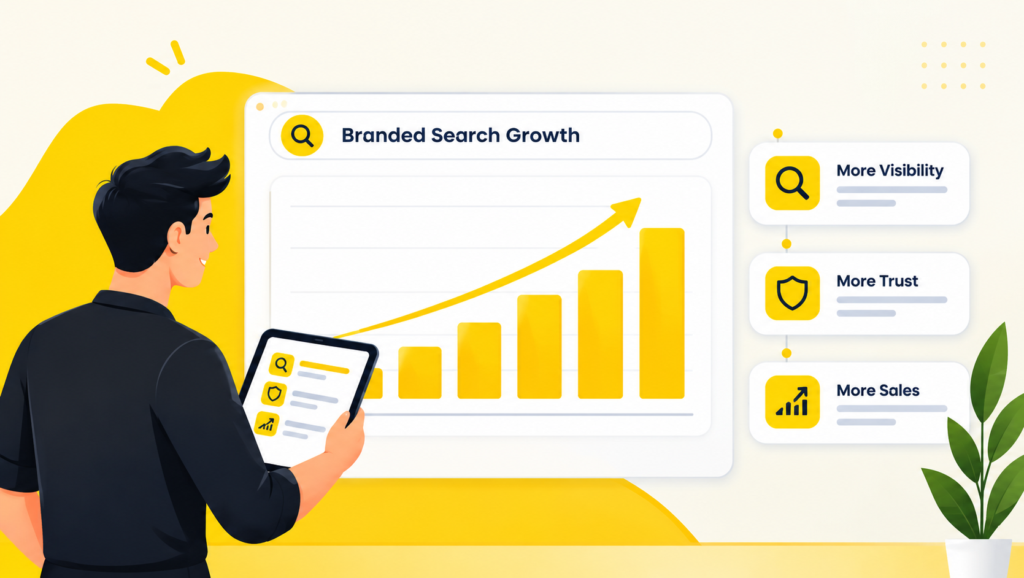
Let’s close this section with a case study to relate everything we discussed above.
Today, when I’m writing this article, almost everyone around the world is aware of Zoom. This online meeting app allowed people to host virtual meetings when the pandemic hit the world.
Zoom created a fantastic brand for itself. It is efficient and trustworthy.
So, when people needed an alternative source of communication, it provided them with the best results. With solid branding, Zoom soon became a verb like Google.
From January 2020 to March 2020, Zoom’s stock soared by 130%. People started to search for “Zoom” or “Zoom video” instead of “video conference tool” or “virtual meeting tool.”
This had a highly positive impact on domain authority, and Zoom became a household name.
How Branding Impacts SEO?
As I mentioned earlier, Google is most likely to prioritize branding over a website. Also, your SEO strategy highly impacts your branding. Now what we need to know is: how branding impacts SEO.
Here is how the impacts are seen:
What Can You Do With Search Engine Optimization?
When people search for keywords on a search engine, your website appears in the first few results. If your website shows up in the first few results, people will be interested in your brand.
SEO allows your target audience to learn more about your company. You can provide them with more information through email marketing and an autoresponder to let them know about discounts or freebies.
These strategies will help your customers find you. It also helps your brand stand out from the competition.
If you’re not among the top few results for a keyword, then your brand image will be dead in the water.
Brand Authority Impacts Domain Authority
Domain authority is a search engine ranking score that predicts the potential ranking of the website in SERPs. Search engines take internal links, website quality, reviews, mentions, etc. into account while building a SERP for queries.
Search engine algorithms will connect your brand with a product category with a high volume of engagement linked to your brand. High-volume branded searches will increase your influence over your competitors.
This process of building an authoritative brand is achievable through SEO.
Emphasis On E-A-T
E-A-T consists of the first letters of expertise, authoritativeness, and trustworthiness. All three of these are crucial for building a brand.
Expertise is the skill or knowledge you offer in a particular field. This can either be achieved by formal education or through your day-to-day experience.
Demonstrating your expatriates in a field that exceeds or matches your competition can classify you as an expert in your area. Authoritativeness stands for how reliable you are.
It is the measurement of how you stand out from the crowd. This can be achieved through your website design and content strategies.
When you provide unique content to people, they will trust your opinion. When more and more people come to you for advice, you are considered an authoritative figure.
Last but not least, trustworthiness can take you a long way in your branding journey. When people use you as a reliable source for information, they refer others to you more.
On online platforms, this is achieved by backlinks. By combining all of these, you create a viable brand, and a solid SEO strategy enables you to achieve all these things.
Internal Linking
Internal linking is the way to redirect your consumers from one page to another on the same domain.
This allows the user to navigate your website with ease. Internal linking establishes a hierarchy of information on your website while assisting in spreading link equity around.
It establishes a site architecture that helps the search engine to crawl through the pages of your website.
Interlinking all these pages helps both your users and the search engines find the required pages with ease. Therefore, you need to put good work into arranging your pages and internally linking them.
You can also check out this complete guideline on How to Use Modern SEO to Build a Brand Exposure Guideline.
Final Words
Branding is becoming more critical than ever. If you want to differentiate yourself in your niche, you need to create a unique brand image. You can’t afford to have your logo and SEO marketing content on your site.
It’s the combined efforts of a pinpointed SEO approach that lead to reaching the landmark.
Stay ahead of the curve, and hand over the task to the best SEO professionals out there. Fingers crossed!
Frequently Asked Questions (FAQs)
SEO helps increase brand visibility by making your website and content easier to discover in search results. Consistent SEO can strengthen brand awareness, build authority, attract relevant visitors, and help your brand become more recognizable within your industry.
SEO puts your brand in front of people who are actively searching for products, services, or information related to your business. Appearing consistently in relevant search results can increase brand exposure and help build familiarity and trust over time.
You can improve brand visibility through strategies such as keyword optimization, high-quality content, internal linking, technical SEO, link building, local SEO, and optimizing branded search results. These efforts can help your website appear for both branded and relevant non-branded searches.
Yes. Publishing useful, accurate, and relevant content can help demonstrate expertise and establish your brand as a reliable source of information. Quality backlinks, mentions, reviews, and positive user experiences can further support your brand’s authority.
SEO can help individuals appear in search results for their name, expertise, services, and areas of knowledge. A well-optimized website and consistent content strategy can increase online visibility, showcase expertise, and help build credibility with potential clients, employers, or audiences.
Hiring an SEO agency can be useful when a business needs specialized expertise, ongoing optimization, technical support, content strategy, or link-building resources. The right approach depends on the company’s goals, internal capabilities, budget, and SEO requirements.
Yes, though mostly indirectly. A strong brand earns more clicks, more mentions, more links and more branded searches. Those factors line up with better visibility in both traditional search and AI answers.
It’s a popular marketing rule of thumb, not a scientific law, and people define it in slightly different ways. The most common version: you have about 3 seconds to grab attention, people need around 7 exposures to start remembering you, and about 27 before your brand really sticks.
Some versions swap the 27 for a message of 27 words or fewer. The practical lesson for SEO: repeated visibility across many searches is what builds recall.
It’s the Pareto principle applied to search. A small share of your pages, keywords, or tactics usually drives most of your results. For brand SEO, that often means a handful of core topic clusters and your branded SERP deliver most of the value, so protect and improve those first.
It can help with parts of it: brainstorming topics, drafting outlines, writing meta descriptions, and speeding up research. It can’t replace strategy, technical audits based on real crawl data, or expert review. It can also get facts wrong. Use it as an assistant, not as the strategist.
Quick wins like fixing your brand SERP, adding schema and cleaning up profiles can show up within weeks. Meaningful growth in branded search and AI visibility usually builds over several months of consistent content and PR. It compounds, so the brands that start earlier pull further ahead.