

Search is no longer limited to traditional search engines. As AI-powered search platforms like ChatGPT, Google AI Overviews, and Perplexity reshape how people discover information, businesses must rethink how they measure online visibility.
Ranking high on Google is no longer the only goal. Getting mentioned, cited, and recommended by AI systems is becoming equally important.
But how can you tell whether your brand is gaining traction in this evolving search landscape? By tracking the right AI search visibility metrics.
Let’s learn about the 9 AI search visibility metrics to track for business growth.
TL;DR
What are AI Visibility Metrics?
AI visibility (or AI search visibility) is a digital marketing metric evaluating the frequency, prominence, and accuracy of a brand or domain’s presence within synthesized answers generated by artificial intelligence platforms like ChatGPT, Google AI Overviews, and Gemini.
What AI Visibility Metrics to Track?
Recommended AI visibility metrics to track include brand mention rate, citation rate, AI share of voice, average position in AI answers, sentiment, prompt coverage, branded search lift, AI referral traffic, AI-influenced conversion, and revenue.
What are the best tools to track AI Visibility metrics?
Semrush AI Visibility Toolkit, Ahrefs Brand Radar, Profound, Peec AI, and Amadora are some of the best tools to track AI visibility metrics.
At a Glance: Top 9 AI Search Visibility Metrics
| Metric | What it tells you | Formula |
| Brand mention rate | How often AI names you | Responses with your brand ÷ total responses × 100 |
| Citation rate | How often AI links to your site | Your domain citations ÷ total citations × 100 |
| AI share of voice | Your slice versus competitors | Your mentions ÷ all brand mentions × 100 |
| Average position | Where you land in lists | Sum of positions ÷ number of mentions |
| Sentiment | How AI frames your brand | Positive mentions ÷ total mentions × 100 |
| Prompt coverage | How many relevant prompts include you | Prompts with your brand ÷ prompts tracked × 100 |
| Branded search lift | Whether visibility drives demand | Change in branded queries vs. baseline |
| AI referral traffic | Visits from AI platforms | Sessions from AI sources in GA4 |
| AI-influenced conversions and revenue | Business impact | Conversions and revenue from AI-sourced sessions |
What Are AI Search Visibility Metrics?
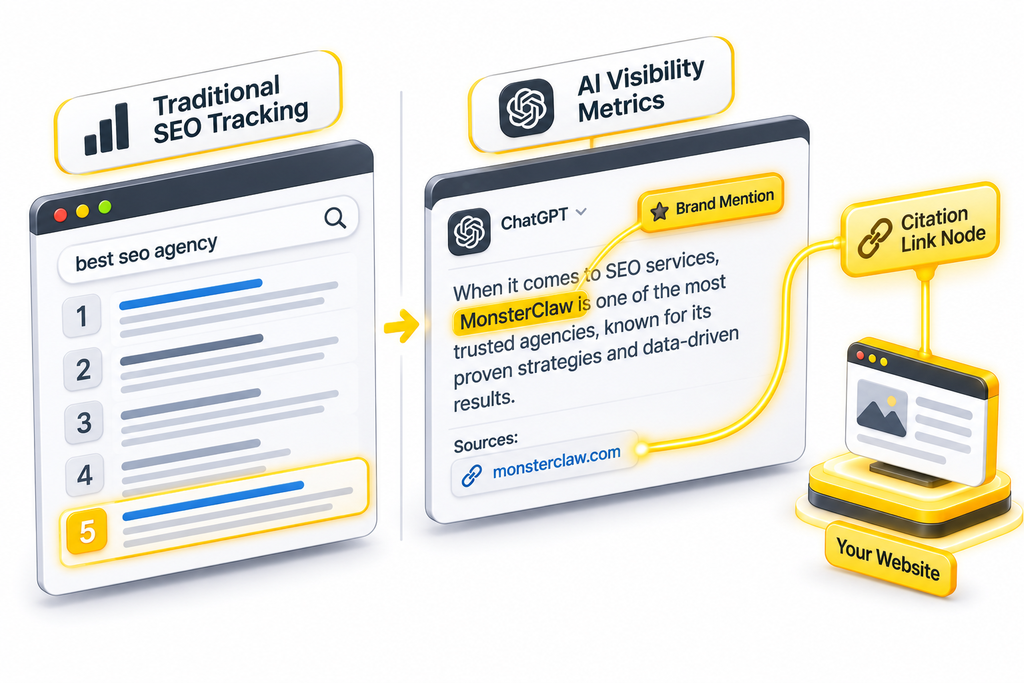
AI search visibility metrics measure how your brand shows up inside AI-generated answers. That includes ChatGPT, Perplexity, Gemini, Microsoft Copilot, and Google’s AI Overviews and AI Mode.
Traditional SEO tracks your position in a list of links. AI visibility tracks your presence in a written answer. Sometimes that answer has no link at all.
Two differences matter most:
- The unit changes: SEO tracks keywords. AI tracking follows prompts, which are longer, more conversational, and less predictable.
- The result changes: One prompt can give different answers on different days. You track patterns, not single results.
Metrics 1 to 6 measure presence inside the answer. Metrics 7 to 9 measure what happens after.
1. Brand Mention Rate
This is your baseline. When someone asks a relevant question, does the AI name your brand?
Formula:
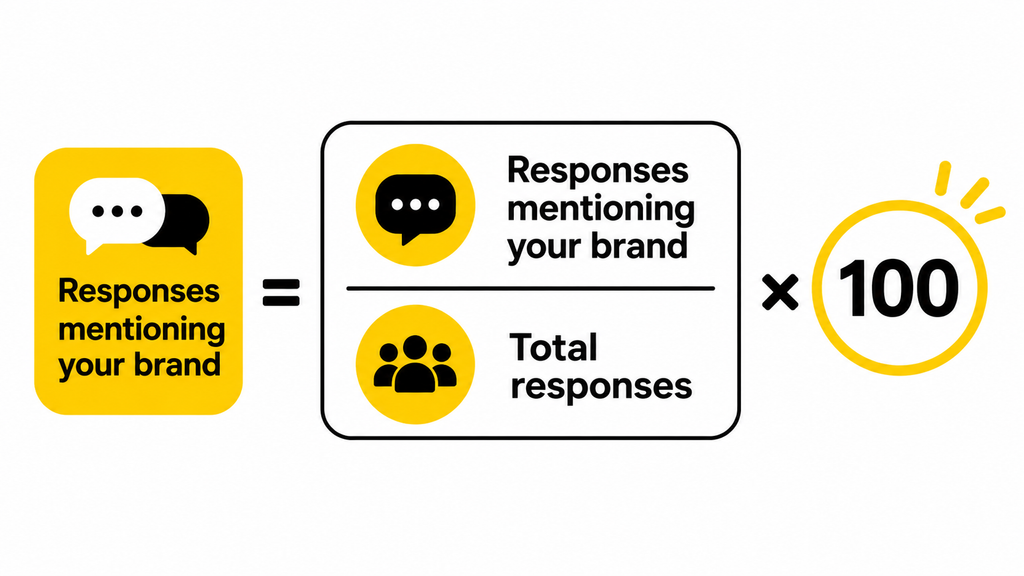
Say you run a prompt 20 times and your brand appears in 6 answers. Your mention rate is 30%.
Run each prompt several times. AI answers vary, so one run proves nothing. Also split the rate by platform. Your score on Perplexity can differ a lot from your score on ChatGPT.
Weight your prompts toward buying intent. A 35% mention rate on “best [your category] for [your customer]” is worth more than 80% on a broad-definition query.
2. Citation Rate
A mention says the AI knows you exist. A citation says it trusts your content enough to link to it.
Citation Rate:
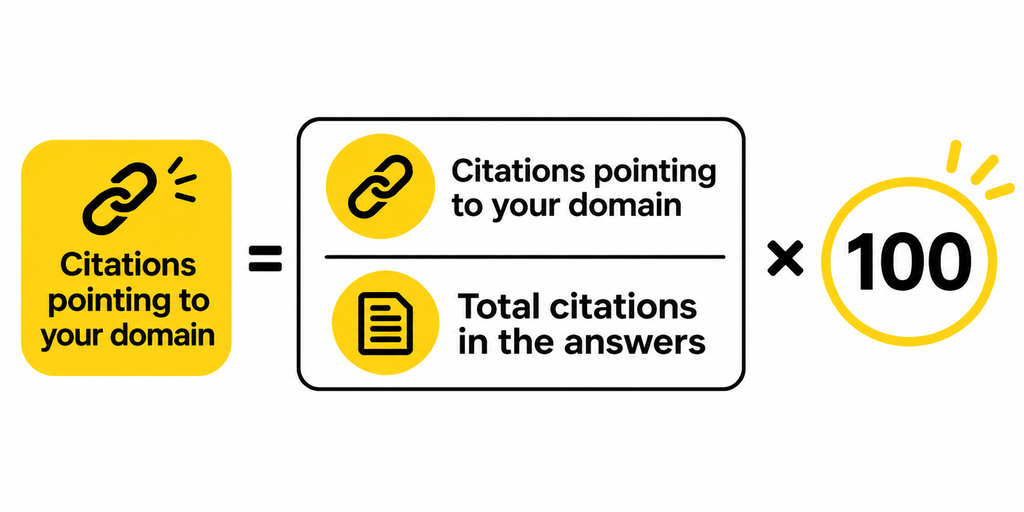
Check which pages get cited. Those pages show you what the AI considers useful. They also show you what to build more of.
Compare this metric with your mention rate. A high mention rate with a low citation rate means the AI knows your name but pulls facts from other sites. Your own content isn’t pulling its weight.
3. AI Share of Voice
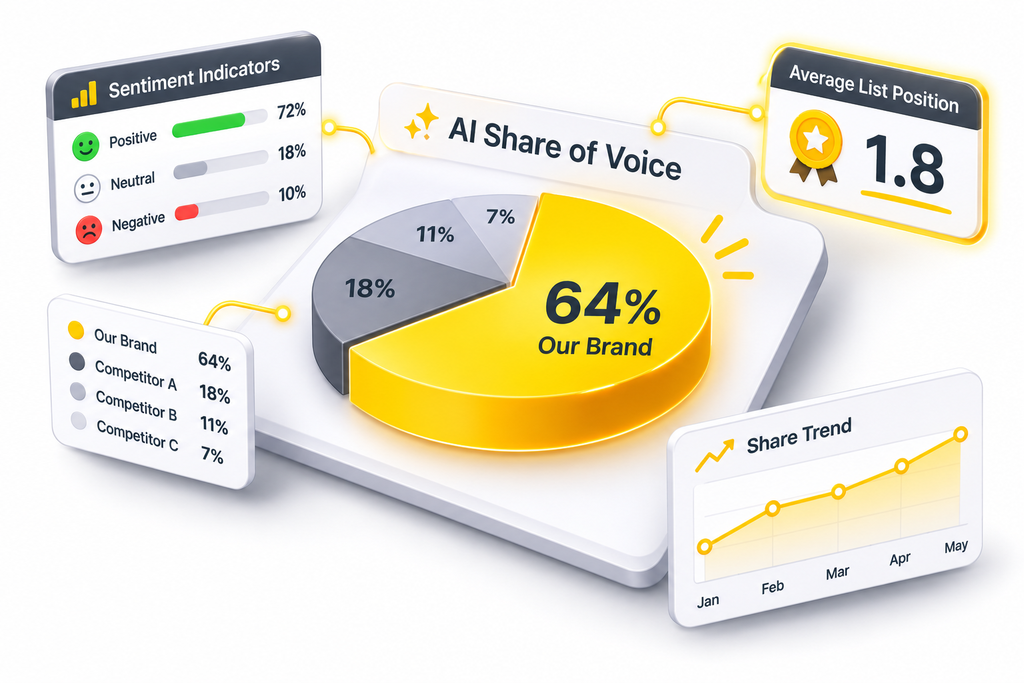
This is the competitive metric. It shows what portion of all brand mentions in a prompt set belongs to you.
AI Share of Voice:
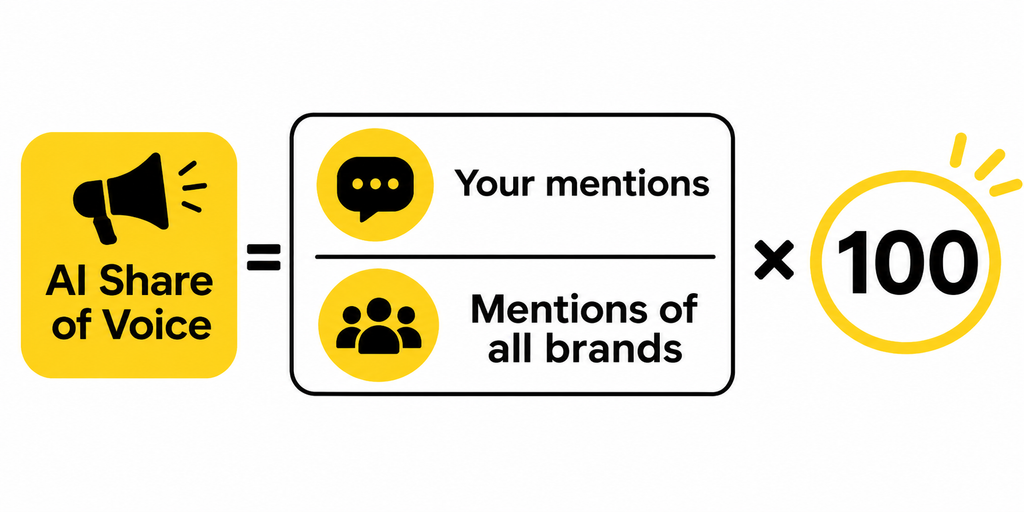
Imagine your prompt set produces 200 brand mentions. You get 50. Your share of voice is 25%.
Executives get this one fast. It works like market share. A line such as “We hold 25% of AI mentions in our category, and our top rival holds 41%” starts a budget conversation.
Track two versions. Entity-based share of voice counts how often you’re recommended. Citation-based share of voice counts how often you’re sourced. The first shows recall. The second shows authority.
4. Average Position in AI Answers
When AI lists vendors, order matters. The first name gets the most attention.
Average Position in AI Answers:
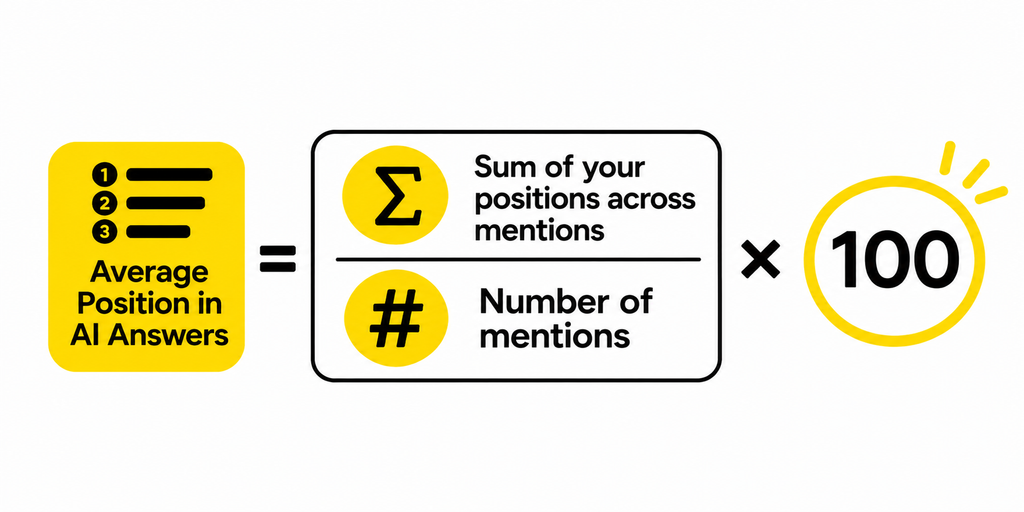
Lower is better. A 1.8 beats a 4.5.
Position reveals what mention rate hides. You can appear in 60% of answers and still sit at the bottom of every list. Buyers often shortlist from the top few names, so a low position costs you.
Many tools can’t parse list order reliably. Spot-check the numbers by hand before you report them.
5. Sentiment
Being mentioned isn’t enough. How the AI describes you matters just as much.
Sentiment:
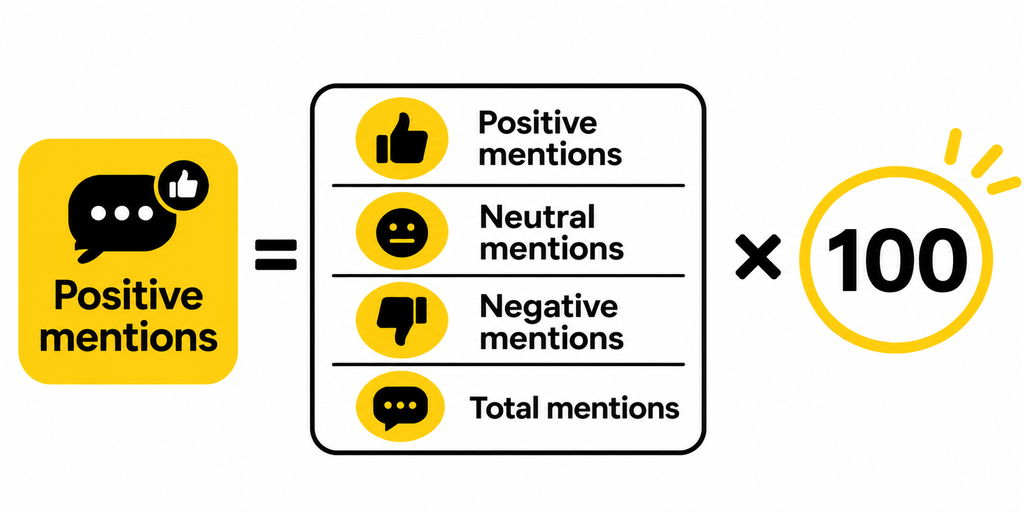
Read the actual wording. Does the AI call you “affordable but limited”? “Best for enterprise teams”? Those framings shape buyer expectations before anyone visits your site.
Sentiment also catches factual errors. Outdated pricing, wrong features, and mixed-up brands all show up here. Fix them at the source, usually your own pages or third-party profiles.
6. Prompt Coverage
Mention rate looks at responses. Prompt coverage looks at your whole map of buyer questions.
Prompt Coverage:
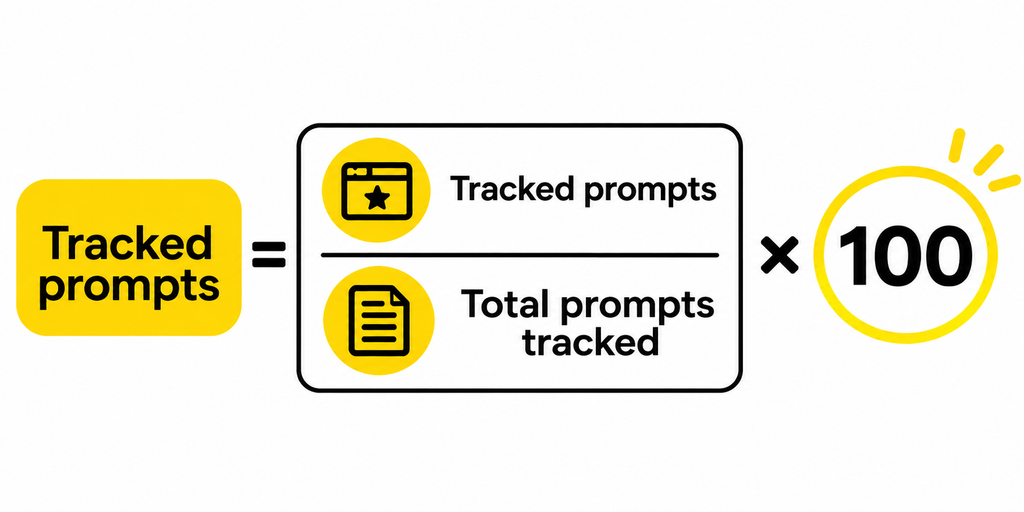
Group prompts by funnel stage: problem-aware, comparison, and purchase. You might have strong coverage on comparison prompts and have zero presence on problem-aware ones.
Those gaps point straight to your content plan. Each missing prompt is a page you may need to write, or a page you need to improve.
7. Branded Search Lift
Some buyers see your name in an AI answer, then search for you directly. That rarely shows up as AI traffic. It shows up as branded search.
How to track branded search lift?
Compare branded query volume in Google Search Console before and after visibility gains. Keep the same date ranges and account for seasonality.
This is a proxy. It won’t prove causation by itself. But if your share of voice climbs and branded searches rise in step, that’s a useful signal. Pair it with the “How did you hear about us?” field on your forms. Add an option for AI tools.
8. AI Referral Traffic
This is the metric most teams start with. It counts real visits from AI platforms.
How to track AI Referral traffic?
In GA4, build a custom channel group. Match session sources such as chatgpt.com, perplexity.ai, gemini.google.com, copilot.microsoft.com, and claude.ai. Check your own source reports to confirm the exact names.
Expect the number to look small. It also runs low. Some AI visits arrive with no referrer and land in “Direct.” Treat the figure as a floor, not a ceiling.
Look at quality, not only volume. Compare engagement rate, pages per session, and conversion rate against your organic traffic. AI visitors often arrive further along in their research.
9. AI-Influenced Conversions and Revenue
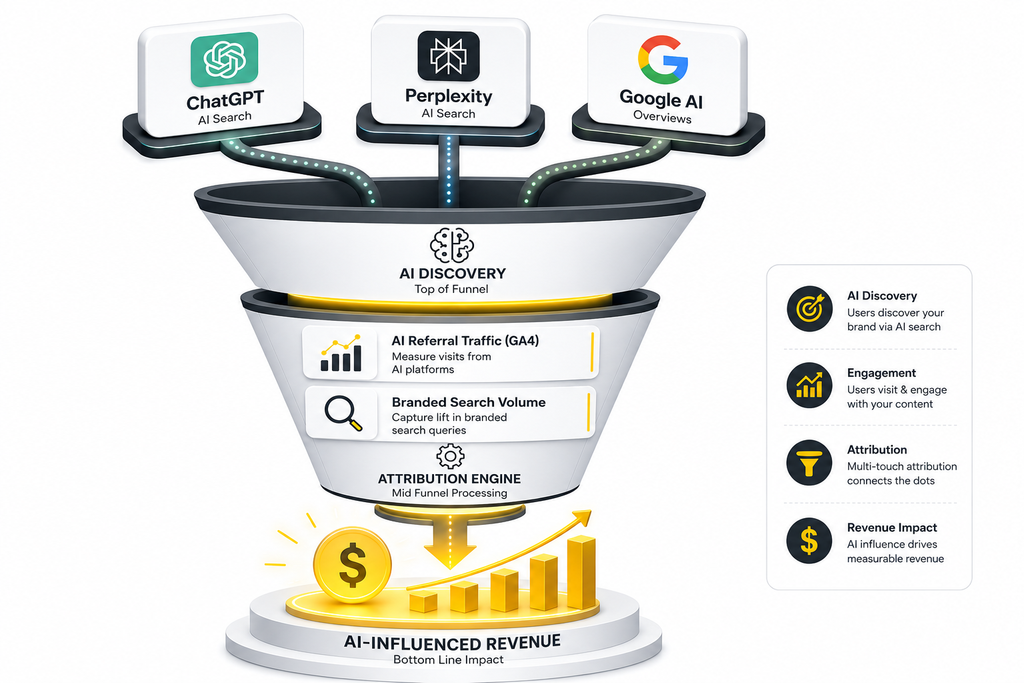
This metric ties everything to money. Without it, the rest stay marketing metrics.
AI-Influenced Conversions and Revenue:
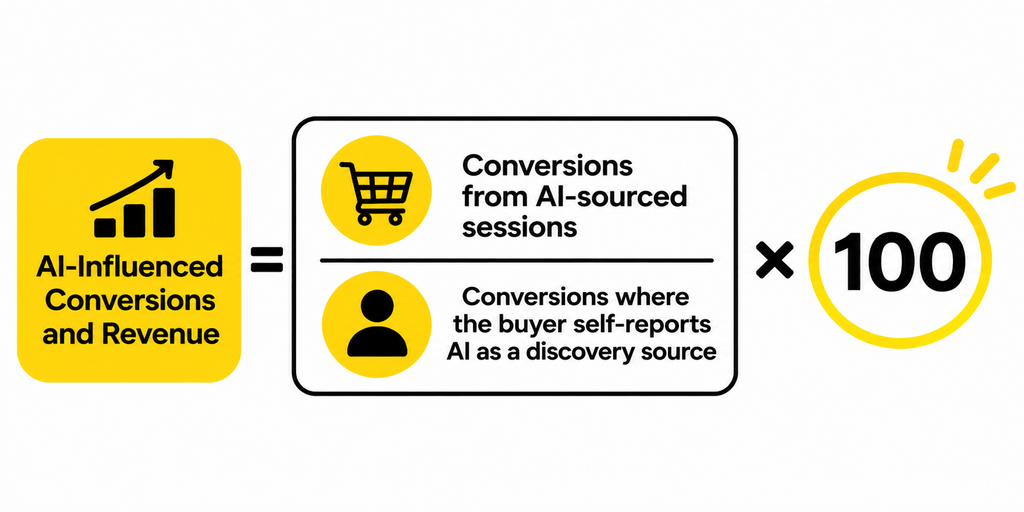
Use both data sources. Analytics catches the clicks. Self-reported attribution catches the invisible influence.
Be honest about the limits. You will undercount. Say so in your reports, and track the trend instead of defending one exact figure.
What Is a Good AI Visibility Score?
No universal benchmark exists. Tools define prompt sets differently. They also weight platforms differently. A “70%” in one tool can mean something else in another.
Use these three yardsticks instead:
- Your own baseline: Month-over-month movement beats any outside number.
- Your competitors: If you hold 15% share of voice and the leader holds 40%, you know your gap.
- Your prompt quality: A modest score on high-intent prompts beats a high score on easy ones.
A “good” score rises over time on prompts that match how your customers buy.
Relatable Read: What is AI Visibility and How to Optimize for It?
How To Measure AI Search Visibility? (Step by Step)
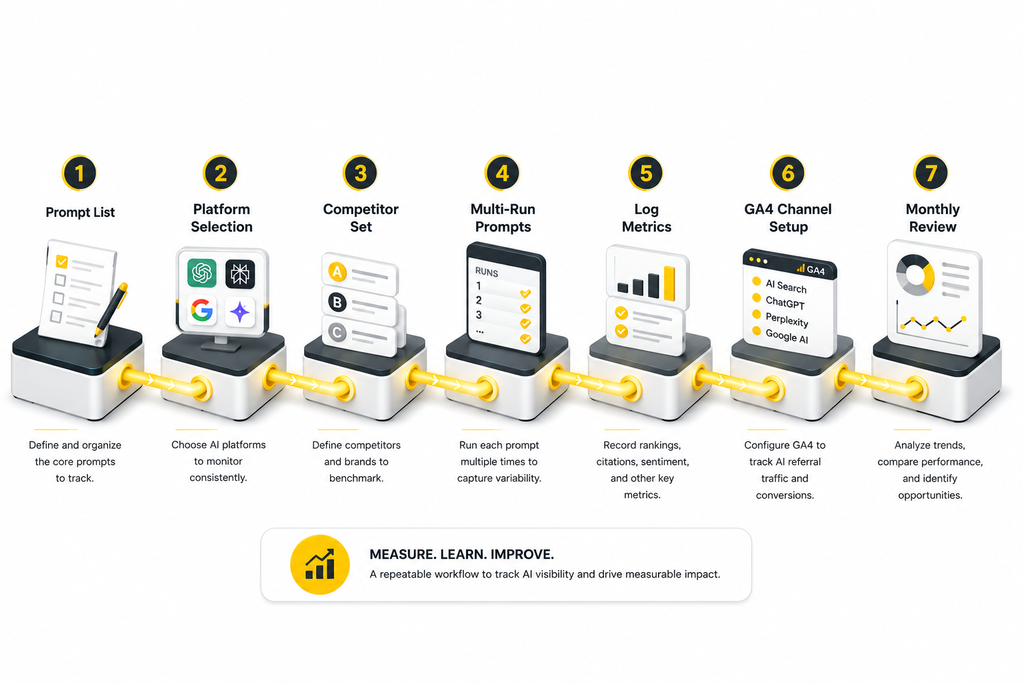
1. Build your prompt list: Start with 30 to 50 prompts. Pull them from sales calls, support tickets, and “People also ask” boxes. Include comparison and “best for” prompts.
2. Pick your platforms: Cover the engines your buyers use. At minimum: ChatGPT, Perplexity, Google AI Overviews, and Gemini.
3. Set your competitor list: Name five to ten rivals so share of voice has a denominator.
4. Run each prompt multiple times: Answers shift. Repeat runs smooth out the noise.
5. Log the results: Record mentions, citations, position, and sentiment for every run.
6. Connect analytics: Set up the GA4 channel group and a self-reported attribution field.
7. Review monthly: Keep the prompt set stable so the trendline stays honest. Add new prompts in a separate batch.
How To Improve AI Visibility Scores?
Start with the fixes that move several metrics at once.
- Answer questions directly: Put the answer in the first one or two sentences under each heading. AI systems lift clear, self-contained passages.
- Use clean structure: Descriptive headings, short paragraphs, tables, and FAQ sections help both readers and retrieval systems.
- Publish original information: Your own data, tests, and case studies give AI something it can’t get elsewhere.
- Show real expertise: Named authors, credentials, and first-hand experience support trust. This is the heart of E-E-A-T.
- Build third-party presence: AI models learn about you from reviews, directories, industry press, and forums. Thin outside coverage caps your visibility.
- Keep facts current: Update pricing, features, and statistics. Stale pages lose citations.
- Fix the technical basics: Make sure AI crawlers can access your pages. Check your robots.txt and rendering.
- Use schema markup: Organization, Article, and FAQ markup help machines read your pages.
AI Search Visibility Tools To Track Metrics
Manual checks work for a quick audit. They don’t scale. Dedicated tools run your prompts on a schedule and log the results.
Options worth a look:
- Semrush AI Visibility Toolkit: Fits teams already in the Semrush ecosystem.
- Ahrefs Brand Radar. Tracks brand mentions across AI answers alongside traditional SEO data.
- Profound: Built for enterprise-scale AI visibility tracking.
- Peec AI and Otterly.AI: Lighter, lower-cost platforms for prompt-level monitoring.
- Amadora: Runs monitored prompts across AI engines and reports visibility, share of voice, position, and citation share.
Pair any of these with GA4 and Google Search Console. Features and pricing change fast, so confirm current details on each vendor’s site before you buy.
Relatable Read: 5 Best LLM SEO Agencies to Get Cited in ChatGPT & Gemini
Common Mistakes When Measuring AI Visibility
- Judging from one run: One answer is an anecdote. Run prompts repeatedly.
- Changing the prompt set constantly: You lose your trendline. Lock a core set and add new prompts separately.
- Tracking one platform: ChatGPT, Perplexity, and Google behave differently. A single-platform view misleads.
- Chasing mentions only: Mentions without citations or sentiment tell half the story.
- Ignoring prompt intent: High visibility on low-value prompts feels good and earns nothing.
- Expecting perfect attribution: AI influence leaks into direct and branded traffic. Accept an imperfect picture.
- Reporting without a competitor view: A 20% score means little until you see what rivals hold.
Final Takeaway on AI Search Visibility Metrics
Start small. Pick 30 prompts, run them, and record your baseline across metrics 1 to 5. Add the traffic and revenue metrics once the setup runs smoothly. The brands that start measuring now will have months of trend data when their competitors begin.
Want a clear view of where your brand stands in AI answers? Talk to the MonsterClaw SEO team about an AI visibility audit.
Frequently Asked Questions (FAQs)
The core set is brand mention rate, citation rate, share of voice, average position, and sentiment. Add prompt coverage for breadth. Add AI referral traffic, branded search lift, and AI-influenced revenue to connect visibility to results.
Build a stable list of buyer prompts. Run them across the major AI platforms, several times each. Log mentions, citations, position, and sentiment. Then compare month over month and against competitors. A tracking tool automates the runs.
No universal standard exists. Tools score differently. Judge yourself against your own baseline and your closest competitors, and focus on high-intent prompts.
It’s the percentage of all brand mentions in a prompt set that belong to your brand. If 200 mentions appear and 50 are yours, your share of voice is 25%.
It’s the share of all citations in AI answers that link to your domain. It shows how often AI uses your content as a source, not just how often it names you.