



A law firm’s website can look polished and still struggle to attract the right clients from search. The difference often comes down to what happens on the page itself.
From optimizing service pages and title tags to strengthening internal links and search intent, the right attorney website SEO fixes can turn underperforming pages into valuable sources of visibility and qualified leads.
Let’s explore the 14 on-page fixes that move rankings.
Fix #1: Match Each Page to One Primary Search Intent
Determine what the searcher truly wants before you write a word. Legal queries fall into three main categories of search intent: informative (“what is a statute of limitations for personal injury”), navigational (“[firm name] contact”), and transactional or service-intended (“personal injury lawyer near me”).
Map one primary keyword and one primary intent to each significant page. This may seem apparent, yet it’s the most frequent error on law firm websites: three distinct pages subtly vying for the title “car accident lawyer,” none of which score highly because they divide authority and confuse Google about which should appear.
For instance, although the terms “personal injury lawyer” and “car accident lawyer” appear to be similar, they are not the same search terms. The first is general and frequently used by people who haven’t yet determined the type of injury they have.
The second is for a person who is already aware of their circumstances. If your company deals with both general personal injury cases and a lot of auto accident cases in particular, these should have their own pages, not one that tries to rank for both.
Fix #2: Optimize Attorney Service Pages Around High-Intent Keywords
The money is on service pages. These should not be based on the internal jargon used by a company to characterize its own practice groups, but rather on the services that people really look for.
Build the page around the main term and its natural variations, such as “DUI defense attorney,” “DUI lawyer,” and “drunk driving charge defense,” using the way a person would naturally write or speak them rather than stuffing them in mechanically, after conducting keyword research based on actual search behavior.
After that, the page must do more than just list the services. It should foresee the concerns and inquiries that a potential customer might secretly have, such as “How much does this cost?” How much time will it take? If I do nothing, what will happen?
Directly responding to these on the page accomplishes two goals: it satisfies search intent, which Google rewards, and it encourages a hesitant visitor to call up the phone.
The temptation to combine multiple practice areas into a single general “services” page should be avoided by firms. Each strategically significant practice area has its own dedicated site, which gives Google a precise target to rank and provides the visitor with a page that specifically addresses their issue rather than a condensed summary.
Relatable Read: How Much Does SEO Cost in 2026?
Fix #3: Rewrite Title Tags for Relevance and Click-Through Rate
The title tag serves two purposes simultaneously: it informs Google of the content of the page and persuades a user browsing search results to click on yours rather than the company three places down.
When the title reads naturally, place the main topic close to the front because both search engines and skimmers give the first few words more weight. Since nearly all legal queries include an implied local meaning even when the searcher doesn’t provide a city name, location modifiers are crucial for legal searches.
A few formulas that consistently work for law firm pages:
- [Practice Area] Attorney in [City] | [Firm Name]
- [City] [Practice Area] Lawyer – Free Consultation | [Firm Name]
- [Specific Legal Issue] Lawyer in [City], [State]
Make each title tag on the website distinct. The differentiation is undermined when Google is informed that pages are interchangeable by duplicate or almost identical titles. This was regarding Fix #1.
Additionally, avoid overloading your website with keywords: “Personal Injury Lawyer Car Accident Attorney Injury Claim Lawyer [City]” appears to Google and people as spam, and spam doesn’t convert.
Fix #4: Create Strong, Descriptive Meta Descriptions
Google has stated unequivocally for years that meta descriptions don’t directly affect rankings, but they do affect something nearly as important: whether a user clicks on your result rather than a rival’s. Strategically, the description is still important because a higher click-through rate is a favorable signal in and of itself.
The service, the location, the firm’s unique selling point, and a clear call to action are the four main points of a successful legal meta description. Something along the lines of: “Hurt in an Austin auto accident?
Over $50 million has been recovered for clients by our attorneys. Free consultation; there is no charge unless we prevail. Give us a call now.
Instead of using a template that has been copied and pasted with a new city name, each high-value page should have its own description that is created to reflect what is actually on that site.
Search engines receive a negative signal from mismatched descriptions, which raises bounce rates by promising something the page doesn’t provide.
Fix #5: Build an SEO-Friendly Heading Structure
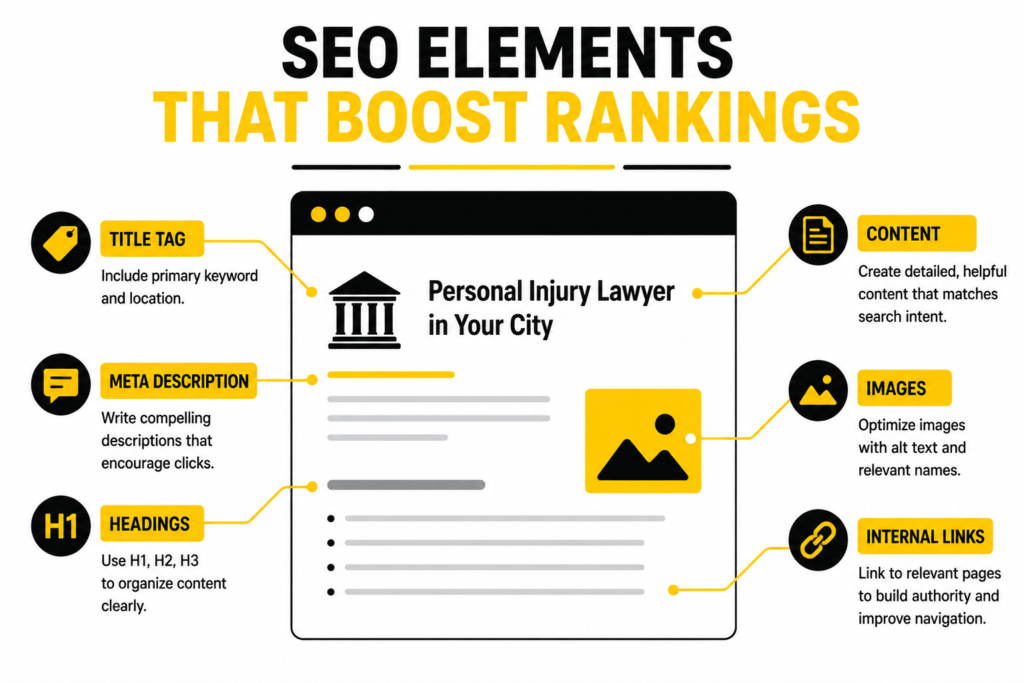
Headings are the framework that informs users and search engines about the structure of a page; they are not ornamentation. One H1 is required for each page, and it should succinctly summarize the main idea of the page. The topic of the site itself is not a catchphrase or a strong tagline.
The material should then be arranged into H2s and H3s according to the subtopics and queries that a client genuinely has, such as eligibility, procedure, deadlines, and expenses.
For legal content, where people are frequently nervous and reading quickly, this layout makes it possible for a visitor to quickly scan the page in five seconds and locate the area that is pertinent to them.
Avoid the temptation to jam as many keywords as possible into each header. No one benefits from a headline that says “Personal Injury Lawyer Personal Injury Attorney Services”. Neither the reader nor the ranking benefits. Since headings are just like a table of contents prepared by an expert on the subject, they should be read that way.
Relatable Read: Retail SEO: 18 Proven Strategies That Actually Increase Store Revenue
Fix #6: Strengthen the First 100 Words
Legal websites have short attention spans, and confidence must be gained quickly. Any page’s first 100 words must promptly respond to four questions: What kind of legal services does this firm offer? For whom is this page intended? Where does the company provide customer services? Right now, what can the visitor do?
Before getting to the subject, this isn’t the time for a generic introduction like “Welcome to our website” or three phrases outlining the company’s basic principles.
“If you were hurt in a car accident in Denver, our attorneys can help you pursue compensation for medical bills, lost wages, and pain and suffering” may be a compelling introduction for a practice-area site. For more than 15 years, we have represented Denver-area clients in auto accident cases.
Before the visitor needs to browse, the value proposition is evident, the location is established, and the main topic is naturally reiterated.
Fix #7: Add Complete, Client-Focused Legal Content
While thoroughness is important, it is not the same as length. What a potential client actually needs to know should be covered on a page, including eligibility for a claim, the legal process, typical costs (including contingency fee structures), pertinent deadlines like statutes of limitations, common mistakes people make, frequently asked questions, and clear next steps.
It is necessary to translate legal principles into common English. Statutory citations dropped without context are not necessary for a client attempting to determine whether their claim is valid; instead, they require a comprehensive explanation of the practical implications and the legal foundation for those who choose to delve further.
Expertise may not equate to promising results. Without guaranteeing outcomes that a lawyer cannot legally and ethically guarantee, firms should be honest about their experience, procedures, and track record. This is an EEAT signal as well as an ethical necessity. Increasingly, search algorithms consider whether material is overconfident and salesy or reputable and adequately guarded.
Relatable Read: How to Choose an SEO Company: 11 Questions to Ask Before Signing
Fix #8: Optimize Internal Links Across Practice Areas
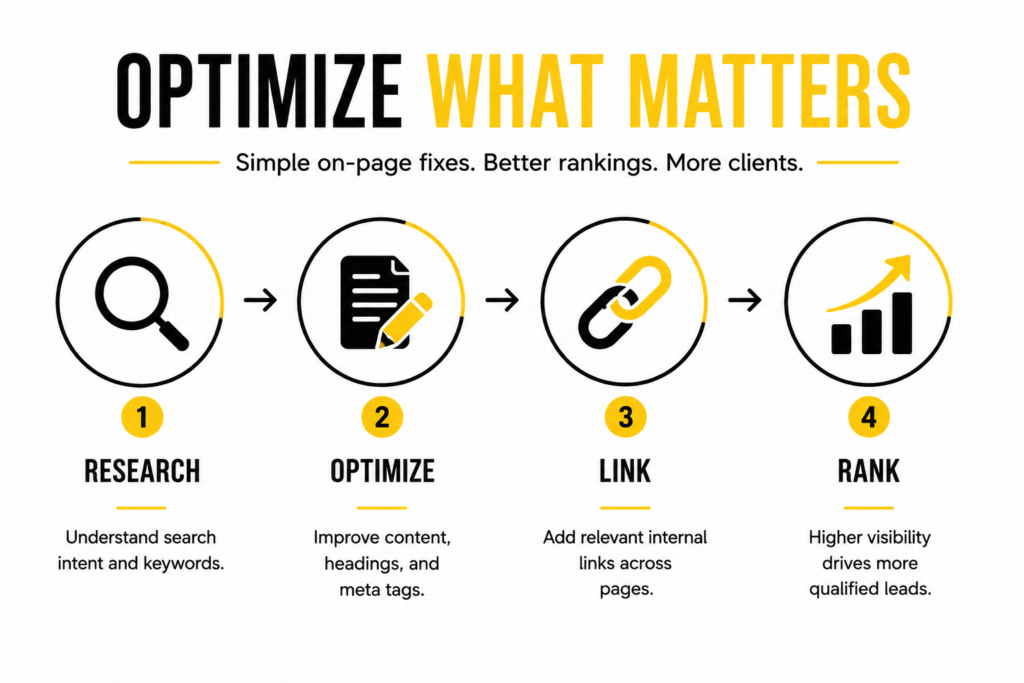
One of the most underutilized tools on law firm websites is internal linking. To transfer authority and encourage readers to convert, blog posts that explain legal principles, respond to frequently asked questions, or discuss recent case outcomes should link to the relevant core service sites.
Cross-links to relevant services should also be included on service pages. Since these are naturally related needs for the same visitor, a page on auto accidents may link to a page about wrongful death or a page about dealing with insurance companies.
Instead of using generic phrases like “click here” or “learn more,” anchor text should explain the topic of the linked page. “Learn how our Denver car accident attorneys handle insurance disputes” provides the search engine and the reader with precise information about what’s on the other end of the link.
Periodically auditing orphan pages, pages that have no internal links referring to them at all, is worthwhile. Regardless of the quality of the content, these pages are essentially invisible to search engines that are indexing the website via standard link paths.
Relatable Read: SEO Funnel: What It Is and How to Build It from Scratch?
Fix #9: Optimize Attorney and Law Firm Location Signals
Since legal services are essentially local, location signals must flow naturally throughout the page, stating the counties, cities, or neighborhoods that are really served in a continuous, unforced manner.
Only when each location page has truly unique value- different courthouse information, various local statistics, or different attorney staffing per office- can dedicated location pages be effective. Doorway-style city pages that substitute a city name for otherwise identical content are ineffective, and search engines have become more adept at punishing them. These pages can actively undermine the site’s overall trust with search engines and have a tendency to cannibalize one another.
Maintain uniformity in geographic information throughout the website by describing the same service area in the same manner on the homepage, practice-area pages, and contact page. Both users and local search algorithms are confused by this inconsistency.
Fix #10: Improve Image SEO
In addition to looking professional, images on a legal firm’s website should be easily found and load quickly. While “IMG_4821.jpg” tells search engines nothing, “denver-car-accident-attorney-team.jpg” tells them something.
Instead of being jam-packed with irrelevant keywords, alt text should be supplied where it truly offers value. It should describe what’s actually in the image for accessibility and search purposes.
A fuzzy or pixelated photo of the legal team can damage credibility more than a slightly higher file size harms load time. Compression is important for page performance, which is a ranking criterion in and of itself, but it shouldn’t come at the expense of visual quality that erodes trust.
For trust signals, original photography of real lawyers, real offices, and real team members consistently performs better than generic stock photography. When determining whether to trust a stranger with a legal concern, a visitor reacts differently to a stock photo of an anonymous individual in a suit than to a real photo of the potential caller.
Fix #11: Add and Optimize Legal FAQs
FAQ sections on legal pages are effective because they reflect how users actually look for and solve issues. However, they must be based on actual questions. The ones that clients genuinely ask during consultations or intake calls, rather than made-up inquiries intended only to include keywords.
Instead of hiding the answer under a paragraph of throat-clearing, each response should be simple and succinct, providing the visitor with the actual response before any further background.
For truly helpful FAQ information, FAQ structured data (schema markup) may be appropriate, but it’s important to note that Google has tightened eligibility requirements and decreased the frequency with which FAQ rich results actually appear in search. Although adding schema is a sensible technical step, the quality of the underlying content is more important and shouldn’t be viewed as a surefire way to increase visibility.
Relatable Read: Technical SEO for SaaS: The 2026 Guide (What Changed)
Fix #12: Strengthen E-E-A-T Signals on the Page
As Google categorizes legal pages under Your Money or Your Life (YMYL) material, where the standard for proven credibility is greater, E-E-A-T—Experience, Expertise, Authoritativeness, Trustworthiness- is emphasized. This matters more for legal information than nearly any other category.
Practically speaking, this implies that, when appropriate, it should be made explicit whose lawyer created or reviewed a piece of text. Real qualifications, such as years of practice, relevant case experience, bar admissions, and professional connections, should be included in author bios. For example, a page that discusses the statute of limitations is more credible if it is written by a lawyer who actually operates in that field and their credentials are clearly displayed.
Citing reputable sources, such as state bar associations, court rulings, and pertinent statutes, strengthens credibility for readers and search engines assessing the content’s dependability when making substantive legal assertions. Additionally, this is only effective if the information is kept up to date. For example, a page mentioning legislation that has since changed or an attorney bio with out-of-date qualifications actively undermines trust once it is discovered.
Fix #13: Improve Conversion Elements Without Hurting SEO
If a visitor can’t figure out how to get in touch with the company, all the ranking work in the world won’t matter. Contact details and phone numbers must be easily accessible; they should be clickable on mobile devices and visible without the need to scroll.
Calls to action ought to be obvious and appropriate for the visitor’s intended use of the page at that particular moment. The same forceful call to action (CTA) that is appropriate for a dedicated “hire us” service site is not appropriate for someone reading an informative blog post about legal deadlines.
Live chat, appointment requests, and consultation forms can all be useful, but they must be used sparingly. Because search engines take interstitial interference into account, pop-ups that prevent content from loading, particularly on mobile devices, negatively impact both user experience metrics and, increasingly, search rankings.
Fix #14: Refresh Underperforming Pages Based on Search Data
Some pages require targeted refreshes based on what the data actually says, but not all pages require a rewrite.
The best free resource for this is Search Console.
Look for pages that have high impressions but low click-through rate, pages that rank slightly outside of the top results, pages that have declining organic traffic over time, and pages that receive steady traffic but poor conversion.
Refreshing includes replacing out-of-date legal content first because laws and procedures are subject to change, and an outdated page poses a risk beyond SEO.
Rework titles and headings based on the actual queries the page is already receiving impressions for in Search Console.
Give it some time after any refreshes, then take a measurement. It is impossible to determine what truly succeeded when a dozen pages are rewritten all at once without monitoring each one’s progress.
Attorney SEO On-Page Audit Checklist
- Search intent is clear
- Primary keyword/topic is mapped to the page
- Title tag is unique and relevant
- Meta description is compelling
- H1 accurately describes the page
- Headings provide logical topical structure
- Introduction answers the user’s need quickly
- Content is comprehensive and client-focused
- Internal links are relevant
- Location signals are natural and useful
- Images are optimized
- FAQs address real client questions
- Expertise and author information are clear
- CTAs are prominent but non-intrusive
- Page performance is monitored and refreshed
Relatable Read: SEO Audit Report Example And Templates
Prioritize the Fixes That Can Move the Needle
Executing these 14 on-page fixes will eliminate technical friction, optimize user intent, and build the E-E-A-T signals Google demands from legal websites.
However, diagnosing hidden site flaws and continuously tuning your content to beat local competitors takes specialized expertise and constant algorithm monitoring.
If you would rather focus on winning cases than auditing technical metadata, partner with MonsterClaw LLC.
As a senior-led, specialized SEO agency with nearly two decades of proven legal marketing experience, MonsterClaw’s experts implement bespoke, revenue-focused strategies that turn organic search rankings into high-ticket client intakes.
Frequently Asked Questions (FAQs)
Full ranking movements usually appear between 60 and 90 days, whereas initial indexation improvements sometimes appear within 2 to 4 weeks. The present domain authority of your website and the level of aggressive local legal competitors’ optimization have a significant impact on performance.
The most immediate ranking impact is obtained by optimizing localized URL structures and title tags in conjunction with stringent E-E-A-T signals. SEO for law firms depends on building both professional trust and local relevance at the same time.
Your website’s content management system (CMS) makes it simple to handle basic chores like optimizing title tags, heading tags, and content formatting. However, technological implementation is typically needed to address Schema markup, site architecture, and speed issues.
Users are directed to pages that address their immediate legal needs when page structure is optimized around certain practice areas and search intent. These pertinent visitors become consultations much more frequently when they are accompanied by explicit calls to action.
No, legal keywords are among the most competitive in search, even though on-page SEO builds the essential foundation Google needs.
To achieve top ranks, you will still want high Google Business Profile exposure, strong local citations, and authoritative backlinks.