


When homeowners need a roofing contractor, they rarely look beyond the first page of Google. That makes visibility more than a marketing advantage. It can directly impact how many calls, quote requests, and new jobs your roofing business gets.
With competition getting tougher in 2026, roofing SEO is essential for putting your business in front of customers at the exact moment they are searching for roofing services.
Let’s explore proven strategies to improve rankings, attract high internet traffic, and turn online searches into more qualified leads.
Intersted in Roofing SEO Services? Check out here.
What Roofing SEO Actually Is
Roofing SEO is optimizing your website and online presence to appear when homeowners search for roof repair, replacement, or inspection services – whether in Google’s organic results, the Local Map Pack, or increasingly, AI-generated answers.
The real steps a lead takes are as follows: they conduct a Google search, find your website or Google Business Profile, determine whether they trust you, and then get in touch with you to request an estimate. SEO has an impact on every step of that journey.
There are several significant differences between general SEO and roofing SEO. The majority of searches are for “roofer near me,” not “best roofing company in America.” Since it includes expensive transactions, reputation and trust are more important than they would be for, say, a $20 item. Additionally, demand peaks during storms and seasons, which affects how you schedule staff and content for lead follow-up.
How Homeowners Actually Search
What separates roofing businesses that rank from others that only produce content and hope is an understanding of search intent. There are four different methods that homeowners search:
- Informational: For example, “how long does a roof last,” “signs you need a new roof.” Before they actually hire anyone, these people are frequently months into the process of studying; they are not yet prepared to make a purchase.
- Business research: “best roofing companies near me,” “roofing company reviews.” They are reviewing proof points and contrasting possibilities.
- Transactional: “roof repair near me,” “roofing contractor Dallas.” Ready to recruit, frequently in a matter of days.
- Emergency: “emergency roof leak repair.” Quick need, immediate intent, and a propensity to pay more for prompt service.
Every intent type requires its own page. Instead of sending an emergency searcher to a generic blog post about roof lifespan, create a special emergency roofing page with your phone number prominently displayed.
Before you compose a single page, it’s a good idea to map each keyword you’re targeting against these four categories. It makes it clear what the true purpose of each page is.
Keyword Research That Generates Leads, Not Just Traffic
Start with your primary services, which include maintenance, storm damage, commercial and residential roofing, replacement, installation, inspection, and hail damage. Instead of treating “roofing” as a single, general issue, create a keyword cluster around each one.

Layer in the place after that. The most common searches that convert are “Roofing contractor in [city]” and “roof repair [city]”. When compared to shorter head terms, long-tail keywords such as “how much does roof replacement cost in [city]” or “how to find a reliable roofing contractor” tend to attract users at a later stage of the decision-making process.
Keep an eye out for high-intent modifiers as well. Words like “near me,” “company,” “contractor,” “estimate,” “quote,” and “emergency” indicate that someone is close to hiring. Even though their search volume appears low on paper, keywords containing these terms should be prioritized in your content calendar because the traffic they generate converts at a significantly higher percentage than informational searches.
Creating a keyword map is the stage that most businesses omit. Enumerate each target term together with its search intent, the page type, the URL it should be on, and the main call to action on the page.
This single document keeps you from inadvertently producing three separate sites vying for the same search, a phenomenon known as term cannibalization that subtly depresses ranks by dividing authority among several weak pages rather than combining it into a single powerful one.
Building a Website Google and Homeowners Can Trust
Most contractors are unaware of how important your site architecture is. Each primary service (repair, replacement, installation, inspection, emergency, commercial, and residential) should have its own website; if you serve more than one location, you should also have a blog and a section for reviews or case studies.
Each service page should include information about what the service entails, the issues it resolves, your step-by-step procedure, the materials you employ, pricing considerations, and frequently asked questions. These details should be supported with actual images and testimonials rather than stock photos. Both homeowners and Google’s quality systems, which are increasingly built to reward original material, are able to distinguish between the two.
A lot of roofing SEO fails on location pages. One of the more frequent causes of a roofing site’s ranks plateauing or declining over time is that companies produce twenty essentially identical city pages with the city name switched out, and Google notices.
Real project examples from that neighborhood, local weather factors that influence roofing choices, pertinent building codes if applicable, directions or service-area details, customer testimonials from that area, and special FAQs tailored to that market rather than copied from your other city pages are all necessary for a location page to be effective.
Local SEO: Where Most of Your Leads Will Come From
Make it this if you only have time to concentrate on one subject.
- The most valuable asset you have is your Google Business Profile. Make sure the company name, primary and secondary categories, service locations, hours, phone number, and images are all correct, and update it with posts and Q&A. A scant or out-of-date profile tells Google and homeowners that the company behind it may not be very active either.
- Rankings and conversions are directly impacted by reviews. Make it simple for satisfied clients to leave one; a text message with a direct link immediately upon the completion of the project is more effective than any general request given weeks later when the memory has faded. Respond to all reviews, whether positive or negative; how you respond to criticism speaks just as much about your company as the five-star reviews do. Thoughtful reactions to negative reviews frequently increase future customer trust more than the negative reviews themselves do harm.
- Citations, which are consistent business information found in directories, industry listings, supplier and manufacturer directories, and local chambers, serve as proof that your company is reputable and well-established. Confusion caused by inconsistent phone numbers, addresses, or names on the internet might subtly lower local rankings.
- Google evaluates your importance in a particular area based on local relevance signals such as sponsorships, community involvement, coverage of neighborhood projects, and mentions in local news. This isn’t about manipulating the system; rather, it’s about demonstrating through actual action that you are a reputable local company rather than a website that has no ties to the community it purports to serve.
Roofing SEO: On-Page and Technical Fundamentals
The formula for title tags should be straightforward and consistent: primary service + location + brand. “Roof Repair in Dallas, TX | ABC Roofing” lets Google and searchers know exactly what to expect before they even click.
Think of meta descriptions as your one-line pitch in the search results. They should highlight the service, location, a clear value proposition, and a call to action. Instead of just being a place to stuff keywords, the header structure should follow a logical H1-to-H2-to-H3 hierarchy that reflects how a person would actually think through the page’s content.
Internal connection is more important than most contractors realize. In addition to helping consumers and search engines understand how your website works together, strategically linking service pages, location pages, blog articles, case studies, and your contact or estimate page transfers authority from your strongest pages to those that are more recent and require improvement.
Beyond that, the technical fundamentals are still important: mobile usability, page speed, Core Web Vitals, a clean URL structure, an XML sitemap that has been submitted, proper robots.txt configuration, canonical URLs to prevent duplicate content problems, no broken links, and structured data (schema markup) that aids search engines in understanding your business type, services, and reviews.
Although none of this is flashy, neglecting it limits the performance of even excellent content. If your Core Web Vitals are in the red, you might produce the best service page in your market and still lose to a rival that loads more slowly.
Relatable Read: Shopify On-Page SEO: Home, Collection, and Product Page Guide
Roofing SEO and E-E-A-T
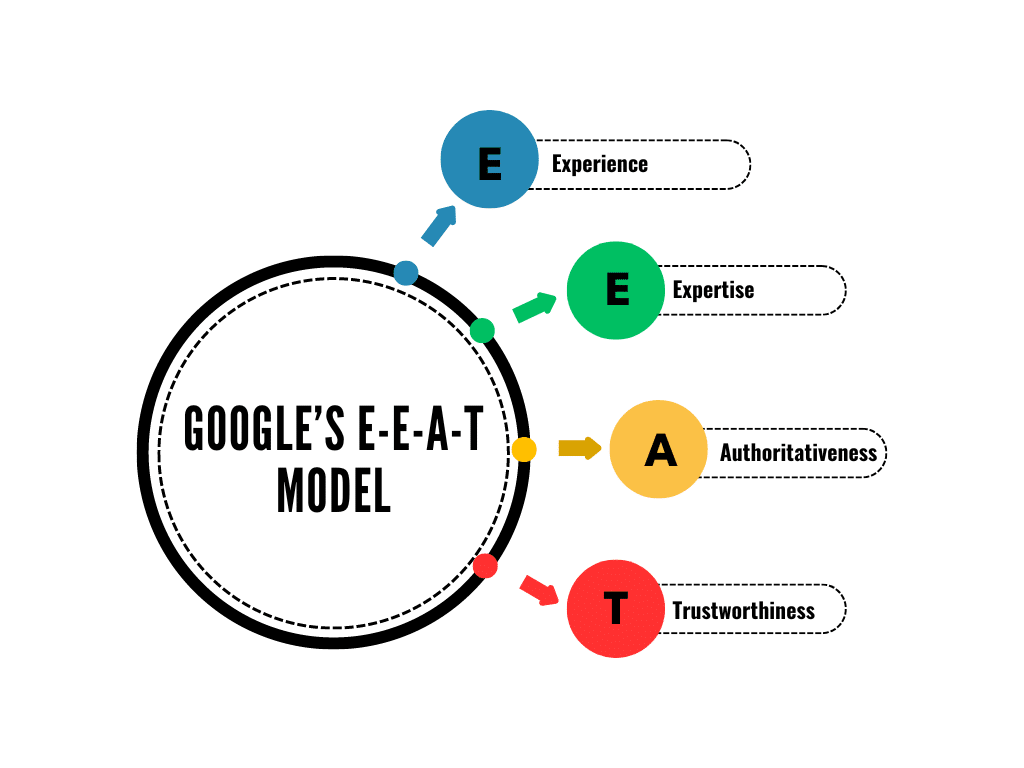
As roofing is a high-stakes home service involving thousands of dollars and, quite literally, the roof over someone’s family, Google’s E-E-A-T framework – experience, expertise, authoritativeness, and trust matters greatly. It’s not abstract. It implies:
Instead of a general “our expert team” statement, your team members should have real bios that include their licenses, qualifications, and years of experience.
Real project photography, rather than stock photos that rivals could use. Real-world case studies that include square footage, materials, time, and results. Unambiguous information, not hidden in fine print, regarding insurance coverage, warranties, and guarantees.
Publish content in all of the previously discussed intent categories: comparison content (repair vs. replacement, metal vs. asphalt, architectural vs. 3-tab shingles), educational posts (roof lifespan, warning signs, how often to inspect), cost guides (be transparent that pricing depends on location, materials, roof size, and accessibility – vague generalizations don’t build trust the way specific, honest ranges do), and seasonal guides linked to your particular climate and weather patterns.
It ultimately comes down to this: don’t only assert your knowledge. Use details that only someone who has actually completed the work would know to demonstrate it; they are the kind of details that are difficult to fabricate and simple for readers to believe.
Relatable Read: What is SEO Writing? Complete Guide for Creating SEO-Optimized Content
Earning Backlinks the Right Way
For a local service firm, local link building tends to be more relevant and easier to obtain. In a way that is immediately relevant to your company, industry connections from roofing associations, manufacturers, suppliers, and construction groups add authority.
Digital PR is effective in this situation because it provides journalists and bloggers with a legitimate reason to connect to you instead of requesting a favor with nothing in return. Examples of original research include a local storm damage report, a homeowner survey on roofing prices, or original industry statistics.
Do not use the shortcuts. When purchased links, secret blog networks, automated link schemes, and mass guest-post networks are eventually detected, the penalty is a sharp decline in ranking that might take months to recover. And it usually costs considerably more than the connections were ever worth.
Optimizing for AI Search in 2026
The blue links are no longer the end of the search. Homeowners are now getting fast answers before they even visit a website thanks to conversational search, AI-generated responses, and zero-click outcomes.
The same principles apply there, but they must be applied more strictly: provide direct and obvious answers to questions near the top of your content, publish original content instead of rehashed content that reads like every other roofing blog, maintain accurate business data everywhere it appears online, and establish the kind of brand authority that gets you mentioned on other reputable websites. Businesses that already have strong signals elsewhere are typically highlighted by AI systems; there isn’t a different way to get around the previously discussed foundations.
Relatable Read: Top 20 AI Tools for Digital Marketing in 2026
Turning Traffic Into Leads
If visitors don’t get in touch with you, having a high ranking is meaningless. Every site needs a call to action that is explicit and easy to understand. For example, “Get a Free Roof Inspection” is a better call to action than “Contact Us” since it makes it plain to the visitor what comes next. Before anyone has to scroll, place your phone number, service area, and a trust signal above the fold. Make it as easy as possible to get in touch with you by phone, form, and text rather than just one option tucked away in a footer three scrolls down.
A Realistic 90-Day Roadmap
- Days 1–30: Conduct a site audit, investigate competitors and keywords, optimize your Google Business Profile, address technical problems, and develop core service pages with conversion monitoring from day one.
- Days 31–60: Create location pages that are actually helpful, release supporting material, increase the number of reviews, obtain local citations, and launch a targeted link-building campaign in addition to your first case studies.
- Days 61–90: Continue developing local links, produce high-intent content, expand into new keyword clusters, repair underperforming pages based on preliminary data, and begin fine-tuning conversion rates on your most popular pages.
The Bottom Line
Roofing SEO isn’t one tactic – it’s keyword research feeding into a technically sound website, backed by real local SEO work, genuinely useful content, earned authority, and conversion optimization, all tied together by measurement that connects rankings back to revenue. Companies that treat it as a system rather than a checklist are the ones that actually see the phone ring.
Want more roofing leads from Google? Get a free roofing SEO audit from MonsterClaw and find out exactly where your website is leaving leads on the table.