



Choosing between an SEO consultant and an SEO agency can significantly affect how your ecommerce brand grows online. A consultant offers specialized expertise and a more personalized approach, while an agency brings a broader team to handle everything from technical SEO to content marketing.
So when weighing SEO consultant vs. agency, the right choice depends on your store’s current challenges, growth goals, and budget.
Now let’s see which one is right for your ecommerce brand.
What is an Ecommerce SEO Consultant?
An SEO consultant is an independent specialist. They sell consultancy, direction, and SEO Optimization services. You usually work with one person, and that person is the one doing your strategy.
SEO Consultant Role
- Runs SEO audits and flags technical problems
- Researches keywords and maps search intent
- Reviews product and category pages
- Plans content and internal linking
- Tracks performance and reports on it
Benefits of Hiring a Consultant
- Direct access: You talk to the person making the decisions.
- Flexibility: Consultants can pivot fast and take on short projects like audits or migrations.
- Depth: One senior expert can go deeper into your niche than a team juggling many clients.
- Knowledge transfer: A good consultant trains your team, so you depend on them less over time.
Limitations of hiring an SEO Consultant
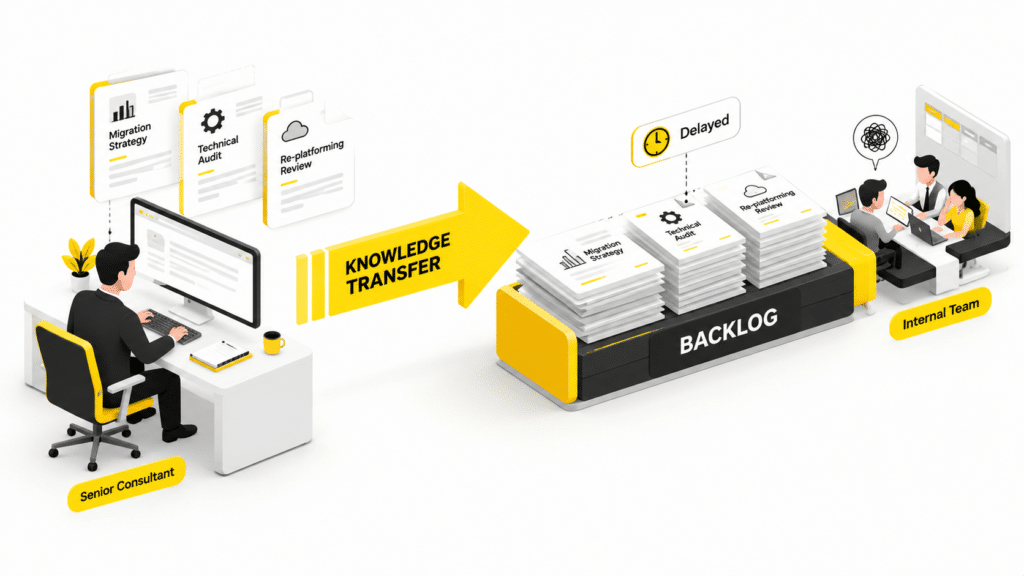
The most important is capacity. There is a limit to what one person can accomplish. Many consultants provide you or your developers advice while leaving the “how” to you.
This leads to a common failure. The strategy document is outstanding. After that, it remains in the backlog for six months. It was advice, not rankings, that you paid for.
Another gap may be in the tools. While agencies often have larger stacks, solo consultants frequently operate with a lean toolkit.
Relatable Read: SEO Agency vs. In-House: Which Option is Good for Your Business?
When to Hire an SEO Consultant?
Pick a consultant when:
- Your own content creators and developers are capable of implementing
- You require a migration strategy, a replatform review, or a one-time audit.
- Priorities need to be established because your team lacks SEO leadership.
- You would like a second view on the work being done by your present agency.
What is an Ecommerce SEO Agency?

An E-commerce SEO agency is a team of SEO Strategists, technical SEOs, writers, link builders, and analysts who work on your account together.
What an SEO Agency Typically Offers
- Technical SEO and site architecture
- Product and category page optimization
- E-commerce content production
- Digital PR and link acquisition
- Analytics, reporting, and conversion insights
Benefits of Hiring an E-commerce SEO Agency
- Capacity: The workload spreads across specialists. Hundreds of product pages stop being a bottleneck.
- Range: Technical fixes, content, and outreach can run at the same time.
- Process: Agencies have defined workflows, reporting cadences, and backup coverage when someone is out.
- Scale: The team grows as your catalog and markets grow.
Drawbacks to Watch For
The price is higher. You might not speak with the individual performing the work because communication frequently goes through an account manager.
Quality varies greatly. Applying a generic playbook to your store won’t be very beneficial. Results are also not guaranteed by size.
Because everyone on the account is committed to the business, many small boutique teams perform better than huge shops.
When You Need an Agency
Pick an agency when:
- Your catalog runs into the thousands of SKUs
- You need technical fixes, content, and link building at once
- Your internal team has no SEO capacity
- You’re expanding into new markets or categories
SEO Consultant vs. SEO Agency: Key Differences
| Factor | SEO Consultant | SEO Agency |
| Team | Usually one specialist | Multiple specialists |
| Communication | Direct and personal | Often through an account lead |
| Pricing | Hourly, project, or retainer | Retainer, project, or custom |
| Expertise | Deep in one or two areas | Spread across disciplines |
| Execution capacity | Limited by one person’s time | Scales with the team |
| Tools | Often a lean stack | Usually a broader stack |
| Best fit | Focused needs, lean teams | Complex stores, broad programs |
Which is More Cost-Effective?
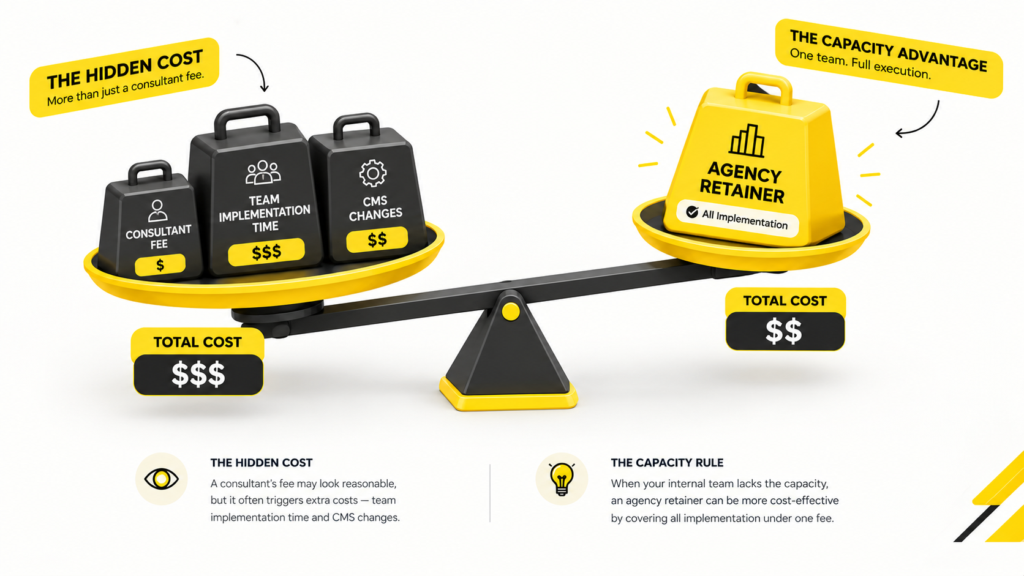
Don’t compare monthly fees alone. Compare what the fee buys, and what it forces you to spend elsewhere.
Typical Pricing
Published ranges vary by source and region. Treat these as ballparks, not quotes.
- Consultants often charge hourly. A commonly cited range runs from about $75 to $350+ per hour, depending on experience. Project-based audits and monthly retainers are also common.
- Agencies usually work on monthly retainers. Commonly cited ranges run from about $1,500 to $10,000+ per month. Large catalogs and heavy content or link-building needs push costs up.
What Drives Ecommerce SEO Costs?
- Number of products and category pages
- Platform and technical complexity (Shopify, WooCommerce, Magento, custom)
- Competition and number of target markets
- Content production and digital PR needs
- How much implementation the provider handles
The Hidden Cost: Your Own Time
Assume the monthly cost of a consultant is $3,000. After that, your team puts their advice into practice for 20 hours per month. That’s an additional $1,200 at $60 per hour. The actual cost to you is $4,200.
An agency that performs the work directly for $5,000 can end up being less expensive altogether. The opposite also takes place. You pay twice if the agency gives you tickets that your engineers need to complete or content that needs to be rewritten.
A simple rule: when your team can execute, consultants will be less expensive. When it can’t, agencies are less expensive.
How to Measure ROI?
Look past rankings. Track:
- Organic revenue and qualified traffic
- Non-branded organic visibility
- Conversion rate and revenue per organic session
- Customer acquisition cost and contribution margin
A cheaper provider isn’t better value if the work never ships. Compare deliverables, implementation capacity, and measurable outcomes.
Pros and Cons of SEO Agency Vs. SEO Consultant
| SEO Agency | SEO Consultant | ||
| Pros | Cons | Pros | Cons |
| Faster execution: Multiple SEO activities can run simultaneously. | Less direct access: Communication may go through an account manager. | Direct communication: Work directly with the expert managing your SEO strategy. | Implementation burden: Your team may need to execute recommendations. |
| Scalable services: Supports growing product catalogs and expansion into new markets. | Variable quality: Larger teams may apply generic strategies that don’t fit your store. | Personalized strategy: Recommendations can be tailored to your business goals. | Limited specialist coverage: One consultant may not have deep expertise in every SEO discipline. |
| Broad expertise: Access to technical SEO, content, analytics, and outreach specialists. | Potentially complex coordination: Multiple team members may require more communication. | Flexible engagement: Suitable for audits, migrations, and short-term projects. | Smaller toolset: May have access to fewer SEO tools and resources. |
| Structured processes: Provides regular reporting, workflows, and backup coverage. | Less flexibility in scope: Some retainers may have fixed deliverables or contract terms. | Knowledge transfer: Can train your in-house team to manage SEO more independently. | Availability constraints: Other clients and workload may affect response times. |
| End-to-end execution: Can manage ongoing SEO activities with less internal involvement. | Results aren’t guaranteed: A larger team does not automatically produce better rankings. | Focused expertise: A senior consultant can provide deep knowledge in a specific niche. | Scaling challenges: Large-scale content production and ongoing optimization may exceed capacity. |
| Larger team: Multiple specialists handle technical SEO, content, and link building | Higher cost: Monthly retainers are generally more expensive. | Lower cost: Often more affordable for focused projects and smaller budgets. | Limited capacity: One person can handle only so much work at a time. |
Which Option is Best for Your Ecommerce Brand?
Match the provider to your actual bottleneck. Is it strategy, execution, or both?
- Choose a consultant if you run a small or growing store: You need priorities and guidance, not a big retainer. A consultant tells you what to fix first. The catch: someone on your side must do the fixing.
- Choose a consultant if you have an in-house team: Writers, developers, and marketers are already on payroll. They lack SEO direction. A consultant fills that gap at lower cost.
- Choose an agency if you manage a large catalog: Thousands of product pages need templates, metadata, internal linking, and ongoing technical care. One person can’t carry that.
- Choose an agency if you need several services at once: Technical SEO, content, and digital PR in parallel call for a team.
- Consider a hybrid if you need both: A consultant sets strategy. An agency or internal team executes.
Realistic Scenarios
- Small Shopify store: A consultant fixes collection page structure and sets a keyword plan. The owner handles edits.
- Growing DTC brand: An agency produces consistent content and expands categories while the founder focuses on product.
- Large WooCommerce or Magento store: An agency manages crawl budget, faceted navigation, and coordinated dev work.
- Established multi-market brand: An agency, often paired with senior consulting oversight, handles international SEO and cross-team coordination.
Quick Decision Matrix
| Your Situation | Likely Fit |
| Under a few hundred SKUs, in-house help available | Consultant |
| Thousands of SKUs, little internal SEO capacity | Agency |
| One-time audit or migration review | Consultant |
| Ongoing content, links, and technical work | Agency |
| Strong in-house team, weak SEO leadership | Consultant |
| Big stakes, need strategy and muscle | Hybrid |
How to Choose the Right Ecommerce SEO Partner?
Between an SEO agency and a consultant, whichever route you pick, vet them the same way as follows:
- Check your e-commerce background: Local or B2B SEO is not the same as e-commerce SEO. Inquire about faceted navigation, product, and category work for your business.
- Review actual case studies: Check the issue, the steps taken, and the result. Testimonials by themselves don’t prove much.
- Test your understanding of the platform: Each of WooCommerce, Magento, and Shopify has its own peculiarities.
- Obtain particular deliverables: “Monthly SEO” is ambiguous. Request figures and demo reports for content pieces, optimized pages, and shipped patches.
- Find out how success is determined: Vanity rankings are outperformed by revenue and non-branded visibility.
- Make it clear who is in charge: Be aware of who will make the changes, you or them.
A quick checklist:
- Can they explain strategy in business terms?
- Do they understand faceted navigation and duplicate content?
- Are recommendations ranked by impact and effort?
- Do they separate branded from non-branded results?
- Is ownership of accounts, content, and assets written down?
Also check data access. Providers need access to Search Console, analytics, and often your CMS. Ask where your data lives, who can see it, and what happens when the contract ends.
Questions to Ask Before You Hire
- What e-commerce experience do you have? Look for named platforms and store sizes similar to yours.
- How will you handle our technical issues? A good answer names specific problems from your site, not generic steps.
- Who implements your recommendations? This one question prevents the backlog trap.
- What will you report, and how often? Expect revenue-linked metrics, not just rankings.
- How do you prioritize? Strong answers weigh impact against effort.
- What’s realistic in 3–6 months? Be wary of big promises. Many businesses see early movement in that window, but timing depends on competition, site health, and execution. No honest provider guarantees a ranking.
- What happens if our priorities change? Check contract length, cancellation terms, and scope flexibility.
Relatable Read: How to Choose an SEO Company: 11 Questions to Ask Before Signing
Can You Combine a Consultant and an Agency?
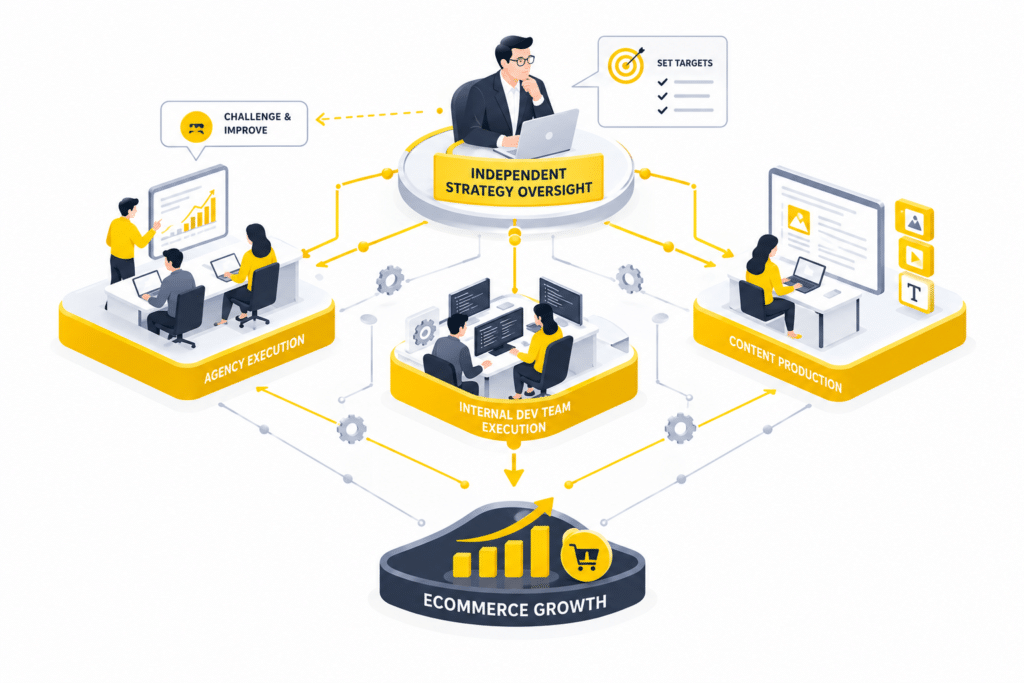
Yes. It works well when you need senior judgment and heavy execution.
How it works: The consultant audits, sets priorities, and defines targets. The agency, your developers, or your internal team carry out the plan. The consultant reviews the work and catches problems early.
Why it helps: The consultant stays independent. They can challenge the agency’s work. You also avoid putting all your trust in one provider.
How to avoid waste:
- Note who is responsible for strategy, execution, approvals, and reporting.
- Use a single reporting format and a single shared project space.
- Decide in advance who will have the last word in disputes.
Without those guidelines, communication between your team, the agency, and the consultant becomes muddled.
Regardless of the path you take, one thing is constant: take responsibility for your approach. The driver is available for hiring. Hold onto the wheel.
Relatable Read: 7 Best B2B SEO Agencies in 2026: Ranked & Compared
Final Words on SEO Consultant vs. SEO Agency
Hire a consultant when you need expert direction, and your team can execute. It’s lean, flexible, and direct.
Hire an agency when you need strategy and hands-on work at scale. It costs more, but it takes the load off your team.
Use a hybrid when the stakes are high, and you want independent oversight plus real capacity.
If your store has a large catalog, limited internal SEO capacity, or growth plans that need steady execution, a full-service team is usually the stronger fit.
That’s where MonsterClaw works. MonsterClaw combines SEO with performance and affiliate marketing, so organic growth connects to revenue. Request an ecommerce SEO audit with MonsterClaw and learn what’s holding your store back and what to fix first.
Frequently Asked Questions (FAQs)
No. You can’t measure superiority in a single term. A consultant is best suited to teams with specific needs and implementation skills. Large catalogs and initiatives requiring multiple abilities at once are best suited for an agency. Select strategy, execution, or both depending on your bottleneck.
Yes, usually on paper. However, implementation is frequently left to you by consultants, which increases internal costs. A consultant is less expensive if your team has extra capacity. If it doesn’t, the total cost of hiring an agency to handle execution may be lower.
They arrange content and internal linking, audit your website, investigate keywords, evaluate product and category pages, and monitor outcomes. Many give advice instead of carrying it out. Verify up front if they will give you a roadmap or make modifications.
Published ranges differ greatly. Many retainers range from about $1,500 to $10,000 or more per month. The size of the catalog, the complexity of the platform, competition, and the necessity for content or link-building all affect pricing. A written scope should always be requested.
Not all the time. Small businesses frequently benefit from having an owner or freelancer handle execution and a consultant handle strategy. When your inventory expands, or no one on your staff has time to do SEO work, hiring an agency makes sense.