


Expanding your agency’s SEO capabilities without increasing your in-house workload sounds ideal, but finding the right white-label SEO partner takes more than comparing prices and service packages.
A reliable white label service provider should work as an extension of your team. From technical expertise and transparent reporting to scalability and proven results, knowing what to look for can make all the difference.
Let’s explore the key factors agencies should consider when choosing white-label SEO services.
What Are White Label SEO Services?

White-label SEO services are SEO work done by a third-party provider and delivered under your agency’s brand. Your client sees your name on every report, deliverable, and email. White label SEO providers stay behind the scenes.
Here’s the basic flow:
- You sell SEO to your client at your own price.
- The provider does the work at a wholesale rate.
- You review the output and present it as your own.
- You keep the difference as a margin.
Most providers offer a mix of these services:
- Technical SEO audits
- Keyword research
- On-page optimization
- Content creation
- Link building
- Local SEO
- Local listings
- Ecommerce SEO
- Reporting
Why Do Agencies Need White-Label SEO Services?
Expand service offerings without hiring an in-house team
Adding SEO to your menu usually means hiring specialists. White-label lets you offer it now, then decide on hiring later.
Reduce operational costs and overhead
Salaries, benefits, software, and training add up. With white-label, you pay for output. Costs scale with client count, not headcount.
Scale client accounts more efficiently
Landing five new clients in a month can break a small team. A solid provider absorbs that spike.
Focus on client relationships and business development
Your edge is strategy and trust. Let someone else handle the audits and link outreach while you handle the calls and the pitches.
Access specialized SEO expertise
SEO covers technical, content, and authority work. Few small teams cover all three well. A good provider fills those gaps.
What Services Should a White Label SEO Provider Offer?

Not every provider needs every service. But the strong ones cover the full range. Look for these:
Technical SEO audits and website optimization
This covers crawlability, indexing, site speed, Core Web Vitals, structured data, and site architecture. It’s the foundation. Without it, content and links underperform.
Keyword research and competitor analysis
Look for research tied to search intent and local businesses’ goals. A raw keyword list isn’t enough. You need priorities and reasoning.
On-page SEO and content optimization
Title tags, headings, internal links, and content updates. Ask how they decide what to change and why.
Content creation and content marketing
Good providers write for people first. They use subject matter input and fact-check claims. Ask for samples.
Link building and digital PR
Quality matters far more than quantity. Ask where links come from and how they’re earned.
Local SEO and Google Business Profile optimization
Key for clients with physical locations or service areas. It includes citations, review strategy, and profile management.
Ecommerce SEO
Product pages, category structure, faceted navigation, and schema all need special care. Not every provider handles them well.
SEO reporting and performance tracking
Reports should show progress against goals. They should also explain what happens next.
Relatable Read: 11 Best SEO Companies in Spokane in 2026
White-Label SEO Services: What to Look for in a Provider
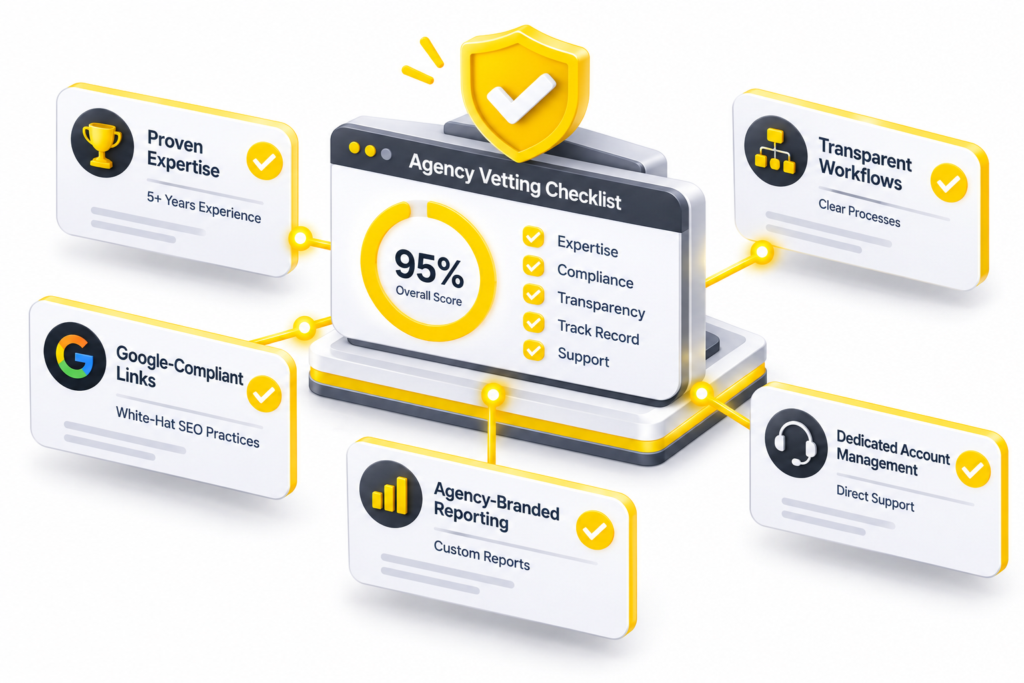
Here are twelve criteria. Use them as a scorecard.
1. Proven SEO expertise and industry experience
Ask how long they’ve run SEO campaigns and in which industries. Look for named team members with real experience, not a faceless dashboard.
2. Transparent processes and deliverables
You should know what gets done each month. A good provider documents tasks, timelines, and outputs. If they can’t explain their process, move on.
3. Customizable, agency-branded reporting
Reports need your logo, your colors, and ideally your domain. Check that the white-labeling goes beyond a logo swap.
4. Flexible pricing and healthy profit margins
You need room to earn. Pricing should let you mark up services and stay competitive. More on that below.
5. Reliable communication and dedicated account management
You want a named contact who replies fast. Slow answers become your problem when clients ask questions.
6. Scalable services and SEO fulfillment capacity
Ask how many agencies and accounts they handle. Ask what happens when you double your volume. Capacity claims should have specifics behind them.
7. Ethical, Google-compliant SEO practices
Google’s spam policies prohibit link schemes, scaled low-value content, and similar tactics. A violation can hurt your client’s site. Your provider should know the guidelines and follow them.
8. Strong content quality and editorial standards
Ask about their editorial process. Who writes? Who edits? Who fact-checks? Google’s guidance rewards helpful, people-first content. It does not ban AI-assisted writing, but it does penalize content made mainly to manipulate rankings.
9. Clear turnaround times and service-level expectations
Get timelines in writing. Audits in X days. Content in Y days. Reports by the Z of each month. Ask what happens when they miss.
10. Data security, confidentiality, and client ownership
Your clients trust you with site access and analytics. Confirm the provider uses secure access, signs NDAs, and never contacts your clients. Confirm who owns the work.
11. Access to tools, analytics, and measurable performance data
Ask which tools they use. Common ones include Google Search Console, Google Analytics, Semrush, and Ahrefs. Also ask whether you get direct access to data.
12. A proven process for handling algorithm updates and performance issues
Rankings drop sometimes. A good provider has a clear response plan. They audit, diagnose, and explain. They don’t panic or hide.
How to Evaluate a White-Label SEO Agency Before Hiring?
Claims are cheap. Evidence is not.
Review case studies and verifiable results
Look for specifics: starting point, actions taken, timeline, outcome. Be wary of vague wins like “increased traffic by 300%” with no context.
Ask about team expertise and fulfillment workflows
Who does the work? Employees or freelancers? Who reviews it? A clear workflow signals maturity.
Request sample SEO reports and deliverables
Ask for a sample SEO audit, a content piece, and a monthly report. Judge them as if a client were reading.
Evaluate communication and onboarding processes
Notice how they behave before you pay. Slow replies in the sales stage get worse later.
Check client references and independent reviews
Talk to current agency partners if you can. Check third-party review sites. Look at patterns, not single comments.
Confirm contract terms, cancellation policies, and ownership rights
Read the fine print. Check notice periods, minimum terms, and who owns the content, reports, and data when you leave.
White-Label SEO Pricing: What Should Agencies Expect?
Prices vary widely. They depend on scope, provider, and market. Treat any number you see online as a starting point, then request quotes.
Monthly retainer pricing vs. project-based pricing
- Retainers suit ongoing SEO. They offer steady workloads and predictable costs.
- Project pricing suits audits, migrations, and one-time builds. It offers clear scope and a defined end.
Many agencies use both.
Factors that influence white-label SEO costs
- Site size and complexity
- Competitiveness of the market
- Number of keywords and locations
- Content volume
- Link acquisition scope
- Reporting and communication needs
How to calculate your agency’s profit margins
Use a simple formula:
Margin % = (Client price − Provider cost) ÷ Client price × 100
Say you charge a client $2,000 a month and pay the provider $1,000. Your gross margin is 50%. Then subtract your own time for account management and QA. That’s your real number.
Understanding setup fees, minimum commitments, and add-on costs
Ask about onboarding fees, minimum contract lengths, and extras like reporting upgrades, additional revisions, or rush work. Hidden costs erode margin fast.
Balancing affordability with service quality
The cheapest option rarely wins. Low-cost SEO often cuts corners on links or content. Repairing the damage costs more than doing it right. Compare value, not just price.
White-Label SEO vs. In-House SEO: Which Is Better for Agencies?
Neither is always better. It depends on your size and goals.
| Factor | White-Label SEO | In-House SEO |
| Hiring and operational costs | Variable, pay per output | Fixed salaries, benefits, tools |
| Specialized expertise | Access to a full team | Limited to who you hire |
| Turnaround time | Fast to start | Slow to hire and train |
| Scalability | Flexible | Requires new hires |
| Quality control | Depends on the partner | Direct control |
| Long-term profitability | Strong at small and mid scale | Can be stronger at large scale |
White-Label SEO vs. SEO Reseller Programs: What’s the Difference?
The terms overlap. Both let you sell SEO you don’t fully produce. The differences show up in the details.
Fulfillment and branding. White-label providers typically work as an extension of your team, often with customized deliverables. Reseller programs may offer packaged services with limited customization.
Pricing and support. Reseller programs often use fixed packages and published price tiers. White-label partners often tailor scope and pricing to each account.
Flexibility. Packages are simple to sell. Custom scopes fit complex clients better.
Which suits you?
- Small or new agencies may like reseller packages for simplicity.
- Growing agencies with varied clients often need the flexibility of a white-label partnership.
Always check how much branding and control each offer truly provides.
Red Flags to Watch for When Choosing a White-Label SEO Provider
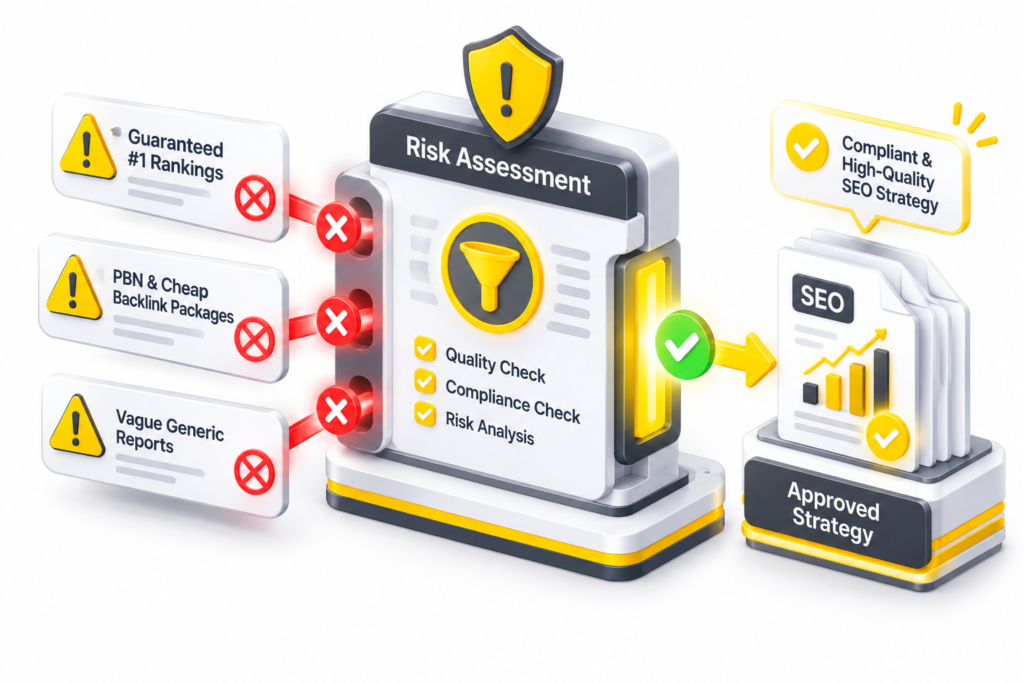
Guaranteed rankings and unrealistic promises
No one controls Google’s results. Google itself warns that no one can guarantee a #1 ranking. Walk away from anyone who says otherwise.
Cheap backlinks and questionable link-building tactics
Bulk link packages, private blog networks, and paid link schemes can trigger spam actions. Your client pays the price.
Vague deliverables and hidden fees
If you can’t tell what you’re buying, you can’t tell what you got. Ask for an itemized scope.
Generic reports with no actionable insights
A chart of traffic isn’t a strategy. Reports should explain what changed, why, and what’s next.
Poor communication and inconsistent turnaround times
Missed deadlines pile up. One late report is a hiccup. A pattern is a warning.
No clear confidentiality or client data policies
If they can’t explain how they protect client data, don’t give them access.
Questions to Ask Before Partnering With White Label SEO Companies
Bring this checklist to your first call:
- What SEO solutions does each package include? Get a line-by-line list.
- Can deliverables be fully branded for our agency? Ask to see examples.
- How do you measure and report performance? Ask which metrics and which tools.
- Who communicates with our clients? The answer should be “no one but you.”
- How do you ensure compliance with search engine guidelines? Listen for specifics.
- Can services scale as our client base grows? Ask about capacity limits.
- What happens if results decline or deliverables are late? Look for a clear remediation process.
- Who owns the content, reports, and campaign data? The answer should be you or your client.
How to Build a Successful White-Label SEO Partnership
Choosing well is half the job. The rest is how you work together.
Define responsibilities and expectations from the start
Write down who does what. Cover approvals, timelines, and escalation steps. Clarity prevents most conflicts.
Establish communication and reporting workflows
Pick one channel, such as Slack or email. Set a regular check-in. Agree on report formats and delivery dates.
Set realistic client goals and KPIs
Search Engine Optimization takes time. Set goals around leads, revenue, and visibility, not rankings alone. Be honest about timelines.
Maintain quality control across deliverables
Review everything before it reaches a client. Spot-check content, audit findings, and links. Your name is on it.
Review performance and refine the partnership regularly
Meet quarterly. Review results, turnaround times, and communication. Adjust scope as clients change.
Final Words
The right partner brings expertise, transparency, scale, and reliable delivery. They protect your reputation and your margins.
Don’t choose on price alone. A cheap provider that gets your client penalized costs far more than a good one. Look at long-term results.
Before you shop, check your own capacity. How many SEO clients can you handle today? How many do you want in a year? That gap tells you what kind of partner you need.
If you want a team that does the work well and keeps your brand front and center, MonsterClaw is a strong place to start. Our SEO specialists handle technical, content, and authority work for agencies, with reporting built for your clients. Get in touch to talk through your goals and see how a MonsterClaw partnership fits.
Frequently Asked Questions (FAQs)
They are SEO services performed by a third-party provider and delivered under your agency’s brand. The client sees your agency, not the provider.
You sell the service, the provider does the work, and you deliver branded results. You manage the client relationship. The provider handles execution.
Costs vary by scope, provider, and market. Retainers and project fees are both common. Request quotes from several providers and compare what each includes.
They can be. Profit depends on your markup, the provider’s quality, and how much time you spend on management. Track margins per client.
Use the twelve criteria above. Review samples, check references, read contracts, and start with a small pilot if possible.
Yes. It lets small agencies offer SEO without hiring full-time specialists. Start with one or two clients to test the partnership.