



The SaaS world moves fast. Blink and your leads ghost you.
Let’s fix that.
We’ll help you go from “What do you do again?” to “Where do I sign?” The playbook even your product team will thank you for. Yes, really.
Welcome to the jungle! The B2B SaaS jungle! However, fear not, brave marketer! You are not here to get lost. You are here to win.
This isn’t just another “growth hack” checklist stuffed with jargon-flavored fluff. This is your complete guide to successful B2B SaaS product marketing.
Filled with genuine tactics, useful advice, and straightforward ideas that convert new members into ardent supporters and churn them into devoted followers.
Let’s now explore the entire strategy for successful B2B SaaS product marketing!
TL;DR
Here is the full B2B SaaS product marketing playbook condensed into 6 moves.
- Position your product around your ICP’s real problems – not feature lists.
- Build a GTM strategy that aligns every team before launch day.
- Create persona-driven messaging and sales content that converts.
- Track the right metrics – adoption, NPS, churn, and CAC.
- Align sales and customer success to close faster and retain longer.
- Execute your launch in 3 phases: pre-launch, launch day, and post-launch optimization.
Do all 6 consistently. That is how SaaS brands win.
At A Glance: The Complete Playbook for B2B SaaS Product Marketing Success
| 1. Creating a Winning B2B SaaS Product Positioning Strategy |
| 2. Building a Scalable Go-To-Market (GTM) Strategy |
| 3. Messaging and Content Strategy That Converts |
| 4. Product Marketing Metrics and KPIs to Track |
| 5. Aligning Product Marketing with Sales and Customer Success |
| 6. Product Launches: How to Plan, Execute, and Measure Success |
Relatable Read: The Ultimate SaaS SEO Guide
What is B2B SaaS Marketing?
B2B SaaS marketing is the process of promoting and selling subscription-based software to other businesses.
The buyer is not a consumer. The buyer is a decision-maker inside a company – a VP, a Director, a Head of Operations – who evaluates software based on ROI, integration fit, and team adoption.
B2B SaaS marketing differs from traditional software marketing in 3 key ways:
1. The product is never fully owned: Customers pay a recurring subscription. That means the marketing job does not end at the sale. It continues through onboarding, adoption, and renewal.
2. The buying cycle is longer: B2B SaaS purchases involve multiple stakeholders. The average enterprise SaaS deal involves 6 to 10 decision-makers. Marketing must reach all of them.
3. Churn is the enemy: A SaaS company can acquire new customers and still shrink. Monthly churn above 2% cancels out growth. Marketing owns part of that retention equation through messaging, onboarding support, and expansion campaigns.
The 3 core jobs of B2B SaaS marketing are: generate qualified demand, accelerate pipeline to close, and retain and expand existing revenue.
Every strategy, channel, and campaign in B2B SaaS marketing serves one or more of those 3 jobs.
What to Consider Before Creating a B2B SaaS Marketing Strategy?
Most SaaS marketing strategies fail before execution starts. The failure happens in the planning phase – specifically when teams skip the inputs that shape every downstream decision.
Before building a strategy, get clear on 6 foundational inputs.
1. Your ICP is defined precisely: Identify company size, industry, job title, tech stack, and primary pain point. A vague ICP produces vague messaging. Vague messaging produces low conversion.
2. Your current funnel has a diagnosed bottleneck: Every SaaS funnel leaks at one stage more than others. Identify where – awareness, activation, conversion, or retention. Build the strategy around fixing that bottleneck first.
3. You know your competitive position: Map your 3 to 5 direct competitors. Identify where your product wins, where it loses, and where buyers are currently undecided. This shapes your messaging, pricing, and channel decisions.
4. Your pricing model is settled: Freemium, free trial, demo-first, or direct pricing – each model changes which channels work, which content you need, and how long the sales cycle runs. Strategy without a locked pricing model is a guess.
5. Your budget is allocated by funnel stage: Demand generation (top of funnel), conversion enablement (middle), and retention (bottom) each require budget. Underfunding any stage creates a gap the other stages cannot cover.
6. Marketing, sales, and product share one definition of success: Define the shared KPIs before the strategy is built. CAC, MQL-to-SQL rate, activation rate, and churn are non-negotiable shared metrics. Teams that track different numbers execute different strategies.
Get these 6 inputs confirmed before writing a single strategy document.
Why is SaaS Marketing Different from Traditional B2B Marketing?
Traditional B2B marketing is built around a one-time transaction. The deal closes, revenue books, and the relationship becomes the account manager’s problem.
SaaS marketing is built around a recurring relationship. The deal closing is not the finish line. It is the starting line.
Here are the 5 differences that change every strategic decision:
1. Revenue is recurring, not transactional: SaaS revenue compounds if churn is controlled. A customer who renews for 3 years generates 3x the revenue of a customer who churns in year one. Marketing must think in lifetime value, not deal value.
2. The product is the primary sales tool: Traditional B2B sells through decks, meetings, and proposals. SaaS sells through free trials, demos, and onboarding. Product experience converts leads at scale. Sales decks do not.
3. Time-to-value is a marketing metric: In traditional B2B, marketing ends at the MQL. In SaaS, marketing owns the onboarding narrative that drives activation. A buyer who does not see value in the first 7 days is a churn risk before they ever become a customer.
4. Buyer committees are larger: The average B2B SaaS purchase involves 6 to 10 stakeholders. An IT lead evaluates security. A finance lead evaluates cost. An end-user evaluates usability. Marketing must create content and messaging for each role.
5. Competition moves faster: New SaaS competitors enter markets with $0 in distribution costs. A well-funded competitor can replicate your feature set within 12 months. Positioning, brand, and topical authority are the durable moats. Not features.
The table below maps the core strategic differences:
| Dimension | Traditional B2B Marketing | B2B SaaS Marketing |
|---|---|---|
| Revenue model | One-time transaction | Monthly or annual recurring subscription |
| Sales cycle length | 3 to 12 months | 14 to 90 days (varies by ACV) |
| Primary conversion tool | Sales team and proposals | Free trial, demo, or freemium |
| Marketing’s job | Generate and pass leads | Generate leads, support activation, support retention |
| Churn risk | Low (contracts are long-term) | High (monthly cancellation is always possible) |
| Key metric | Deal value | LTV, CAC, churn rate, NPS |
Understand these differences before building strategy. A traditional B2B playbook applied to a SaaS product will underinvest in retention and overinvest in acquisition.
Understanding the Role of Product Marketing in B2B SaaS
In B2B SaaS, product marketing is essential in bringing the product to market.
This helps to make sure that it:
- Satisfies client demands
- Promotes adoption, retention, and revenue development
6 Key Responsibilities of a SaaS Product Marketer
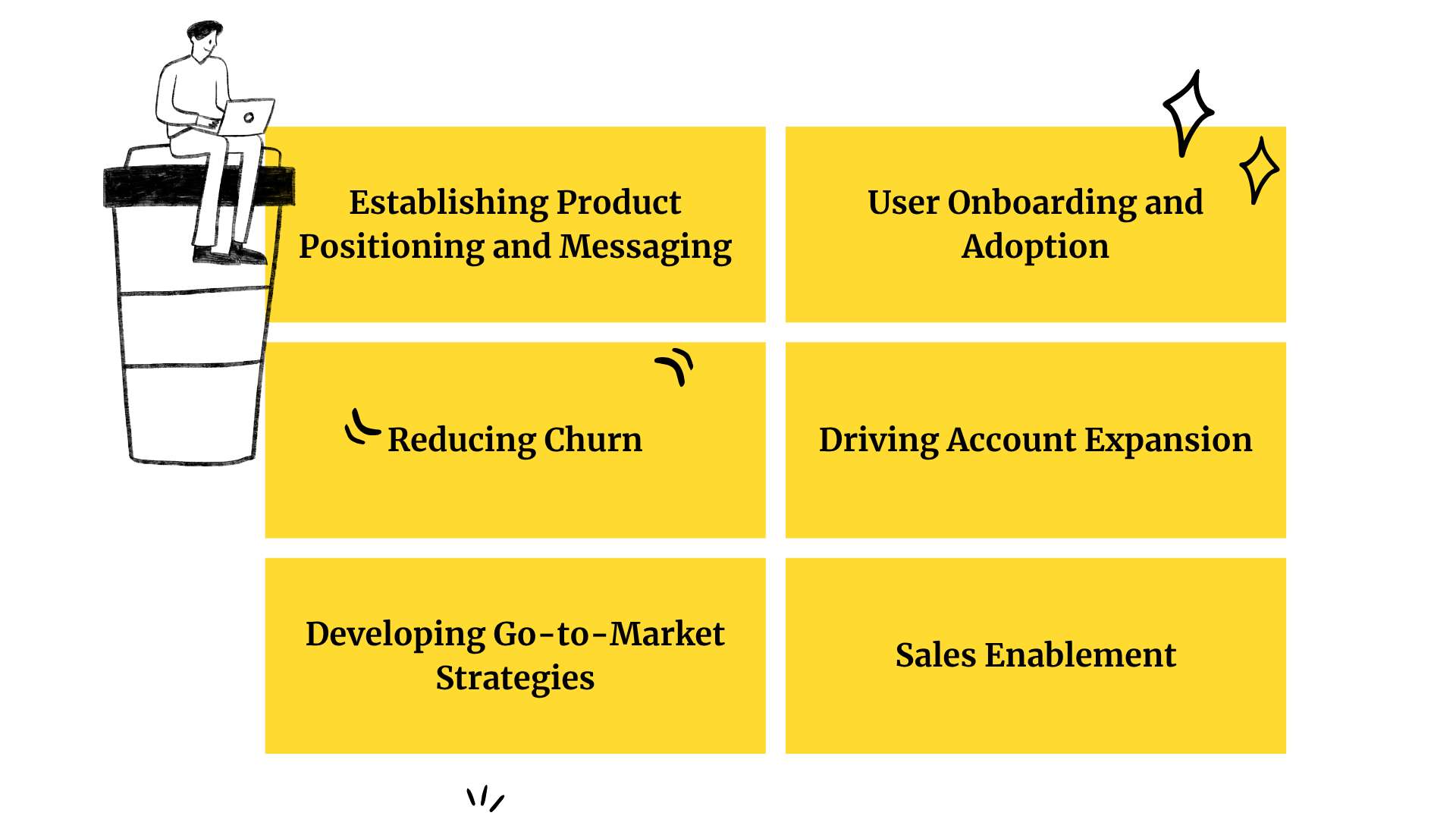
1. Establishing Product Positioning and Messaging: Develop precise and focused positioning. Make sure it communicates the product’s special value to the appropriate market.
2. User Onboarding and Adoption: Create ongoing onboarding procedures to–
- Boost feature adoption
- Assist users in realizing the value of the product
3. Reducing Churn: Identify areas of friction and improve messaging and user experience to solve them to keep consumers.
4. Driving Account Expansion: Using tailored communications to identify upsell and cross-sell possibilities within current client accounts.
5. Developing Go-to-Market Strategies: Organize and carry out campaigns and product launches. As it helps to create demand and coordinate the efforts of the product, marketing, and sales teams.
6. Sales Enablement: Sales enablement is giving sales teams the resources, messaging, and instruction they need to successfully convey the value of a product and dispel objections.
Comparison Between Product Marketing, Growth, and Brand Marketing
| Aspect | Product Marketing | Growth Marketing | Brand Marketing |
| Purpose | Product positioning, message, acceptance, and value | Driving rapid user acquisition, activation, and retention via data | Building long-term emotional connection and trust with the brand |
| Focus | Customer needs and product fit | Data-driven scaling and experimentation | Brand recognition, loyalty, and identity |
| Key Activities | Market research, messaging, onboarding, sales enablement | A/B testing, funnel optimization, multi-channel campaigns | Brand storytelling, campaigns, and consistency across channels |
| Goal | Product adoption, revenue, and retention | Quick growth in users and revenue | Long-term equity and customer loyalty |
| Interaction with Customers | Deep user insights to tailor messaging and product usage | Analytical and tactical execution to optimize the customer journey | Emotional engagement and building brand perception |
Relatable Read: How to Build a Killer Sales Funnel
How Does Product Marketing Drive Revenue and Retention?
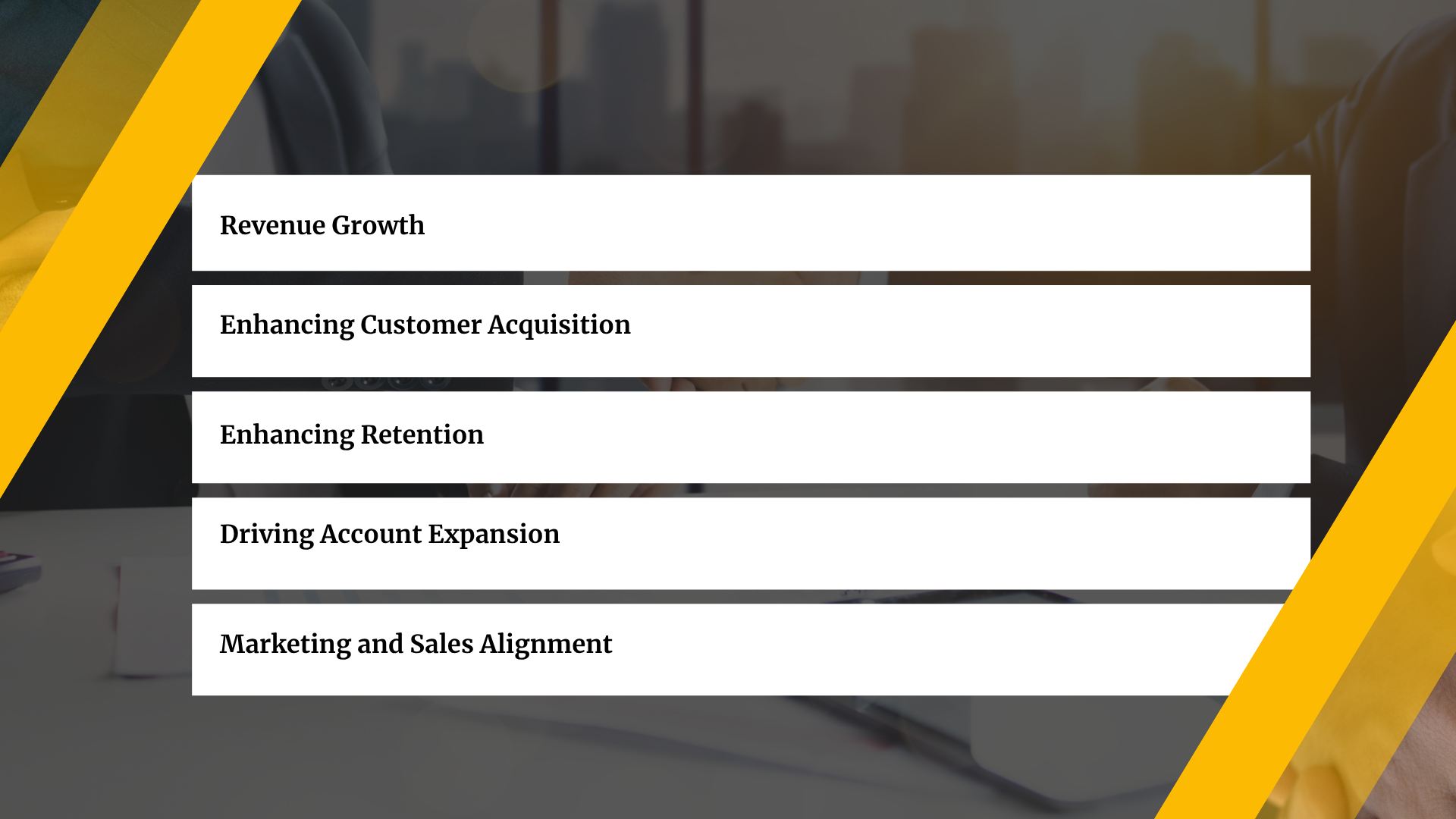
Revenue Growth: Product marketing creates demand and speeds up sales by:
- Crafting compelling positioning
- Messaging that appeals to target personas
Enhancing Customer Acquisition: You can lower acquisition costs and boost sign-up rates by providing a clear product value through:
- Free trials
- Onboarding
- Website experiences
Enhancing Retention: You can increase client loyalty by:
- Ongoing training via secondary and tertiary onboarding
- Feature uptake
- User interaction
Driving Account Expansion: By segmenting active users and presenting tailored offers, product marketing finds upselling and cross-selling opportunities. As a result, it increases average revenue per user.
Marketing and Sales Alignment: Working closely with sales teams guarantees that the value proposition of the product is communicated clearly. To reduce sales cycles and improve close ratios.
1. Creating a Winning B2B SaaS Product Positioning Strategy
Some essential steps in developing a successful B2B SaaS product positioning strategy are:
- Creating a compelling value proposition
- Using successful positioning frameworks
- Establishing a scalable go-to-market strategy with team alignment and launch planning
- Defining your ideal customer profile
How to Define Your Ideal Customer Profile (ICP) and Buyer Personas?
An ICP is a detailed description of the perfect customer that fits well with your product. It tends to have high retention, profitability, and satisfaction.
Define your ideal customer profile and buyer personas through:
- Customer segmentation
- Data-driven strategies
- Interviews and feedback
Create a Compelling Value Proposition
- Customer-Centric: Put your attention on resolving particular issues for customers. Provide observable advantages like cost reductions or increased productivity.
- Clarity and Simplicity: Use straightforward language that stays away from jargon to connect with prospects right away. Keep it brief and benefit-focused.
- Differentiate: Stress the emotional and utilitarian advantages of your product to differentiate it from rivals.
- Test and Improve: Continuously run A/B tests on your messages and gather feedback to improve your value proposition and increase conversion.
2. Building a Scalable Go-To-Market (GTM) Strategy

A GTM strategy is a thorough plan that coordinates product launch, marketing, sales, and customer success. It helps to draw in and keep customers while increasing revenue.
Feature updates concentrate on particular benefits to a targeted market with suitable scaling. New product releases need a comprehensive strategy encompassing channels, messaging, and discovery.
To provide a flawless customer experience, make sure all teams share common objectives, KPIs, and channels of communication.
Moreover, to organize activities, use structured templates that address:
- Positioning
- Campaign planning
- Cross-functional alignment
- Pre-launch research
- Post-launch analysis
3. Messaging and Content Strategy That Converts
Create a message that speaks to the distinct goals, difficulties, behaviors, and motivations of each persona. Use customer language from reviews or interviews to provide relatability and authenticity to your content.
Sort, simplify, and choose messages so that partners, marketing, and sales may easily utilize and customize them for their target audience.
Customized content for social media personas increases relevance and empathy. It raises engagement and returns on investment.
Key Content Assets
One-Pagers: Brief, benefit-oriented publications condense complex information into a brief, captivating image for a variety of audiences. For instance, sales, investors, and customers.
Sales Decks: Sales decks are graphic presentations that tell an engaging tale. They:
- Highlight the benefits of the product
- Employ social proof
- Conclude with powerful calls to action
Battle Cards: They are succinct competitive summaries. They include
- Important competitor and product features
- Scripts for overcoming objections
- Proof points
They are intended to be quickly consulted during sales talks.
Demo Scripts: Demo scripts are structured screenplays with interactive and narrative components. They are intended to captivate, prove value, and convert prospects.
4. Product Marketing Metrics and KPIs to Track
Key Metrics:
- Product Adoption: Monitors user uptake and engagement using metrics. Such as retention, time-to-value, activation, adoption rate, and feature utilization.
- Net Promoter Score (NPS): The Net Promoter Score (NPS) divides customers into promoters, passives, and detractors. Based on a customer’s propensity to suggest. It normally ranges from -100 to +100.
- Churn: A measure of the percentage of customers or accounts that are lost over time. It is crucial to track revenue, health, and retention. There are several types of churn. These include dollar churn, gross and net dollar churn, and customer (logo) churn.
- Customer Acquisition Cost (CAC): The average cost of sales and marketing to bring in a new client. It is used to determine ROI and create budgets.
Relatable Read: 14 SEO Strategies to Grow Enterprise SaaS Companies in 2026
5. Aligning Product Marketing with Sales and Customer Success
Product marketing should be carefully matched with sales and customer success. Develop a cohesive strategy that increases revenue and improves customer satisfaction.
Give sales teams specialized tools and messaging that representatives are prepared to interact with prospects efficiently and reduce sales cycles.
Cooperation with customer success teams:
- Lowers churn
- Promotes customer engagement
- Helps remove adoption barriers
Moreover, creating strong feedback loops across marketing makes continuous improvement possible.
Enabling the Sales Team with the Right Tools and Messaging
Sales enablement solutions increase productivity by giving sales teams access to capabilities like
- Content management
- Training communication
- Analytics
- CRM connection
Moreover, sales representatives may provide meaningful and individualized communications to prospects through a variety of channels. That too, with the backing of sales enablement technologies and effective messaging.
Collaborating with Customer Success to Improve Adoption and Reduce Churn
To boost product adoption, product and customer success teams need to collaborate closely.
Customer success teams actively engage customers throughout their journey to improve retention and reduce churn. They also foresee problems and offer pertinent resources.
Moreover, collaboration across departments about customer data and objectives
improves both corporate growth and the overall customer experience.
6. Product Launches: How to Plan, Execute, and Measure Success
Pre-launch Planning
- To get teams in agreement on product positioning and launch strategy, conduct internal communications.
- Solicit input from beta users before the product is fully released.
- Create go-to-market strategies and clear messaging based on strategic positioning and research.
Launch-day Tactics
- To raise awareness and pique client interest, use well-planned email campaigns, press releases, webinars, and demos.
- Launch materials and enablement resources for productive customer interactions can help boost sales and customer success.
Post-launch Optimization
- Use feedback loops to prioritize product versions, record user experiences, and pinpoint problems.
- To evaluate success, track important launch indicators pertaining to adoption, engagement, and revenue effect.
- To maintain momentum and raise user engagement, make adjustments to marketing and product strategies in light of the information acquired.
Should You Hire an SEO Agency for SaaS Product Marketing?
Organic search is the highest-intent channel in B2B SaaS marketing. Buyers researching solutions go to Google first. If your product is not ranking, you are invisible at the exact moment they are ready to evaluate.
Most SaaS teams do not have the bandwidth to run SEO well. Product marketers own positioning, messaging, launches, and sales enablement simultaneously. SEO gets deprioritized. Rankings stagnate. Competitors take the organic real estate you should own.
That is where a specialized SaaS SEO agency changes the outcome.
What a SaaS SEO agency does that a generalist cannot:
- Understands the SaaS buyer journey and maps keyword strategy to each stage
- Builds content that targets high-intent, bottom-of-funnel queries – not just traffic volume
- Executes technical SEO at scale across large SaaS site architectures
- Aligns SEO strategy with your product positioning and GTM motion
Hiring the right agency frees your product marketing team to focus on positioning and launches. SEO runs as a parallel growth channel, not a side project.
The answer is yes – if SEO is currently a gap in your marketing system.
If your SaaS product is not ranking for the queries your buyers use to find solutions like yours, a specialized SaaS SEO service closes that gap faster than building the capability in-house.
How to Structure a SaaS Product Marketing Team
Structure follows stage. Here is the progression.
0 to 15 employees: One PMM generalist covers everything – positioning, messaging, sales enablement, and launches. Do not hire a demand gen specialist before positioning is locked. Demand gen amplifies the message. If the message is weak, spend makes it worse.
15 to 75 employees: Add 3 roles in this order. First, a Content and SEO Lead – highest compounding investment at this stage. Second, a Sales Enablement Manager – teams with dedicated enablement close 15 to 20% faster. Third, a Customer Marketing Manager – hire this role the moment monthly churn crosses 2%.
75 to 200 employees: Build the full function.
| Role | Owns |
|---|---|
| VP of Product Marketing | Strategy, positioning, C-suite alignment |
| Competitive Intelligence Lead | Battle cards, win/loss research, competitor tracking |
| Content and SEO Lead | Organic content, editorial calendar, topical authority |
| Launch Manager | Product launches, cross-functional coordination |
| Sales Enablement Manager | Sales content, messaging governance, training |
| Customer Marketing Manager | Lifecycle campaigns, NPS, expansion messaging |
200+ employees: Split the team by product line, segment, or geography depending on where the biggest positioning gaps exist.
3 Hiring Mistakes to Avoid
Hiring a content writer before a PMM. Content without positioning drives traffic that does not convert.
Making PMM report to product management. Product marketing is a commercial function. It reports to the CMO.
Delaying the customer marketing hire. Most SaaS companies make this hire 12 to 18 months too late. By then, churn has already compounded.
Let’s Get Into The Next Level B2B SaaS Product Marketing!
Let’s be real. Even the best playbooks need a quarterback. That’s where MonsterClaw steps in.
We are the growth engine your SaaS deserves with strategies sharper than your sales funnel and execution smoother than your onboarding flow!
So, claw your way to the top and get in touch with MonsterClaw today!
FAQs: The Complete Playbook for B2B SaaS Product Marketing Success
The techniques and tactics used to market and sell software-as-a-service (SaaS) goods to other businesses are referred to as business-to-business (B2B) SaaS product marketing.
The strategic process of launching a Software as a Service (SaaS) product, with an emphasis on sales and promotion to attract new clients and establish a strong brand in the market, is known as SaaS product marketing.
Creating and implementing plans to sell and market goods to other companies is the responsibility of a business-to-business (B2B) product marketer.
LinkedIn is the best medium for business-to-business (B2B) marketing because of its professional setting and capacity to connect with important decision-makers.
The path a prospective consumer takes from first discovering a product to becoming a paying subscriber and possibly even an advocate is described by a SaaS marketing funnel.
Start with positioning. Know your ICP, their core problem, and why your product solves it better than alternatives. Without that, every campaign
wastes budget.
Then build your GTM motion around 3 actions:
1. Run trials or demos that let the product prove itself
2. Create content that educates buyers at each funnel stage
3. Align sales, marketing, and customer success on the same messaging
Marketing a SaaS product is a continuous system. It generates demand, converts leads, and retains customers – simultaneously.
The 5 highest-return channels for B2B SaaS are:
1. Organic Search (SEO): Captures buyers at the moment of intent. Traffic compounds over time without ongoing spend.
2. LinkedIn: Reaches VP, director, and C-suite decision-makers where they already spend attention.
3. Email Marketing: Nurture sequences and onboarding flows keep your product in front of prospects and existing customers consistently.
4. Free Trials / Freemium: Letting buyers experience the product removes the biggest barrier in B2B purchasing.
5. Content Marketing: Long-form guides, comparison pages, and use-case content work at every stage of the funnel.
Start with 2 or 3 channels that match your ICP’s behavior. Dominate those before expanding.
Track these 7. Nothing else is primary.
1. CAC (Customer Acquisition Cost): Total sales and marketing spend divided by new customers acquired in the same period.
2. MQL to SQL Conversion Rate: The percentage of marketing leads that sales accepts. A low rate signals a targeting or messaging problem.
3. Product Activation Rate: The percentage of new sign-ups who complete a key in-product action within 7 days. Low activation means onboarding is broken.
4. Monthly Churn Rate: Customers lost as a percentage of total customers. Churn above 2% monthly means retention is broken – and no acquisition volume fixes that.
5. NPS (Net Promoter Score): Measures likelihood to recommend. Ranges from -100 to +100. A score above 30 is strong for B2B SaaS.
6. MRR Growth: Month-over-month increase in recurring subscription revenue. This is the clearest signal that marketing and retention are working together.
7. LTV:CAC Ratio: Customer lifetime value divided by acquisition cost. A healthy ratio sits at 3:1 or higher. Below that, your acquisition model is not sustainable.