



B2B ecommerce SEO works differently than regular ecommerce SEO. Your buyers aren’t making impulse purchases. They’re comparing vendors, looping in stakeholders, and researching for weeks or months before anyone signs a purchase order.
That changes what your SEO strategy needs to do. You’re not optimizing for single-session conversions. You’re building visibility across a longer, more complex buying journey, one that involves 5.4 decision-makers on average, according to Gartner’s research on B2B purchasing groups.
This guide covers the ten strategies that actually move the needle for B2B ecommerce SEO in 2026 such as keyword research built around procurement language, content mapped to each stakeholder in the buying committee, technical fixes that protect crawl budget at scale, and the account-based SEO approach that’s becoming standard for serious B2B teams.
The Importance of SEO for B2B Ecommerce Growth
SEO plays a great role in B2B marketing initiatives. It helps companies gain more online exposure and attract high-quality leads.
It’s more crucial than ever to understand how SEO affects business-to-business success, as 66% of B2B buyers rely on online searches to find products.
Even creative B2B businesses run the risk of being invisible to their potential clients if they don’t have effective SEO techniques.
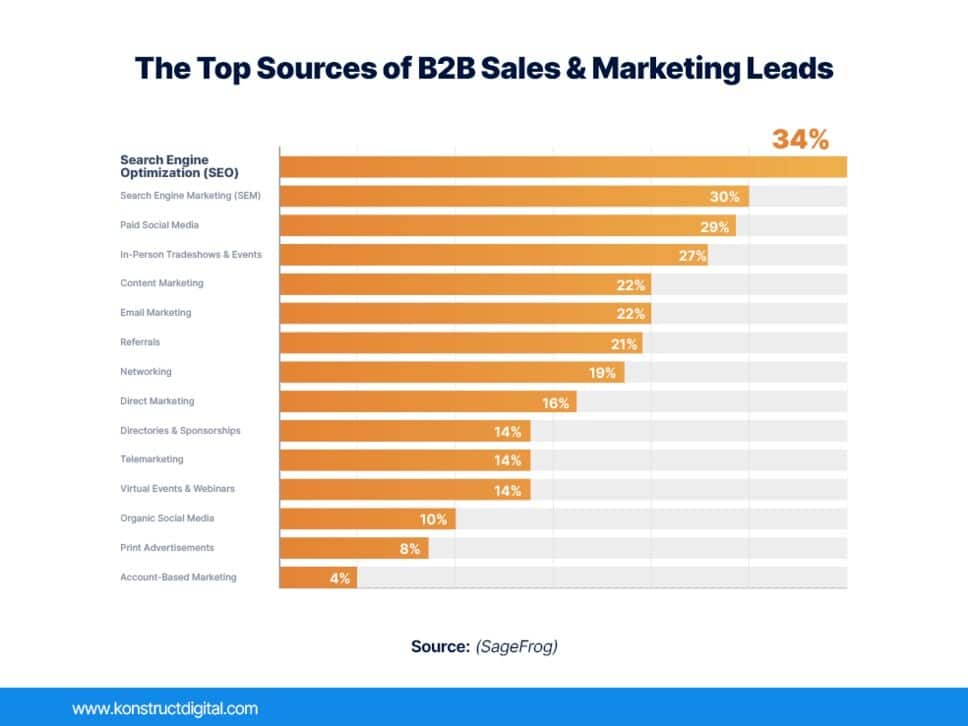
Impact of SEO
Enhanced Visibility in Search Results: Companies are easier to find when they score well for relevant keywords. Potential B2B clients use these keywords to find goods or services. This enhanced visibility also helps in organic traffic from qualified leads.
Bringing in the Correct Audience: SEO enables companies to focus on particular keywords that prospective customers use. It helps to ensure that site visitors are actually interested in the products and are more likely to become leads.
Developing Reputation and Trust: A company’s reputation is increased by having a high search engine ranking. People tend to view websites with high ranks as trustworthy and authoritative. High search engine rankings and informative content tell search engines that a company is reliable.
It creates a reputation over time.
Supporting the Buyer’s Journey: The B2B buyer journey involves
- Awareness
- Consideration
- Decision-making stages
Optimizing content for each stage increases the likelihood of conversion by meeting the audience’s needs at the right time.
Cost-Effective Lead Generation: SEO is a cost-effective method for generating B2B leads. Compared to paid search campaigns or traditional advertising.
While it requires an initial investment, the organic traffic generated does not incur ongoing costs like pay-per-click advertising. This makes it a sustainable long-term strategy.
Relatable Read: The Ultimate SaaS SEO Guide

B2B vs. B2C SEO Strategies
B2B SEO targets decision-makers evaluating a purchase for their company. B2C SEO targets individual consumers buying for themselves. That single difference changes everything downstream, from the keywords you target to the content you publish.
| Aspects | B2B SEO | B2C SEO |
| Target Audience | Business decision-makers and professionals | Individual consumers |
| Keywords | Long-tail, niche, intent-driven, industry-specific terms | High-volume, broad, transactional keywords |
| Content Strategy | Detailed, informative, research-driven | Engaging, emotionally-driven, visually appealing |
| Sales Cycle | Long, complex, involves multiple stakeholders | Short, often impulse-driven, can be minutes or days |
| Conversion Goal | Lead generation, nurturing long-term relationships | Immediate sales and quick conversions |
| Key Metrics | Lead quality, organic pipeline value, and conversion rates for qualified leads | Conversion rate, revenue per visit, click-through rate (CTR) |
| Messaging | Focus on ROI, value, and solving business problems | Focus on emotion, brand loyalty, and immediate benefits |
Relatable Read: How to Set Realistic SEO Goals for Your Enterprise Business?
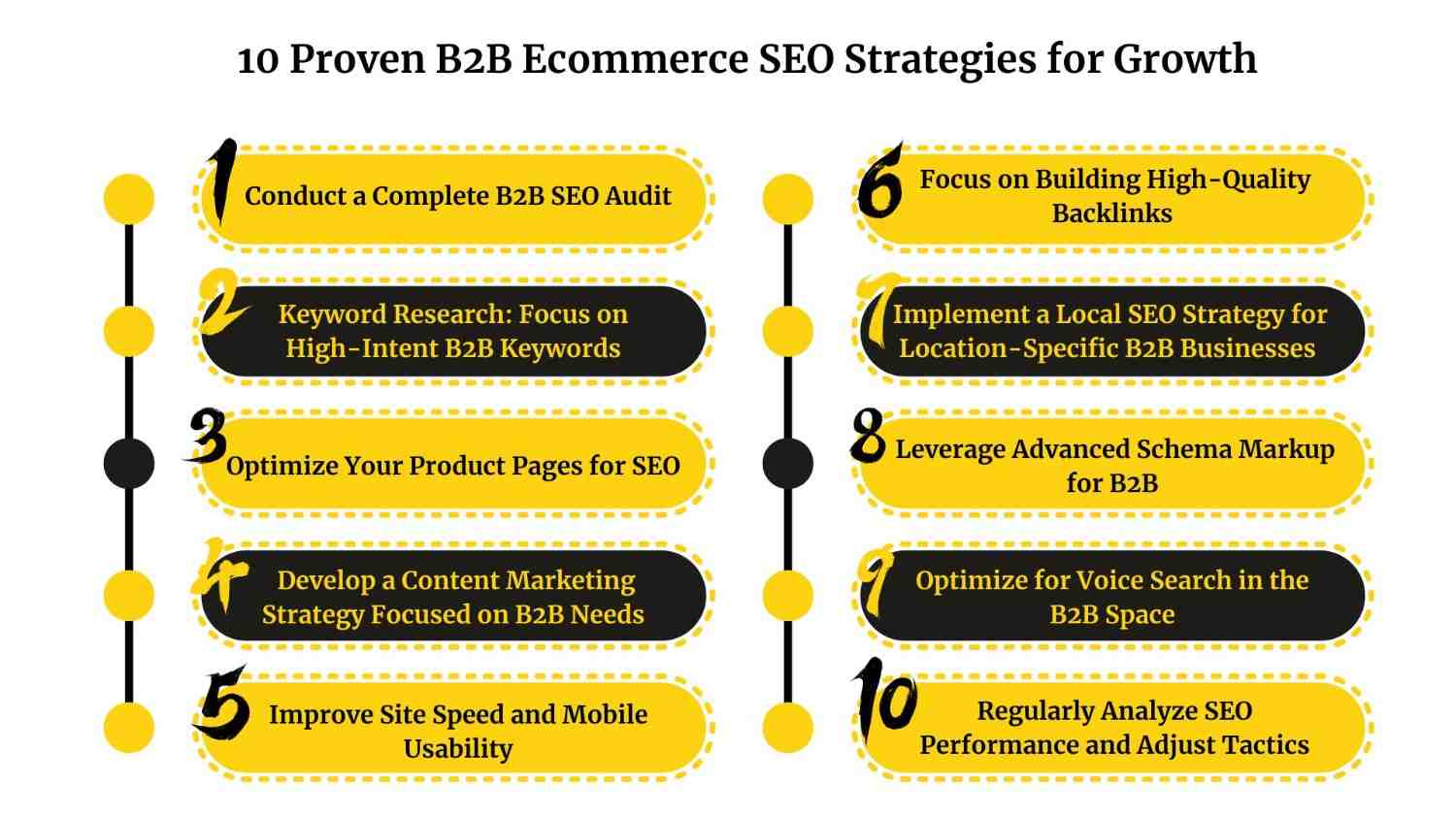
1. Conduct a Complete B2B SEO Audit
An SEO audit is an organized process. It is used to assess a website’s search engine performance and pinpoint areas in need of development. It involves many processes to examine the technological elements, content, and outside variables. This ultimately affects search rankings.
Consider On-Site Factors
This involves checking elements like content, technical problems, and site speed. Some important factors of on-page SEO include:
- Optimize for search intent
- Enhance URLs
- Hone title tags
Review Backlinks and Keyword Rankings
Backlinks are one aspect of off-page SEO. It is often examined as part of a thorough SEO audit. Understanding performance inherently includes evaluating keyword ranks.
Use SEO Tools
A complete audit can be carried out with tools like Ahrefs, SEMrush, and Google Search Console. Many SEO audit checklists advise using a site audit tool to examine performance. Other steps in an SEO audit are:
- A thorough site crawl
- On-page SEO optimization
- Organic traffic checks
Uncover the Growth Potential of Your Business in Less Than 3 Weeks with Our Deep SEO Audit
2. Keyword Research: Focus on High-Intent B2B Keywords
Ever wondered why your B2B content gets traffic but no actual leads? The secret isn’t more blogs. It’s smarter keywords.
It’s time to give up on vanity metrics and focus on what actually converts if you’ve been struggling with how to rank for B2B. Learn how to identify, evaluate, and control the keywords that influence company purchases.
Focus on Long-Tail Keywords
These extremely specific search engine searches can help in drawing in high-quality traffic. These keywords are usually made up of multiple words. They are more focused and provide better search results for both site owners and users.
Long-tail keywords that target particular demands work better for business-to-business transactions than generic terms.
Incorporate Industry-Specific Terminology
It is essential to employ terminology that speaks to their particular sector and difficulties, as B2B clients are often well-informed. Even if customers aren’t looking for a specific solution, it’s important to find keywords that are directly related to their demands.
For instance, “marketing software” is not as effective as “AI-powered marketing automation for SaaS companies.”
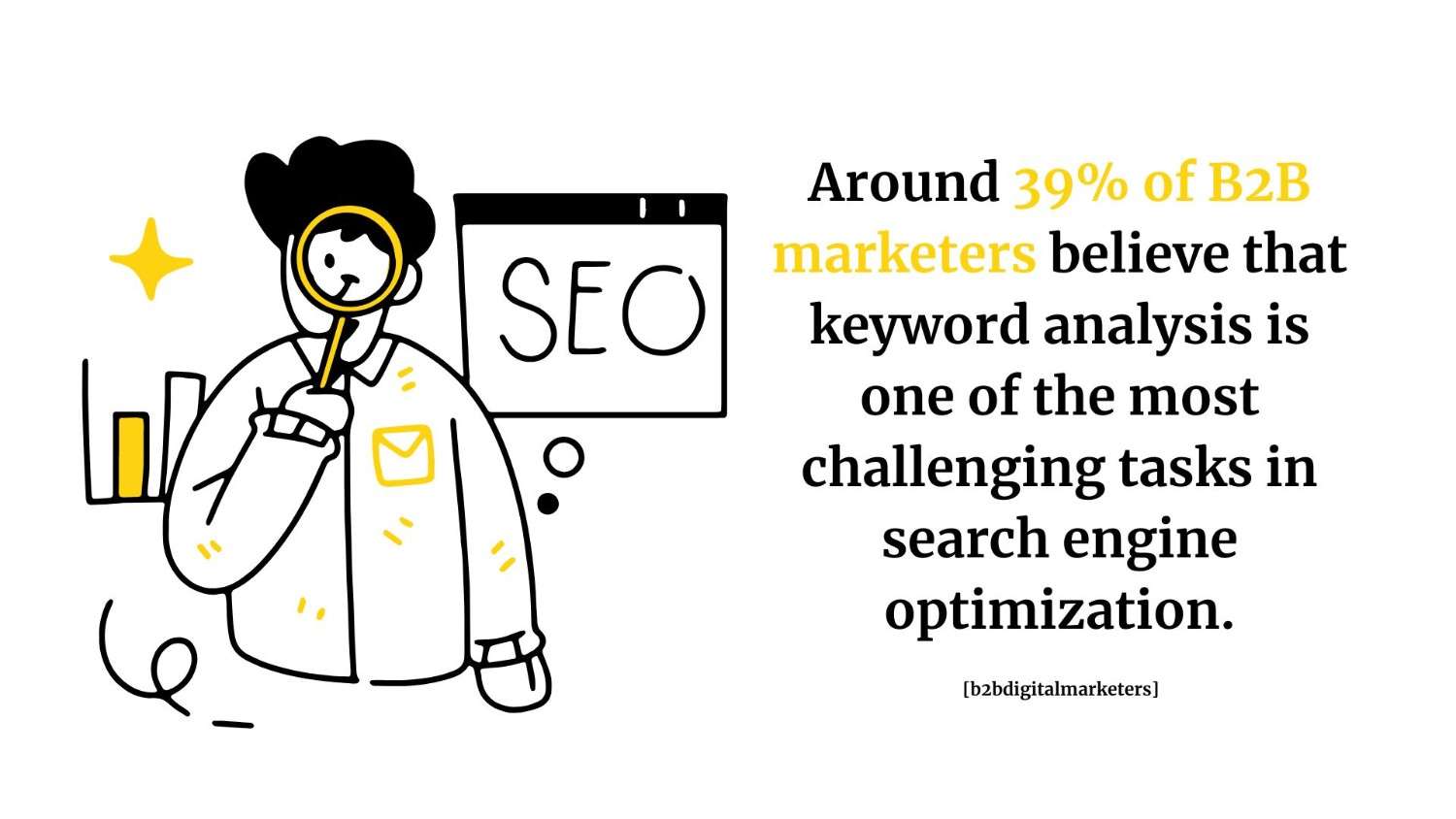
Analyze Competitor Keywords and Trends
A key part of conducting successful B2B keyword research is examining competitors for valuable insights. Knowing the keywords that your rivals are ranking for can help you adjust your own approach.
Target Procurement-Intent Keywords
Most B2B ecommerce keyword research stops at product and category terms. That misses an entire layer of search intent specific to how procurement actually happens.
Procurement-intent keywords are the phrases buyers use once they’ve moved past browsing and into the actual purchasing process. They include terms like “bulk order MOQ pricing,” “wholesale supplier RFQ,” “net-30 payment terms supplier,” and “volume discount pricing tiers.” These aren’t high-volume keywords. They’re high-intent ones, and the searcher typing them is usually much closer to placing an order than someone searching a generic product name.
Build dedicated content around this cluster: a wholesale pricing page, an RFQ (request for quote) submission page, a payment terms and credit application page, and a bulk ordering FAQ. Competitors rarely build this content because it doesn’t look like traditional SEO content. That’s exactly why it works. It captures a searcher at the exact moment they’re ready to move forward, with almost no competition for the keyword.
Best Keyword Research Tools for B2B Ecommerce SEO
Google Keyword Planner works, but it’s built for consumer search volume, and B2B procurement terms often show artificially low volume because the total search pool is smaller than consumer categories.
Ahrefs and SEMrush both handle this better, since their B2B-relevant keyword databases include commercial and industrial search terms that Keyword Planner underreports. Moz’s Keyword Explorer is useful for identifying keyword difficulty specifically, which matters more in B2B than raw volume does, since you’re often competing for a few hundred monthly searches against entrenched distributors rather than millions of searches against consumer brands.
Relatable Read: BRAND KEYWORDS NOT APPEARING ON GOOGLE? HERE IS THE FIX!
3. Optimize Your Product Pages for SEO
Think your product pages are doing enough? Think again. In the B2B world, even the best products won’t sell if Google can’t find them.
That’s where B2B SEO strategies come in. Turning your product pages from digital brochures into lead-generating powerhouses.
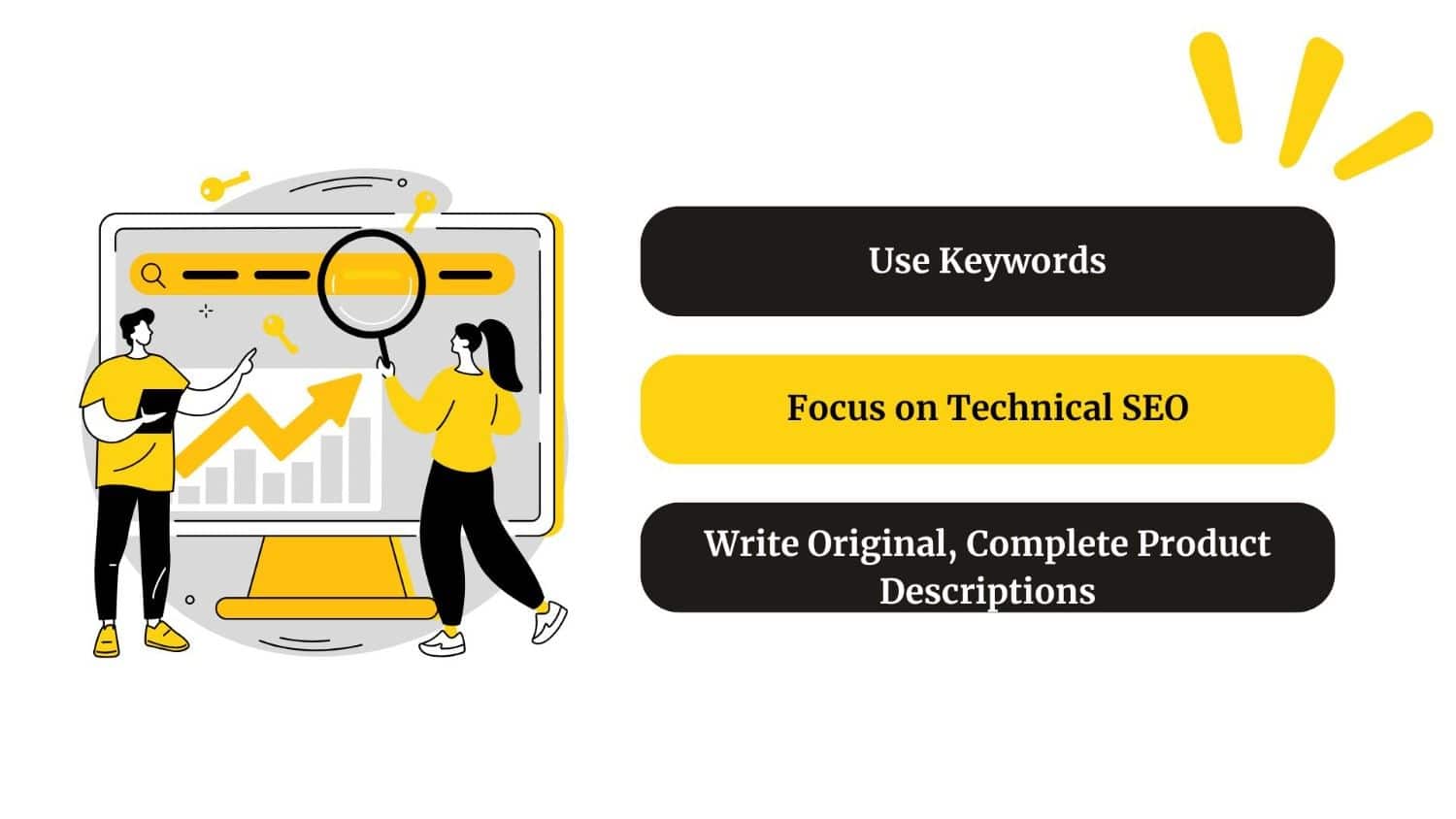
How to Place B2B Keywords in Product and Category Pages
Your title tag and meta description keywords need to show up in the actual page copy too, not just the metadata. Place your primary keyword in the first 100 words of the product description, in at least one subheading, and naturally throughout the specs and features section. Category pages need the same treatment in the intro copy above the product grid, not buried in a footer paragraph nobody reads.
Focus on Technical SEO
Take user-generated content and URL structure into account when optimizing your product pages for increased
- SEO visibility
- Traffic
- Sales
Write Original, Complete Product Descriptions
Make use of thorough, keyword-rich product descriptions. To improve the quality of product pages, use high-resolution images or videos to showcase your goods from several angles.
4. Develop a Content Marketing Strategy Focused on B2B Needs
Most B2B brands talk to their audience. Smart ones talk to them.
The difference?
A sharp B2B SEO content strategy built on a purposeful B2B marketing framework. Building authority and trust through high-quality content contributes to an increase in organic traffic. The goal of B2B content marketing is to build relationships through the creation of valuable content.
Get More Traffic With The Best Content Strategy
Create Buyer-Focused Content
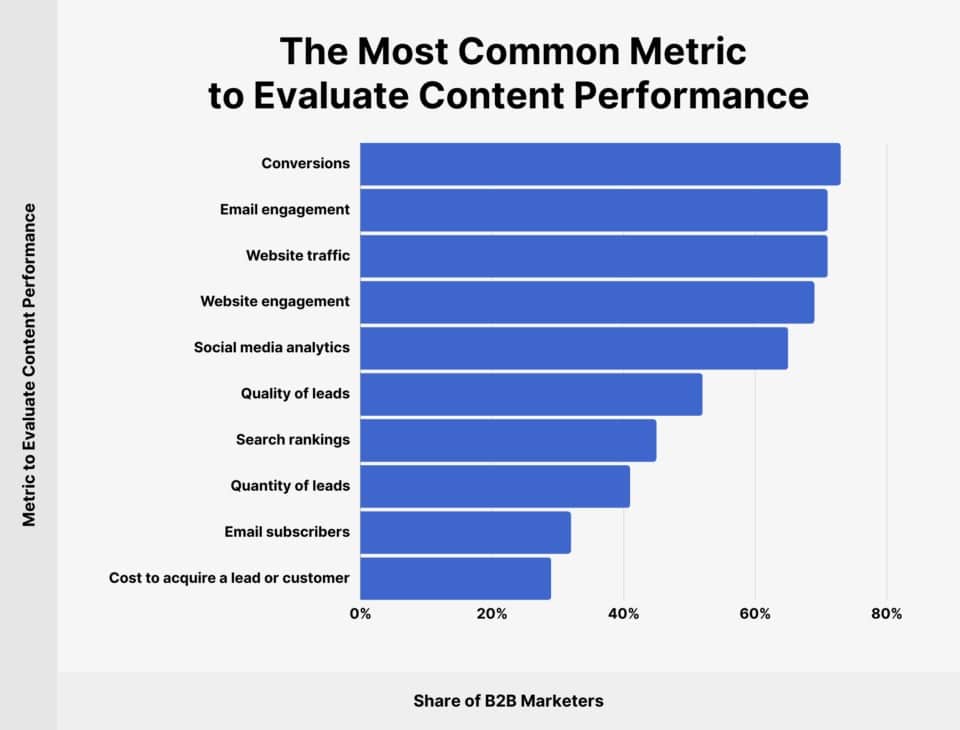
The main goal of any effective B2B content marketing plan should be to produce and disseminate audience-pleasing, high-quality material. This involves creating informed, relevant, and valuable content for a range of marketing platforms.
[Source: Backlinko]
Deal with Typical B2B Pain Points
Determine the objectives of your B2B content and research your target market to learn about their problems.
Optimize Content with Internal Linking and Relevant Keywords
To optimize return on investment (ROI), master B2B content marketing by concentrating on
- Strategy
- Content types
- Distribution advice
- Measurement techniques
Use Webinars and Video Material
Some tactics include sending out weekly newsletters, producing industry research, and testing out material on LinkedIn.
Relatable Read: What is SEO Writing? Complete Guide for Creating SEO-Optimized Content
5. Improve Site Speed and Mobile Usability
Providing a smooth user experience, improving your search engine results, and eventually raising conversion rates all depend on optimizing your website’s speed. A poor mobile experience can have detrimental effects on users, with consumers depending more and more on mobile devices.
As of April 2026, 5.83 billion people use mobile phones worldwide, and mobile devices now account for 73% of global ecommerce sales (DataReportal, Digital 2026 Global Overview). For B2B ecommerce specifically, that means procurement managers and technical evaluators are increasingly starting their research, and sometimes finishing it, on a phone.
Conduct Speed Tests
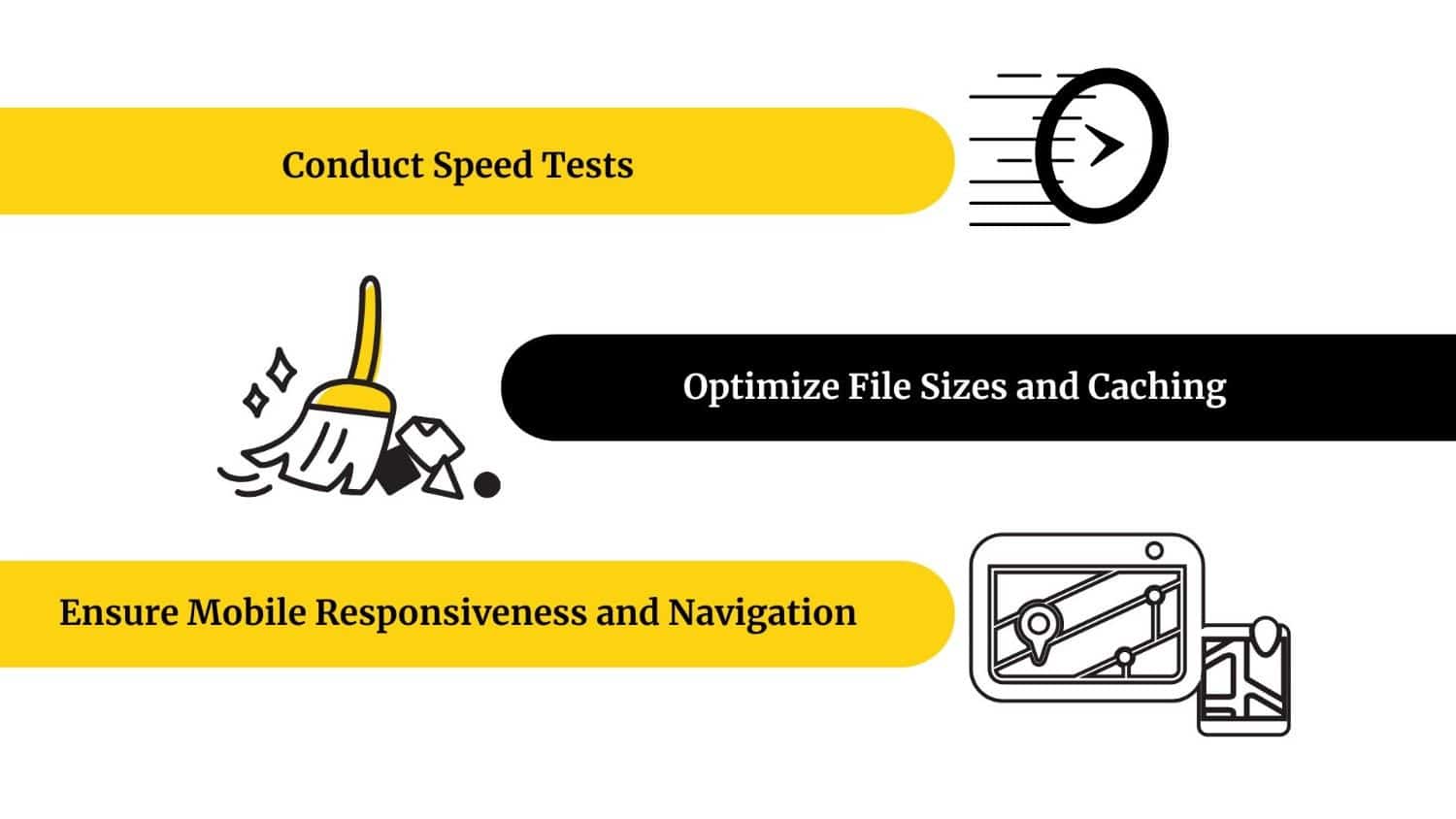
Use tools like Google PageSpeed Insights to evaluate the functionality of your website and get recommendations for enhancements.
Optimize File Sizes and Caching
Reduce the size of your images by resizing, compressing, and using WebP formats. Use GZIP compression to lighten your website and speed up download times.
Moreover, use browser HTTP caching to
- Decrease server effort
- Speed up load times
- Use less bandwidth
Ensure Mobile Responsiveness and Navigation
Use a responsive design that adjusts to different screen sizes and orientations to provide a similar experience across all devices. Make navigation easier with
- Logical menu structures
- Instantly identifiable icons
- Effective search features
Mobile users often have limited time and patience. They prioritize important content and employ caching techniques to ensure quick loading times.
Relatable Read: How to do Technical SEO for eCommerce Websites in 2026
6. Focus on Building High-Quality Backlinks
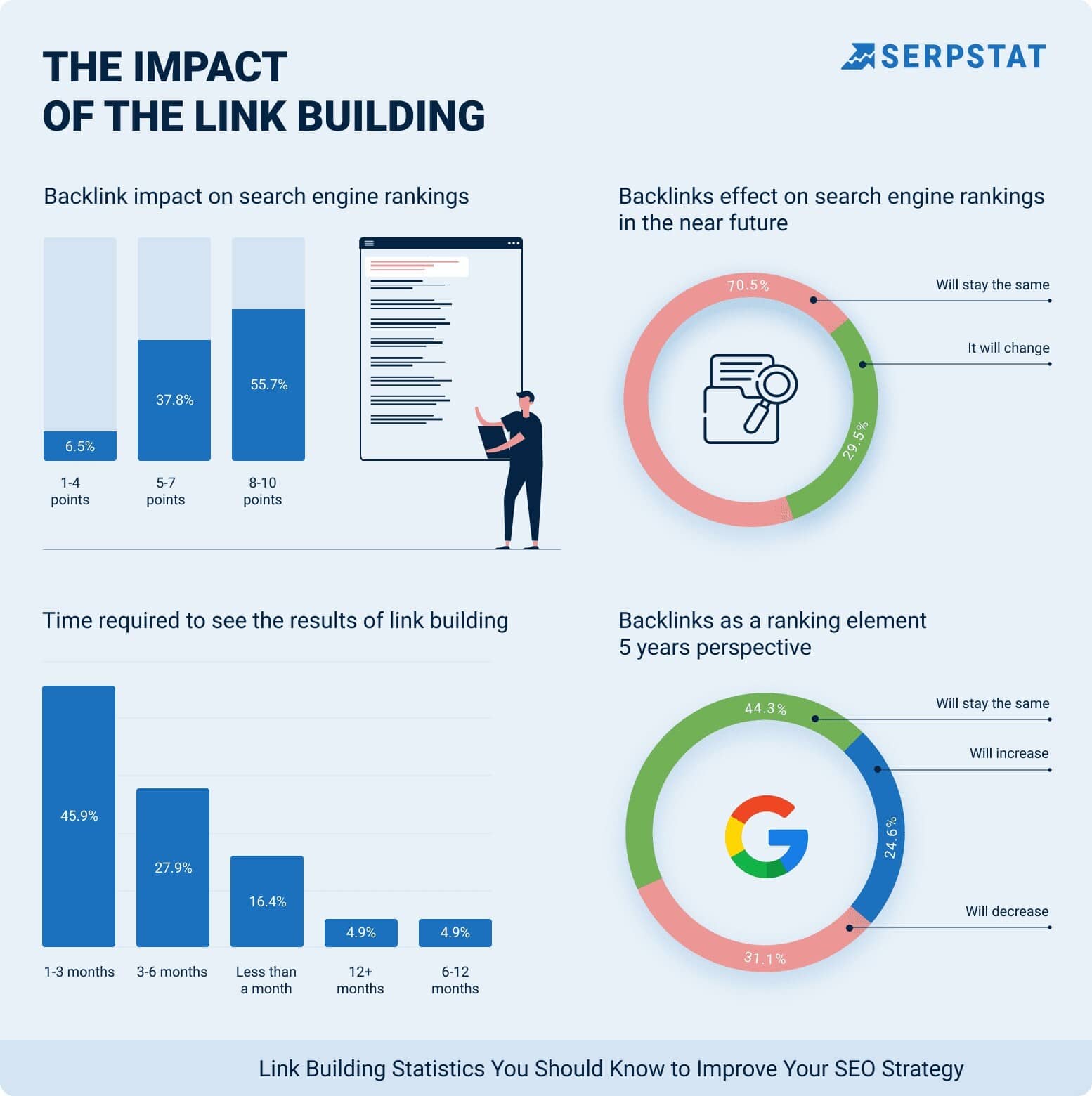
Increasing the domain authority, search visibility, and organic traffic of your website all depend on building high-quality backlinks. Backlinks work as “word-of-mouth marketing” in the digital sphere.
Quality backlinks are links from respectable, highly authoritative websites that offer substantial SEO value.
Guest Posting
One well-liked and efficient strategy for obtaining inbound links is to guest post on business websites and industry blogs. Look for niche-related blogs that welcome guest writers since relevant links increase “link juice” and build search engine credibility.
Write a brief, customized pitch email to blog owners that highlights a particular post that you find inspiring and suggests suggestions for related topics.
Relatable Read: THE IMPORTANCE OF GUEST BLOGGING IN 2025
Partnerships and Collaborations
Think about asking bloggers in your niche to review your products. This can result in links and high-quality traffic.
Content Creation and Promotion
Make informative content, like original infographics, that people will want to link to. Infographics are shared, easily comprehensible content that can help readers with their problems. Send your infographics to pertinent submission sites and directories.
Competitor Analysis
Evaluate the backlink profiles of your rivals to determine the types of websites that connect to them and the number of links you may require to rank similarly. Look for chances to obtain complimentary backlinks by means of guest articles or directories that provide links to your rivals.
You can also find broken links on other websites and replace them with your functional, relevant link.
Relatable Read: How to Outrank a Tough Competitor in Search Engine Rankings
7. Optimize for International B2B SEO
Most B2B ecommerce companies don’t sell to a five-mile radius. They sell nationally, and a growing number sell across borders. That’s a different SEO problem than local search, and it’s one most B2B SEO guides skip entirely.
Implement Hreflang for Multi-Market Catalog Pages
If you maintain separate versions of your catalog for different countries or languages, hreflang tags tell Google which version to show which searcher. Without them, Google may show a US searcher your UK pricing page, or index duplicate near-identical product pages as competing against each other instead of serving different markets.
Set hreflang tags at the page level for every localized product and category page, and make sure your XML sitemap reflects the full set of regional URLs. This is one of the most commonly misconfigured elements on international B2B ecommerce sites, and it’s worth a dedicated technical audit rather than a one-time setup.
Add Currency and Tax Structured Data
International B2B buyers, particularly procurement teams, need to see accurate pricing in their own currency and understand tax or VAT treatment before they’ll consider a page credible enough to act on. Implement Product schema with locale-specific priceCurrency and, where applicable, structured data reflecting VAT-inclusive or VAT-exclusive pricing depending on the market.

This isn’t just a user experience improvement. Google uses this structured data to serve the right regional pricing in search results and shopping-adjacent features, which directly affects whether an international buyer clicks through at all.
Build Locale-Specific Shipping and Lead Time Content
B2B buyers evaluating a supplier outside their own country care about exactly one operational question before anything else: how long will this actually take to arrive, and what will customs or import handling cost them. Generic “shipping information” pages that don’t specify this by region create friction at exactly the point a procurement manager needs certainty.
Build dedicated shipping and lead time content for each major market you serve, specifying typical transit times, customs handling, and any region-specific logistics partners. This content also tends to rank well for procurement-intent searches like “international supplier shipping to [country],” since almost no competitors build it out at this level of specificity.
8. Leverage Advanced Schema Markup for B2B
Schema markup is crucial for B2B companies as it increases
- Visibility
- Click-through rates
- Search engines’ comprehension of information
This is especially advantageous in markets with intense competition.

Implement Various Schema Markup Types
B2B tech firms can improve their visibility in search results by using schema markup for product, FAQ, reviews, and company profiles.
Additionally helpful for product, review, and organization information is schema markup.
Test Your Schema Markup
It is important to use the Structured Data Testing Tool, ensure that your schema markup is executed correctly.
Increase Chances for Rich Results
Well-executed schema markup can raise the possibility of showing up in knowledge graphs, rich results, and featured snippets. It will ultimately increase search engine visibility.
Relatable Read: B2B Marketing Automation Guideline for Your Online Business
9. Optimize for Voice Search in the B2B Space
Voice search integration in B2B marketing is now a necessity rather than a sci-fi idea. Considering that a sizable percentage of B2B purchasers now use voice search for business-related inquiries. As a result, making adjustments for this technology offers a considerable competitive edge.

Use Natural, Conversational Keywords
Compared to conventional text searches, voice searches are usually longer and more conversational. It often mimics genuine language.
Long-tail keywords make up 70% of all terms. You may greatly lower competition and raise your chances of showing up in voice search results. Voice assistants can extract quick answers by using question phrases in content, particularly in headlines.
Optimize for Question-Based Queries
Voice search questions usually begin with “what” or “how” and often include words like “best” and “top”. “What features should a recruitment platform have?” and “How much does a recruitment platform cost?” are examples of the kinds of questions that B2B marketers should expect their audience to ask.
Create FAQ Pages
For voice search optimization, FAQ pages work quite well because they answer frequently asked queries by users of voice assistants. It’s essential to write in the first person, using a conversational approach.
As though addressing a coworker, and to give succinct, straightforward responses when creating frequently asked questions. Because they provide material that mimics voice search queries. FAQ sections also help in improving SEO rankings.
10. Regularly Analyze SEO Performance and Adjust Tactics
Use Analytics Tools
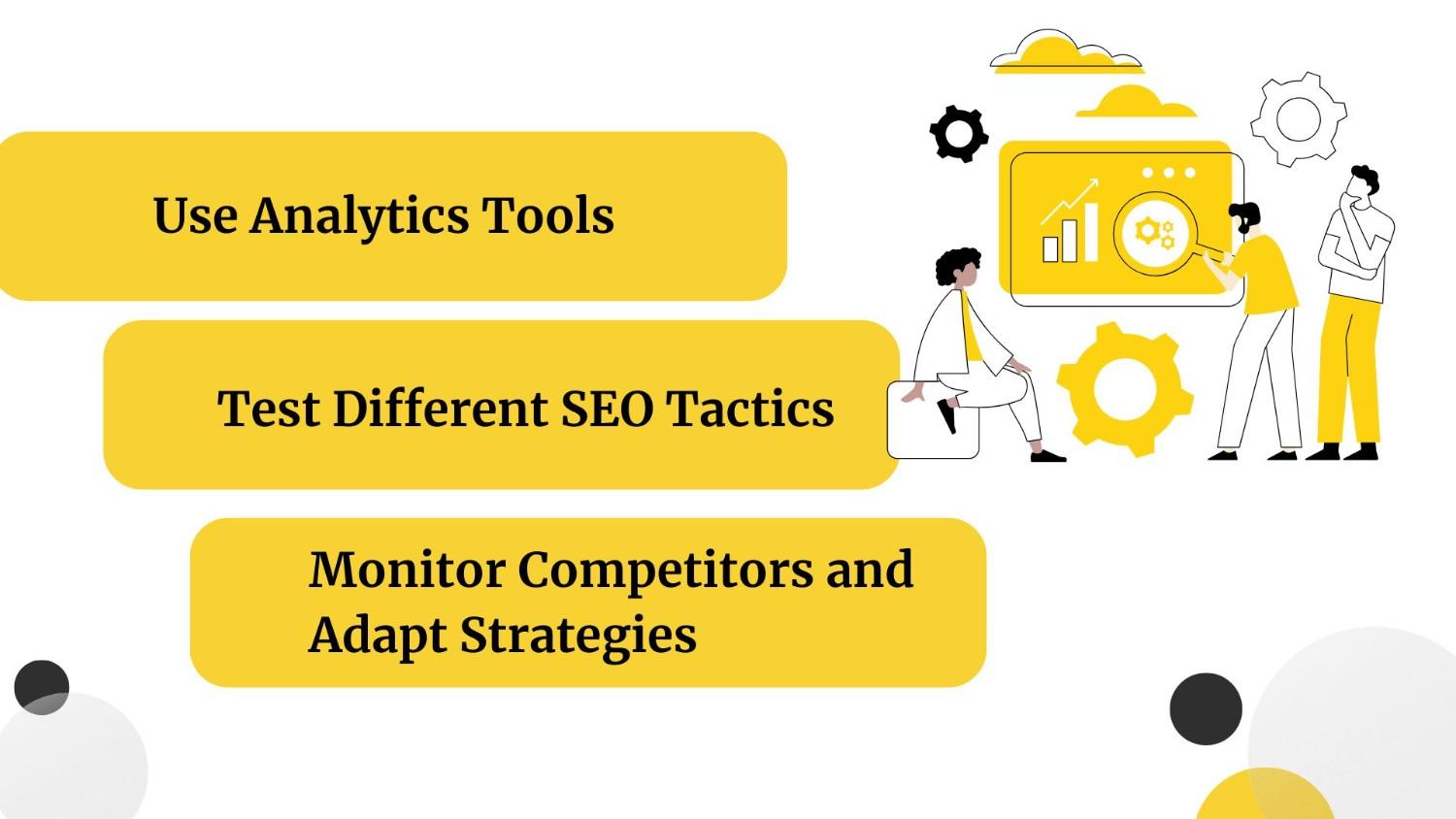
Tracking important data like traffic, rankings, and voice search conversions requires the use of tools like Google Analytics and Semrush.
Test Different SEO Tactics
SEO is an iterative process that gains from ongoing experimentation and testing. What works best in search results can be found by experimenting with various
- Voice search strategies
- A/B testing content formats
Monitor Competitors and Adapt Strategies
Maintaining a competitive edge requires keeping up with changes in the SEO landscape and rival tactics. Future-proofing digital marketing tactics requires
- Adjusting to changing customer behavior
- Technical improvements
Relatable Read: 5 MAJOR E-COMMERCE MARKETING STRATEGIES FOR YOUR BUSINESS
11. Build an Account-Based SEO Strategy
B2B purchases aren’t made by one person. Gartner puts the average buying group at 5.4 people, and each of them searches differently.
The CFO searches “enterprise pricing” and “total cost of ownership.” The IT lead searches “API integration docs” and “system requirements.” The procurement manager searches “vendor compliance” and “supplier certifications.” A single product page written for one generic buyer persona misses four of the five people who need to say yes.
Account-based SEO (ABS) is the practice of aligning your SEO content to the specific industries, company sizes, and job titles that make up your target accounts, rather than optimizing for a single generic buyer. It’s the natural extension of account-based marketing into organic search, and it’s becoming the standard approach for B2B teams serious about pipeline, not just traffic.
Map Content to Each Stakeholder in the Buying Committee
Start by identifying who actually influences the purchase decision for your product. For most mid-market and enterprise B2B ecommerce sales, that’s typically some combination of a technical evaluator, a financial approver, an end user, and a procurement or compliance reviewer.
Build content for each one specifically:
- Technical evaluators need integration documentation, API references, spec comparisons, and compatibility guides.
- Financial approvers need pricing transparency, total cost of ownership breakdowns, and ROI calculators.
- End users need product walkthroughs, use case content, and comparison guides against alternatives.
- Procurement and compliance reviewers need certifications, vendor security documentation, and terms of service clarity.
Each of these becomes its own content cluster, targeting the specific search language that role actually uses. Nobody in finance is searching “product features.” They’re searching “cost comparison” and “pricing calculator.”
Build Content for Your Ideal Customer Profile, Not a Generic Audience
Traditional SEO content tries to rank for the broadest possible audience. Account-based SEO does the opposite on purpose. It targets the specific industries, company sizes, and roles that match your actual ideal customer profile (ICP), even if that means writing content with a smaller total addressable search volume.
A B2B ecommerce company selling industrial equipment to mid-size manufacturers doesn’t need to rank for generic “industrial equipment” searches nationally. It needs to rank for “CNC machine parts supplier for automotive manufacturers” or “industrial equipment MOQ for 50-200 employee manufacturers,” phrases with a fraction of the search volume but a dramatically higher match to who actually buys.
Align Sales and SEO Around the Same Target Accounts
The highest-leverage version of account-based SEO happens when your content team and sales team are targeting the same named accounts or account segments. If sales is actively pursuing mid-market logistics companies, SEO content should be built specifically for the search behavior of buyers at mid-market logistics companies, not generic logistics content aimed at everyone.
This is where account-based SEO earns its name. It’s not about ranking for more keywords. It’s about ranking for the right keywords, for the right accounts, at the right stage of a longer, multi-stakeholder buying process.
B2B Ecommerce SEO Isn’t Optional Anymore
Ready to turn your B2B eCommerce site into a lead-generating powerhouse? With the right SEO strategy, growth isn’t a dream. It’s a data-driven reality. If you’re looking for Ecommerce SEO Services, let the experts at MonsterClaw help you climb those SERPs and crush your competition.
Ready to grow smarter? Partner with MonsterClaw today and make your SEO strategy unstoppable.
FAQs on B2B E-Commerce SEO
B2B SEO aims to improve a company’s website so that it appears higher in search engine results for keywords that companies use to find goods or services.
Create thorough buyer profiles and comprehend your sales funnel before developing a B2B SEO plan to match content to the client journey. After that, map the terms your target audience employs to the various stages of the funnel by conducting keyword research. Next, produce valuable, high-quality content, optimize landing pages, and develop backlinks from reputable websites, both internal and external. Lastly, use analytics to track your progress and adjust your approach as necessary.
For B2B SaaS, SEO is essential because it generates highly qualified leads, establishes credibility, and fosters long-term, sustainable growth at a lower cost than paid advertising.
SEO services help B2B brands by raising online visibility, generating highly quality leads, establishing a reputation, and eventually improving income and business growth.